)
Private Hospital Medical Mafia Latest News: The greed in the medical equipment industry has now reached its peak. Despite this, the profiteers are not yet tired. The situation is that this is not about a single city. In every city of the country, patients are being looted in the name of medical equipment. Whether it is the national capital Delhi or the capital of Uttar Pradesh, Lucknow.
One argument that can be made here is that when you go to a retail shop to buy medical equipment, you are given a 15-20 percent discount. But is this discount justified? Let us decode this through a retail bill.
The Medical Mafia Still Loots Even After Giving a Discount
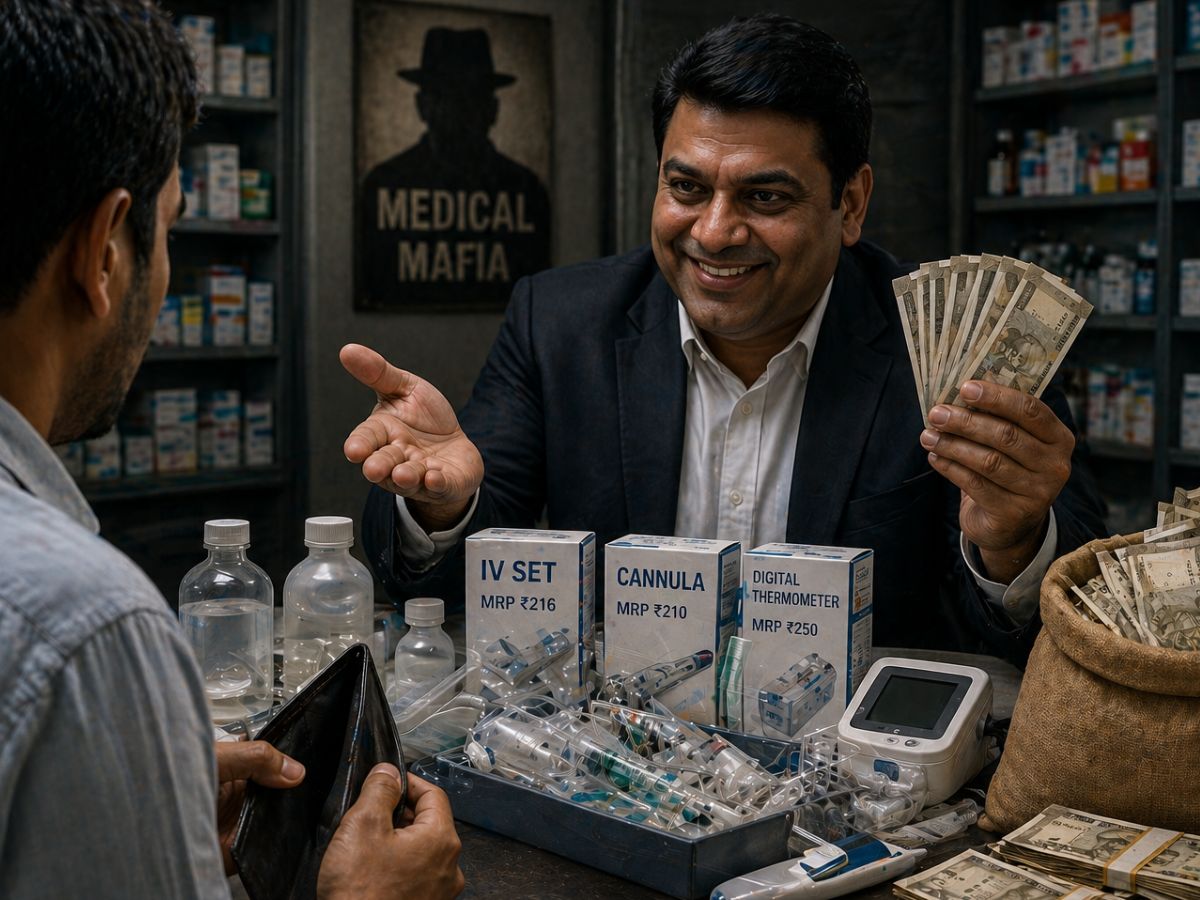
The MRP of a digital thermometer from the Hicks company is written here as 250 rupees. With a 20% discount, it is sold for 200 rupees. Even after giving a 20% discount, Jalpan Medical Hall sold it for 100% more than its purchase price. Below this, the MRP of an IV set from the ROMSONS company is given as 216 rupees. The shopkeeper generously gave a 20% discount on this as well and sold it to the patient for 172 rupees. This means a profit of more than 1000%.
The third item on the bill is a cannula. The shopkeeper sold it for 161 rupees with a 20% discount. You should know that its wholesale rate is only 6.5 rupees, meaning a profit of 2300%.
When Will This Robbery Be Stopped?
The effect of this web of profiteering and margins is that there is now a demand to put a full stop to this profiteering. On April 22, 2026, the Association of Indian Medical Device Industry, i.e., AiMeD, formally requested the government to review the MRP-based system and impose a limit on trade margins.
It has been demanded that the unjustified difference between the manufacturing cost and the MRP of equipment be reduced. It is being demanded that the price of life-saving equipment should be uniform across the country, i.e., ‘One Nation, One Price’. It is being demanded that if ‘Jan Aushadhi Kendras’ can exist for medicines, then why not for equipment?
‘Limit Profits to 30 Percent’
The third demand is that the profit margin on equipment should be limited to 30%. Along with this, it is also demanded that patients inside hospitals should have the facility to purchase equipment from outside the hospital as well.
AiMeD member Manish Sabharwal says that some private hospitals are demanding a higher MRP from manufacturers so that they can earn even more profit. Currently, the MRP is 4-5 times higher. This covers the costs of the entire chain. For example, the MRP of a crepe bandage is 550 rupees, while its actual price is 95 rupees. By the time it reaches our distributor, it becomes 100 rupees. But private hospitals are demanding that the MRP be set at 10-15-20 times higher. By doing this, they buy these items from pharmaceutical companies at very low prices, but because the MRP is written higher, they will fill their pockets by charging patients many times more.
The Greed of Private Hospitals Is Costing Lives
The direct accusation is that hospitals demand the highest possible MRP from companies, and moreover, hospitals do not give any discount like retail shops. The situation is that today, when people go to a hospital, they are not as afraid of the doctor’s fee or the room rent as they are of that ‘surgical bill’.
When someone is admitted to a hospital, whatever medicine is prescribed, whatever equipment is needed, the patient’s attendants quietly buy it from the hospital’s pharmacy and bring it. At that time, there is no bargaining or asking about margins. This is why the hospital pharmacy does not give discounts. On the contrary, it makes huge profits. The sad thing is that on the hospital prescription, it is shamelessly written ‘<