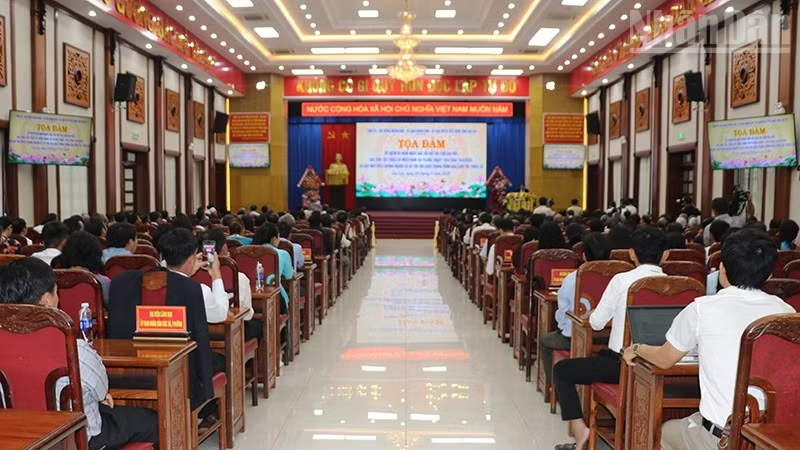
The event was not only an occasion to revisit a special milestone in the history of great national unity but also emphasized the enduring values of Ho Chi Minh’s thought on great unity, the close bond among brotherly ethnic groups in the promising and proud Central Highlands region.
Speaking at the discussion, a party official and Chairman of the Provincial People’s Committee, emphasized: “Commemorating 80 years since Uncle Ho sent a letter to the Congress of Ethnic Minorities in the South affirms the value of President Ho Chi Minh’s thought on great unity; at the same time, it expresses gratitude for the great contributions of ethnic groups and prestigious individuals to the revolutionary cause, and to the building and defense of our homeland and country today.”
Uncle Ho’s letter to the Congress of Ethnic Minorities in the South in Pleiku in 1946 was a crystallization of love, closeness, and unwavering trust toward the people of the Central Highlands and the South. His simple yet heartfelt words became the ideological foundation, a solemn oath, and a powerful driving force throughout the process of building and defending the Fatherland.
Throughout 80 years, the strength of unity has been the core value, the “invisible thread” binding the ethnic groups of the Central Highlands, joining efforts to overcome all historical challenges, achieving resounding victories on the Central Highlands battlefield, contributing to the complete liberation of the South and the reunification of the country in 1975.
Beyond its historical significance, the spirit of unity continues to be preserved and promoted by the Party and people of all ethnic groups in Gia Lai province throughout the work of recovery and reconstruction of the homeland after peace, as well as in their united efforts to rise strongly during the period of reform and integration.
According to the provincial leader, from the early days of the new development period after the merger, Gia Lai province identified a socio-economic development strategy based on the combined strength of the entire population, maximizing local potential and advantages linked with innovation. The province prioritizes key programs and projects, with special attention to ethnic minority areas, former revolutionary base areas, and border regions: developing high-tech agriculture and strengthening modern irrigation systems.
Alongside economic development, education and vocational training are identified as key factors in building quality human resources, ensuring sustainable development for the future. Gia Lai focuses on investing in boarding and semi-boarding schools for ethnic minority students in remote and border areas, creating conditions for career choices and effective job placement. Simultaneously, the healthcare sector is being upgraded through the Provincial Health System Development Project for the 2026-2030 period, prioritizing health care for people at 24 border and island medical stations, providing free medical examinations and treatment for people in particularly difficult areas.
Alongside its economic, educational, and healthcare development strategies, Gia Lai always values preserving and promoting the traditional cultural values of ethnic groups, exploiting sustainable tourism potential, creating new livelihoods for communities, and contributing to building a rich spiritual and cultural life for its people.
Besides the correct development path, an indispensable factor in Gia Lai’s success is the persistent and responsible contribution of prestigious individuals among ethnic minorities. The province currently has 1,098 prestigious individuals, of whom 95 outstanding individuals are being honored on this occasion. They are “unity cores,” a direct bridge between local authorities and the people, exemplary in propagating and mobilizing people to faithfully implement the Party’s policies, participate in economic development, poverty reduction, protect cultural identity, and maintain order and security in villages.
Assessing this role, the Chairman of Gia Lai Province shared: “I believe that prestigious individuals will continue to be a reliable support for local party committees and authorities, a bridge between the Party’s