Ahmedabad region achieves strong debut with 96.61% result.
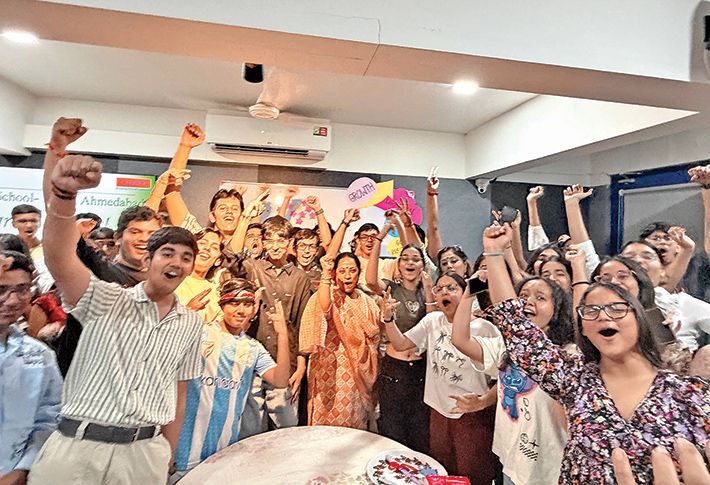
DPS students celebrate their stellar result
The Central Board of Secondary Education (CBSE) on Wednesday declared the Class 10 results for 2026, with the newly formed Ahmedabad region delivering an impressive debut. The region recorded a pass percentage of 96.61%, with 90,506 students appearing out of 90,709 registered across 193 centers.
Ahmedabad emerged as the eighth-best performing region in the country, behind Trivandrum and Vijayawada (99.79% each), Chennai (99.58%), Bengaluru (98.91%), Delhi West (97.45%), Delhi East (97.33%) and Pune (96.66%).
Nationally, CBSE reported a marginal rise in the overall pass percentage, from 93.66% in 2025 to 93.70% this year, signaling a stable trend. Officials noted that results were declared nearly a month earlier than usual, on April 15, after evaluation of around 1.6 crore answer books in just 23 days.
In the Ahmedabad region, 1,445 students (3.20%) were placed in the compartment category. While this is significantly better than regions such as Guwahati (13.27%), Ranchi (13.01%) and Noida (11.61%), it trails top performers like Chennai (0.40%) and Bengaluru (1.07%).
Strong participation across schools
Participation remained robust across school types. Government schools had 944 registered candidates (938 appeared), government-aided schools 38,814 (38,743 appeared), and independent schools accounted for the largest share with 45,346 registered (45,245 appeared).
Girls outperform boys
Girls continued to outperform boys in the region, recording a pass percentage of 97.53% against 95.90% for boys. Of the 25,961 boys and 19,146 girls who appeared, 24,903 boys and 18,673 girls cleared the examination.
Independent schools lead
Independent schools posted the highest pass percentage at 99.74%, followed closely by Jawahar Navodaya Vidyalayas at 99.6%. Government-aided schools recorded 96.22% and government schools 95.87%. Private candidates, however, lagged significantly with a pass percentage of 25%.
Trivandrum
Trivandrum, officially known as Thiruvananthapuram, is the capital city of the Indian state of Kerala. Historically, it was the heart of the princely state of Travancore, with its golden age under King Swathi Thirunal in the 19th century, who fostered arts, culture, and the construction of landmarks like the Napier Museum. Today, it is known for its iconic Sri Padmanabhaswamy Temple, pristine beaches, and as a major hub for technology and education.
Vijayawada
Vijayawada is a major city in the Indian state of Andhra Pradesh, situated on the banks of the Krishna River. Historically, it was an important cultural and political center, known for its ancient temples like the Kanaka Durga Temple, which dates back centuries. The city also served as a key hub during the British colonial era and continues to be a vital commercial and spiritual destination today.
<div class="my-4 p-4 rounded-lg shadow-md
Trivandrum
Trivandrum, officially known as Thiruvananthapuram, is the capital city of the Indian state of Kerala, historically serving as the seat of the Travancore royal family. The city is renowned for the Sri Padmanabhaswamy Temple, a ancient and opulent temple dedicated to Lord Vishnu, which was a central part of the Travancore kingdom’s history. Today, Trivandrum is a major cultural and educational hub, blending its rich royal heritage with modern development.
Thiruvananthapuram
Thiruvananthapuram, the capital city of Kerala, India, is a historic coastal city known for its rich cultural heritage and the iconic Sree Padmanabhaswamy Temple, a Hindu shrine dedicated to Lord Vishnu. Its history dates back to the 18th century when it became the capital of the Kingdom of Travancore under King Marthanda Varma, and it later developed into a major center for art, education, and politics. Today, the city blends traditional architecture with modern urban life, attracting visitors with its beaches, museums, and vibrant festivals.
Travancore
Travancore was a princely state in southern India, existing from the 18th century until its merger with the Indian Union in 1949. Known for its progressive rulers, it was a center of art, culture, and religious tolerance, with its capital at Thiruvananthapuram. The region is famous for landmarks like the Padmanabhaswamy Temple and its unique mural paintings.
Napier Museum
The Napier Museum, located in Thiruvananthapuram, Kerala, is a prominent art and natural history museum established in 1855 during the rule of the Travancore kingdom. It was named after Lord Napier, the then Governor of Madras, and its architectural style blends Indian, Gothic, and Kerala influences. The museum houses a rich collection of bronze idols, ancient ornaments, and ivory carvings, offering insight into the region’s cultural and historical heritage.
Sri Padmanabhaswamy Temple
The Sri Padmanabhaswamy Temple is a historic Hindu temple located in Thiruvananthapuram, India, dedicated to Lord Vishnu. Its origins date back to at least the 8th century, with the current structure built in the 18th century by the Travancore royal family, who consider the deity their family guardian. The temple is renowned for its Dravidian architecture and for holding immense hidden treasures, discovered in its underground vaults in 2011.
Vijayawada
Vijayawada, located on the banks of the Krishna River in Andhra Pradesh, India, is a historic city with roots dating back to ancient times. It is renowned for the iconic Kanaka Durga Temple, perched on the Indrakeeladri Hill, and served as a significant political and cultural center under the Satavahana and Vijayanagara empires. Today, it is a bustling commercial hub, often called the “business capital” of Andhra Pradesh.
Krishna River
The Krishna River is one of India’s longest rivers, originating in the Western Ghats of Maharashtra and flowing through Karnataka, Telangana, and Andhra Pradesh before emptying into the Bay of Bengal. Historically, it has been a lifeline for ancient kingdoms like the Satavahanas and Vijayanagara Empire, supporting agriculture and trade. The river is also deeply sacred in Hinduism, with the town of Srisailam on its banks hosting a famous temple dedicated to Lord Shiva.
Kanaka Durga Temple
The Kanaka Durga Temple is a historic Hindu temple located on the Indrakeeladri hill in Vijayawada, Andhra Pradesh, India, dedicated to Goddess Durga. Its origins are ancient, with legends connecting it to the epic Mahabharata, and the current structure was built by the Vijayanagara Empire in the 16th century. The temple is a major pilgrimage site, especially during the Dasara festival, when the goddess is worshipped in various forms over ten days.