“As May Day approaches, Beijing’s parks display both late spring scenes and early summer vibes. During this year’s May Day holiday, the city’s municipal parks and the China Garden Museum will deeply integrate the cultural heritage of historic gardens with contemporary tourists’ leisure needs, offering over 60 holiday activities including science education, cultural exhibitions, sports and fitness, market performances, red education, and cultural experiences.
“Most Beautiful Garden Paths” Dressed Up to Welcome Visitors, Painting a New Picture of a Garden City
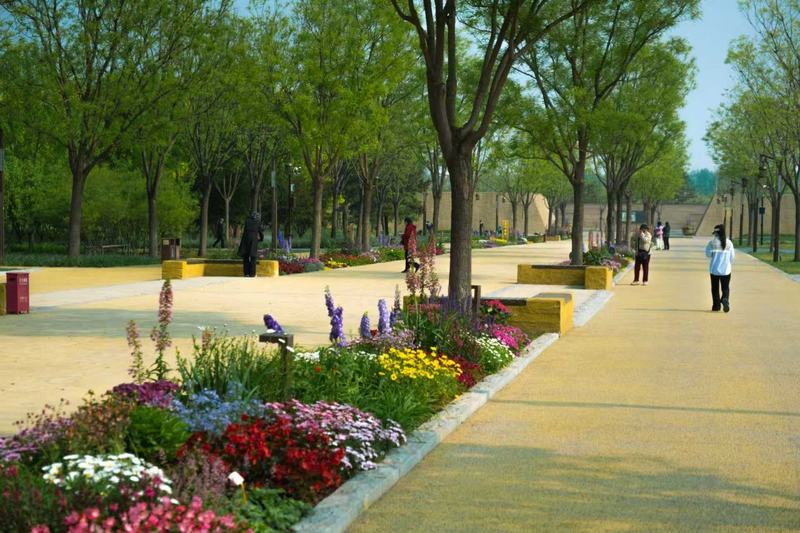
The “most beautiful garden paths” and “featured flower borders” in the parks are presenting a visual feast with changing scenery at every step. At the Luxian Ancient City Site Park in Tongzhou, the “featured flower borders” are adjacent to the museum to the east and connect to the city gate square to the north, forming a complete tour route. With a simulated Han Dynasty imperial road as the central axis, it links five themed flower borders: Shennong’s Herbal Garden, Mulberry Shade by the Path, Shanglin Flower Seasons, Frontier Farewell Songs, and Bountiful Harvests. These borders cleverly incorporate over ten plant species such as large-flowered begonias, delphiniums, hydrangeas, and salvias, supplemented by layers of plants like leafy spurge, mountain peach grass, and geraniums, along with miniature landscapes like granaries and frontier musical instruments, blending the social life scenes of Han Dynasty Luxian into the garden landscape.
The “featured flower borders” at Luxian Ancient City Site Park.
The “Bamboo Forest Path” at Zizhuyuan Park, the most beautiful garden path, is located in the Junshi Garden Scenic Area along the main path from the park’s small east gate to the palace area. It stretches 780 meters, combining the charm of Jiangnan-style gardens with year-round plant beauty. Nestled by hills and water, with winding paths leading to secluded spots, it features bamboo, rocks, and water scenes as its core. Streams, waterfalls, black-tiled bamboo pavilions are arranged in a staggered manner, offering a changing view at every step, fully displaying the serene and graceful Jiangnan garden atmosphere. Redbuds, azaleas, and fragrant viburnums bloom in succession, filling the air with floral scents. Along the path, flower borders are decorated with mountain-shaped grilles, paired with over ten types of ground cover flowers like roses, sweet peas, foxgloves, strawflowers, and cinquefoils, and more than 80 bamboo varieties including dwarf bamboo, green bamboo, beautiful indocalamus, and yellow-striped bamboo. Evergreen pines and bamboos, dense fir forests, and scattered flowering trees create a layered landscape. Plant science identification signs along the way allow visitors to immerse themselves in the garden scenery, enjoying a poetic park experience.
It is reported that the 15 “most beautiful garden paths” in municipal parks have a total length exceeding 7,400 meters, covering vast green areas, and have become an intuitive window for citizens and tourists to experience the achievements of the capital’s garden city construction.
Activities Cover All Age Groups, Emphasizing an Age-Friendly Service Concept
During the holiday, each park has carefully planned special activities for different age groups, including children, teenagers, and middle-aged and elderly visitors, ensuring that all citizens and tourists can find their own fun in the parks.
For families with children, multiple parks have designed highly interactive science education activities where parents can take their kids to identify plants in nature, experience traditional crafts, and learn while playing. For elderly visitors, parks have optimized walking paths and rest facilities, increased service staff for guided assistance, and introduced slower-paced leisure content such as garden culture lectures and calligraphy and painting experiences suitable for older adults.
For young art enthusiasts, several parks have opened garden-themed art markets and open-air music and dance performances. The municipal parks have optimized tour routes, service facilities, and activity settings around age-friendly principles, ensuring every visitor can enjoy a comfortable and pleasant holiday time in Beijing’s garden spring scenery.
For children and families, a series of science education and fun experience activities “fill up” the holiday time. The Summer Palace will offer science activities like “<div class="my-4 p-