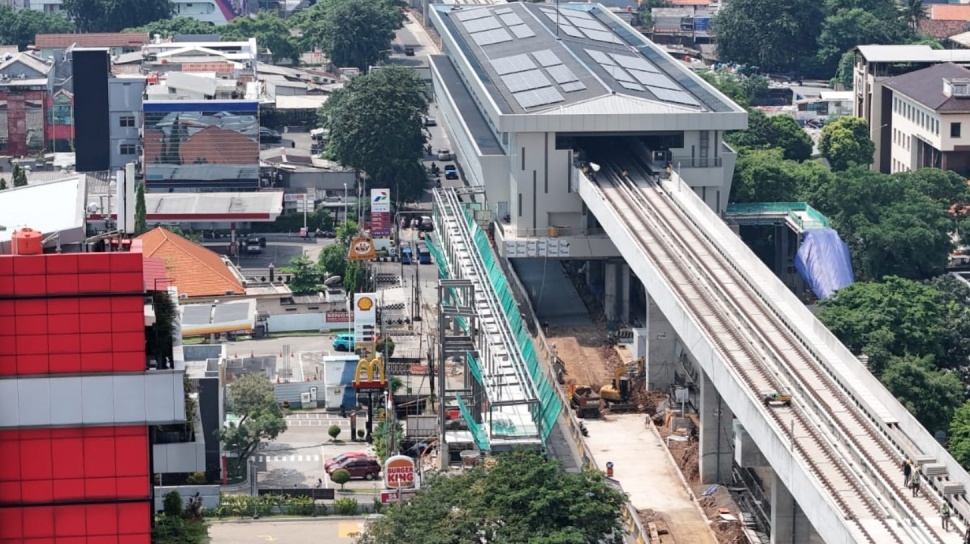
Commemorating National Transportation Day on April 24, PT Waskita Karya (Persero) Tbk has stated its commitment to continue promoting safe, comfortable, and sustainable public transportation modes. One example is the work on the Light Rail Transit (LRT) Jakarta Phase 1B Velodrome-Manggarai line.
The company is currently accelerating the completion of this project owned by PT Jakarta Propertindo (Jakpro). The realization of the LRT Jakarta construction has reached 91.86 percent.
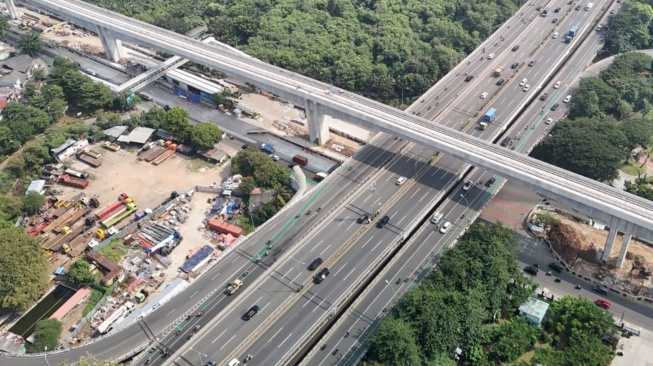
The LRT elevated track crossing over the Ir Wiyoto Wiyono Toll Road is 100 percent connected. Currently, Steel Box Girder (SBG) installation is underway at the Matraman intersection.
The installation of the girder span is a crucial stage in the work on LRT Jakarta Phase 1B. This section is one of the critical points on the project route.
“Waskita Karya is grateful that the entire construction process is running smoothly according to plan. This success demonstrates strong synergy between the company, PT Jakarta Propertindo, local government, and stakeholders,” stated an official statement.
One of the innovations implemented by Waskita is the use of long spans, including execution methods in implementing Building Information Modelling (BIM) up to level 7D. The implementation includes incremental lifting of Steelbox Girders, lifting and sliding of PC-Girders, and Traveler Launcher cast-in-situ Balance Cantilever, aimed at facilitating work on the project located in road areas with active traffic and dense toll routes in Jakarta.
“Thanks to this innovation, installing the LRT elevated track over the toll road is easier and does not disrupt traffic or driver mobility. This proves the company successfully prioritized work safety and security aspects,” the statement explained.
It was explained that the LRT Jakarta elevated track from Kelapa Gading to Jalan Pramuka is now also connected. This line connects North, East, and Central Jakarta through an integrated elevated rail network.
Furthermore, several main structures along the corridors of Jalan Pemuda, Jalan Pramuka, Jalan Tambak, and Jalan Sultan Agung are also already connected. Waskita Karya is optimistic that the completion of LRT Jakarta Phase 1B will be on time.
“This project has been highly anticipated by the people of Jakarta and surrounding areas because it is considered capable of reducing congestion, while also lowering the urban carbon footprint to support better air quality,” the statement noted. The LRT, valued at Rp4.1 trillion, is expected to soon be utilized by public transport users.
Thanks to this project, last year Waskita Karya successfully became a finalist in Bentley’s Going Digital Awards Year in Infrastructure (YII) 2025, held in Amsterdam, Netherlands. The company’s digital innovation in building LRT Jakarta Phase 1B was assessed as capable of improving efficiency, safety, and sustainability in the construction process.
In this annual event, which included 250 nominees from 47 countries, Waskita showcased technology to simplify project work amidst dense urban areas. It was noted that building mass transportation facilities in urban areas is not easy, requiring innovative solutions to handle field complexities.
To accelerate construction, Waskita applied BIM-based digital solutions and Bentley Systems technology. The company also utilized photogrammetry drones and 4D simulation to monitor and manage the project in real time.
“Waskita uses an integrated digital platform that combines spatial data, BIM models, and work schedules in a single system. This method aims to make it easier for all teams, both technical and non-technical, to access project information directly and make decisions quickly,” the statement said.
Thanks to this method, the company successfully identified and resolved over 1,200 potential issues before the construction process took place. Not only did it improve work safety, but the implementation of 4D simulation also pushed the company towards more efficient and precise construction methods.
“The company is committed to continuing innovation and supporting the presence of a reliable

![Suku Dinas Lingkungan Hidup Jakarta Barat bersama Palang Merah Indonesia (PMI) menggencarkan penggunaan teknologi ramah lingkungan untuk hilangkan bau menyengat di Tempat Pembuangan Sementara (TPS) RW 02, Kampung Randu, Duri Kosambi, Cengkareng, Jumat (18/7/2025) [Suara.com/ANTARA/HO-Pemkot Jakbar]](https://asiacity.news/wp-content/uploads/2025/07/44238-sampah-150x150.webp)