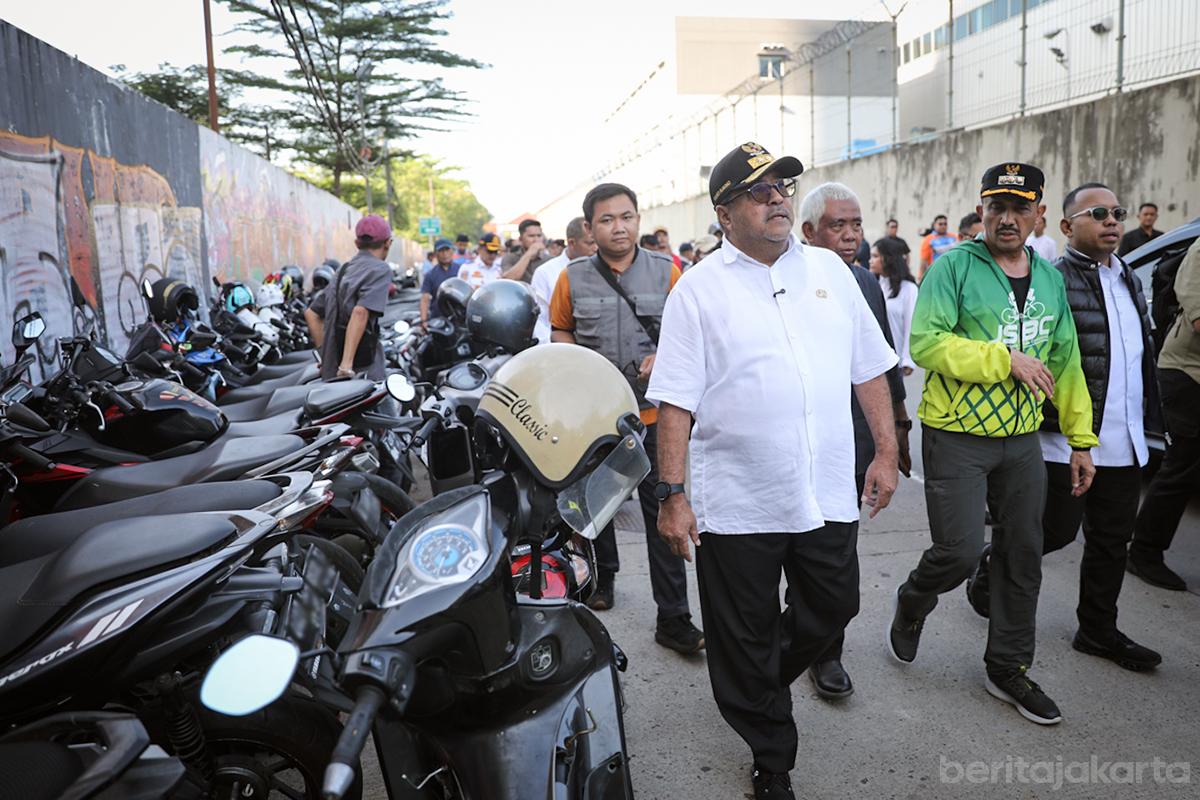
The Deputy Governor of DKI Jakarta, Rano Karno, led a joint effort to clean land and control parking on Jalan R.A. Kartini RT 09/07, Lebak Bulus Village, Cilandak, South Jakarta, on Friday (April 24). The activity involved 200 combined personnel and residents.
“I urge residents not to park here anymore, as it causes traffic jams. Public access becomes obstructed and prone to crime,” said Rano.
Rano stated that all parked vehicles and traders on Jalan R.A. Kartini will be relocated to an area owned by Perumda Sarana Jaya. Thus, their presence will no longer disrupt road access.
The Head of the Parking Unit at the DKI Jakarta Transportation Agency, Masdes Arrofi, explained that the land owned by Perumda Sarana Jaya used for temporary parking has an area of about 1.8 hectares.
In the future, Masdes acknowledged that further discussions will be held regarding the use of the land, including the technical management of parking on that site.
“For now, the important thing is that it does not disrupt the road function. We will discuss it further later,” he emphasized.
Meanwhile, Instagram influencer Rafli Zulkarnaen, who had viralized this illegal parking case, admitted he was quite surprised that his complaint was directly responded to by the Deputy Governor of DKI Jakarta. Initially, he thought the disruptive parking issue would only be followed up by the Transportation Agency.
“Yesterday, I expected maybe just from the Transportation Agency. But it turned out the Deputy Governor himself came down,” he stated.
Lebak Bulus
Lebak Bulus is a neighborhood in South Jakarta, Indonesia, originally known as a swampy area (its name means “bamboo swamp” in Sundanese) until urban development transformed it into a residential and commercial hub. Its modern significance grew with the construction of the Lebak Bulus MRT station, which opened in 2019 as part of Jakarta’s first mass rapid transit system. The area is also home to the historic Kebun Binatang Ragunan zoo and serves as a key transit point connecting the city’s southern suburbs to central Jakarta.
Cilandak
Cilandak is a subdistrict located in South Jakarta, Indonesia, known for its mix of residential areas and commercial hubs. Historically, the area was part of the vast agricultural lands surrounding Jakarta, but it began to develop rapidly in the late 20th century as the city expanded. Today, Cilandak is recognized for its modern shopping centers, such as Cilandak Town Square, and its proximity to the Pondok Indah area.
South Jakarta
South Jakarta is a major administrative city within the Indonesian capital, known for its modern business districts, upscale shopping malls, and vibrant nightlife. Historically, it developed rapidly from the 1970s onward, transforming from quieter residential and agricultural areas into a key economic hub. Today, it houses many foreign embassies, corporate headquarters, and landmarks like Pondok Indah Mall, reflecting Jakarta’s contemporary urban growth.
Jalan R.A. Kartini
Jalan R.A. Kartini is a street commonly found in many Indonesian cities, named after Raden Ajeng Kartini, a national heroine who
Lebak Bulus
Lebak Bulus is a neighborhood in South Jakarta, Indonesia, best known as the location of the Lebak Bulus Bus Terminal, a major transportation hub. Historically, the area was a swampy, rural region, but it developed rapidly in the late 20th century with urban expansion. Today, it is a bustling residential and commercial area, also home to the popular Lebak Bulus Grand Mosque.
Cilandak
Cilandak is a subdistrict in South Jakarta, Indonesia, known for its mix of residential areas and commercial developments. Historically, it was part of the vast agricultural lands surrounding Jakarta, but urban expansion in the late 20th century transformed it into a bustling suburban center. Today, Cilandak is recognized for landmarks like Pondok Indah Mall and its proximity to the Pondok Indah Golf Course.
South Jakarta
South Jakarta is a major administrative city within the Jakarta Special Capital Region, known for its upscale residential areas, business districts, and shopping centers. Historically, it developed rapidly during the 1970s and 1980s as the city expanded southward, transforming from agricultural land into a modern urban hub. Today, it is home to landmarks like the Pondok Indah Mall and the Ragunan Zoo, reflecting its blend of suburban comfort and metropolitan growth.
Jalan R.A. Kartini
Jalan R.A. Kartini is a prominent street named after Raden Ajeng Kartini, a national heroine of Indonesia who advocated for women’s rights and education in the early 20th century. The street is commonly found in many Indonesian cities, serving as a tribute to her legacy and often located near cultural or administrative centers. Its history reflects the nation’s respect for Kartini’s contributions, with the naming typically occurring after Indonesia’s independence to honor her role in the country’s social development.
Kebun Binatang Ragunan
Kebun Binatang Ragunan, located in South Jakarta, Indonesia, is a sprawling zoological park that opened to the public in 1966. It was originally established by the Batavia Planten en Dierentuin (Batavia Botanical and Zoological Gardens) in 1864, making its roots one of the oldest in Southeast Asia. Today, it houses over 2,000 animals from nearly 300 species and serves as a popular recreational and conservation site.
Pondok Indah Mall
Pondok Indah Mall (PIM) is a large upscale shopping center located in South Jakarta, Indonesia, which first opened its doors in 1992. Developed by the Metropolitan Kentjana Group, it is one of the oldest and most prestigious malls in the city, having undergone several expansions and renovations to maintain its modern appeal. Today, PIM consists of three interconnected sections (PIM 1, 2, and 3) and remains a popular destination for shopping, dining, and entertainment.
Cilandak Town Square
Cilandak Town Square is a shopping and entertainment complex located in the Cilandak area of South Jakarta, Indonesia. It was developed as part of the broader urban expansion in the late 20th century, serving as a modern commercial hub for the surrounding residential communities. The square features a mix of retail outlets, dining options, and recreational facilities, reflecting Jakarta’s growing suburban lifestyle.
Lebak Bulus MRT station
Lebak Bulus MRT station is a major transit hub in South Jakarta, Indonesia, serving as the southern terminus of the Jakarta MRT system’s first phase. It opened in March 2019 as part of the city’s efforts to alleviate traffic congestion, and its name derives from the surrounding Lebak Bulus neighborhood, which historically was known for its swampland and later developed into a residential and commercial area. The station integrates with the Lebak Bulus bus terminal, making it a key connection point for commuters.