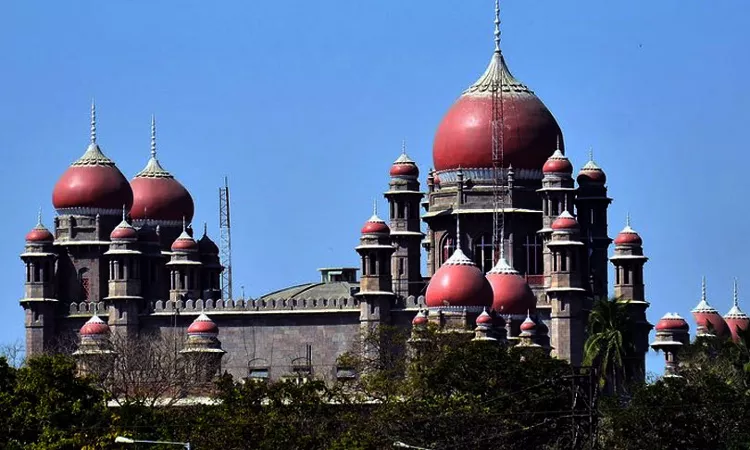
Court objects to token action against illegal construction.
Hyderabad: The Telangana High Court commented that the GHMC’s action against illegal constructions is merely nominal. It was found to be wrong that despite receiving numerous complaints in this regard, the GHMC has taken only limited action.
It was also found to be wrong that they are issuing show-cause notices to illegal builders and remaining silent on the complaints. It was stated that orders are being issued only in some cases. It was suggested that complaints related to illegal construction should be included on the website. Doing so will make the public aware of illegal constructions.
For implementing the orders issued by the High Court and the Supreme Court, the help of the GHMC Commissioner and police can be sought. High Court Justice N.V. Shravan Kumar recently heard a petition filed by Mukund Soni and two others, challenging the lack of action on complaints filed by a person named Gyan Shekhar against illegal constructions in the Kothi area of Hyderabad.
Also read…
On the occasion, the GHMC commented that officials visited the area with illegal construction and found a defect there, but no action was taken other than informing the petitioners on March 26. However, the illegal constructions were sealed. After this argument, the hearing of the case was adjourned until April 27.
Telangana High Court
The Telangana High Court is the highest judicial body in the Indian state of Telangana, located in Hyderabad. Its history traces back to the Hyderabad High Court, which was established in 1954 under the States Reorganization Act, serving both Telangana and Andhra Pradesh. Following the bifurcation of Andhra Pradesh in 2014, the court was renamed the Telangana High Court in 2019, with a separate High Court established for Andhra Pradesh.
Hyderabad
Hyderabad is a major city in southern India known for its rich history as the capital of the princely state of Hyderabad under the Nizams, who ruled from the 18th century until India’s independence. Founded in 1591 by Muhammad Quli Qutb Shah, it is famous for landmarks like the Charminar and its blend of Hindu and Muslim cultural influences. Today, it is a thriving tech hub, often called “Cyberabad,” while still preserving its historic pearl and bangle markets.
Supreme Court
The Supreme Court of the United States is the highest federal court, established by Article III of the Constitution in 1789. It holds the power of judicial review, allowing it to declare laws unconstitutional, a principle solidified in the landmark 1803 case Marbury v. Madison. The Court’s iconic neoclassical building in Washington, D.C., completed in 1935, symbolizes the independence and authority of the judicial branch.
Kothi area
The Kothi area, located in the old city of Hyderabad, India, is a historic neighborhood known for its grand mansions (kothis) built during the Nizam’s rule in the 19th and early 20th centuries. This affluent district served as a residential enclave for nobles and wealthy merchants, featuring a blend of Indo-European architectural styles. Today, it remains a culturally significant site, with many of its stately homes preserved as reminders of Hyderabad’s royal past.
Telangana High Court
The Telangana High Court, located in Hyderabad, is the highest judicial body in the state of Telangana, India. It was established on January 1, 2019, following the bifurcation of the erstwhile Andhra Pradesh High Court, after the state of Telangana was formed in 2014. The court functions from the historic Justice City complex, which was originally built to house the Andhra Pradesh High Court.
Hyderabad
Hyderabad is a major city in southern India, known for its rich history as a center of the Deccan Sultanates and later the princely state of Hyderabad under the Nizams. Founded in 1591 by Muhammad Quli Qutb Shah, the city is famous for its iconic Charminar, a blend of Indo-Islamic architecture, and its historic pearl and diamond trading heritage. Today, it is a thriving tech and cultural hub, preserving landmarks like the Golconda Fort while embracing modernity.
Supreme Court
The Supreme Court of the United States is the highest federal court, established by Article III of the Constitution in 1789. It holds the power of judicial review, allowing it to declare laws unconstitutional, a precedent set in the landmark 1803 case *Marbury v. Madison*. The court meets in a neoclassical building in Washington, D.C., completed in 1935, symbolizing the balance of justice.
Kothi area
The Kothi area, located in the old city of Lahore, Pakistan, is a historic neighborhood renowned for its cluster of grand, often dilapidated havelis (traditional mansions) built by wealthy Hindu and Sikh merchants during the 19th and early 20th centuries. These ornate buildings, featuring intricate woodwork, frescoes, and courtyards, reflect the area’s past as a bustling commercial and residential hub before the Partition of India in 1947. Today, Kothi stands as a poignant, fading testament to Lahore’s multicultural heritage, with many of its structures in various states of disrepair.
Charminar
Charminar is a historic monument and mosque located in Hyderabad, India, built in 1591 by Sultan Muhammad Quli Qutb Shah. It was constructed to commemorate the founding of Hyderabad and to serve as a central landmark, with its four grand arches representing the four caliphs of Islam. Today, it remains an iconic symbol of the city, surrounded by bustling markets and rich cultural heritage.
Cyberabad
Cyberabad is a colloquial nickname for Hyderabad, India, particularly its Hi-Tech City and surrounding areas, reflecting the city’s transformation into a global hub for information technology and biotechnology. The name emerged in the late 1990s and early 2000s as the government developed HITEC City and attracted major tech companies like Microsoft, Google, and Infosys. This modern identity contrasts with Hyderabad’s historic past as a princely state capital known for its pearls, cuisine, and the iconic Charminar.