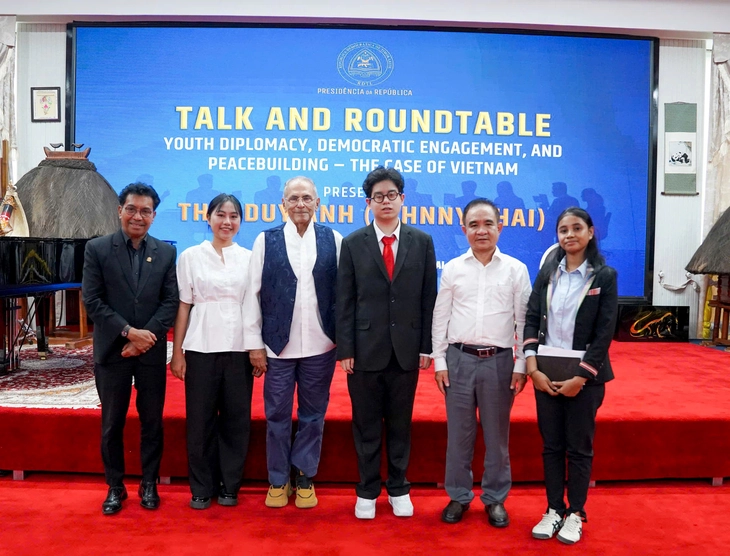
From a manuscript sent “boldly” to the Office of the President of Timor-Leste, Thai Duy Anh—a 14-year-old 9th-grade student at the Asian International School (Ho Chi Minh City)—received a direct invitation to meet and have a private meal with the President.
The opportunity began when Duy Anh worked on a roughly 300-page manuscript about Middle Eastern history, focusing on the Israeli-Palestinian issue. He got stuck on a few complex points that needed verification and feedback to ensure objectivity.
An Unexpected Email
Unsure where to send it, Duy Anh decided to submit the manuscript to various places for review. Among those addresses was the Presidential Office, which, according to Duy Anh: “I didn’t expect a reply; I just considered it a ‘test’ for myself.”
But to his great surprise, not long after, the 14-year-old student received a response email that left him astonished. The email came from the personal email account of President José Ramos-Horta.
In the letter, the President expressed surprise at the young age of the author and the content of the manuscript he had received.
“You are amazing, are you really only 13 years old? I can hardly believe it, but I have to, and I am very impressed…,” the President wrote. In this reply, the President also extended an invitation for Duy Anh to visit Timor-Leste.
Initially, upon receiving the email reply from the office of President José Ramos-Horta, Duy Anh couldn’t believe it was real.
He said he had to read it over and over again, even thinking it might be a fake or scam email.
But once he verified it was genuine, Duy Anh said what impressed him most was the simplicity of the letter—concise, clear content and a signature that was just his personal name, without any title.
A Borderless Journey
Before going to Timor-Leste, Duy Anh had already taken his first steps into the international arena by submitting opinion pieces to some regional magazines.
For instance, inspired by a domestic cultural phenomenon like the film Red Rain, which drew attention at the box office, Duy Anh researched the development of cinema, audience trends, and how a local work could create a wider impact.
From there, he wrote an article sharing his personal perspective, raising questions about why the film was well-received and its significance within the broader landscape of Vietnamese cinema.
After finishing, Duy Anh sent the article to Asia Times with the simple thought, “Just send it; there’s nothing to lose.” However, on September 29, 2025, the article was published in the culture-society section of the magazine.
This experience became a memorable milestone, helping him feel more confident in bringing stories from Vietnam beyond its borders. Besides Asia Times, he also contributed to Asia Sentinel and some local outlets…
Ms. Tran Thi Thuy Phuong, D
Timor-Leste
Timor-Leste, also known as East Timor, is a Southeast Asian nation that gained independence in 2002 after centuries of Portuguese colonial rule and a 24-year occupation by Indonesia. The country’s rich cultural heritage blends Austronesian and Portuguese influences, with landmarks like the Cristo Rei statue and the mountainous region of Mount Ramelau reflecting its history and natural beauty. Today, it stands as one of the world’s youngest nations, with a resilient spirit shaped by its struggle for sovereignty.
<div
Presidential Palace
The Presidential Palace is the official residence and workplace of the head of state in many countries, often serving as a symbol of national government and history. Its architecture and location vary widely by nation, with some palaces dating back centuries and originally built for royalty or colonial governors before being repurposed for presidential use. For example, the Presidential Palace in Helsinki, Finland, was originally constructed as a private residence in the 1820s and later became the official seat of the Finnish president.
Middle Eastern history
The Middle East is a region of profound historical and cultural significance, often considered the cradle of civilization, where ancient Mesopotamia, Egypt, and Persia flourished. It gave rise to major religions, including Judaism, Christianity, and Islam, and was a central hub for trade, science, and philosophy during the Islamic Golden Age. Its complex modern history, shaped by colonialism, oil discovery, and geopolitical conflicts, continues to influence global affairs today.
Israeli-Palestinian issue
The Israeli-Palestinian issue is a long-standing conflict over land, identity, and sovereignty, primarily centered on the region of historic Palestine. Its modern roots trace back to the late 19th and early 20th centuries, with the rise of Zionist immigration and Arab nationalism, escalating after the 1948 establishment of Israel and the displacement of many Palestinians. Key points of contention include borders, the status of Jerusalem, Israeli settlements, and the rights of Palestinian refugees, with efforts at resolution continuing through various peace processes.
Timor-Leste
Timor-Leste, also known as East Timor, is a Southeast Asian nation that gained independence from Indonesia in 2002 after a long and tumultuous history of colonization by Portugal from the 16th century and a brutal Indonesian occupation beginning in 1975. Its cultural sites, such as the Cristo Rei of Dili statue and the Resistance Museum, reflect a blend of Portuguese, indigenous, and post-conflict heritage. The country’s mountainous landscapes and coral reefs also highlight its natural beauty, though its history of struggle for sovereignty remains a defining feature of its national identity.
Red Rain
“Red Rain” is a natural phenomenon that has occurred in Kerala, India, where rainfall appears colored red due to the presence of microscopic algae spores or dust particles. The most famous incident took place in 2001, sparking scientific debate and even speculation about extraterrestrial origins. Despite various theories, the phenomenon remains a fascinating example of how environmental factors can create unusual weather events.
Vietnamese cinema
Vietnamese cinema has evolved from its early roots in the 1920s under French colonial influence, with the first feature film “Kim Vân Kiều” produced in 1923. It gained momentum during the mid-20th century, focusing on war and revolutionary themes, particularly during the Vietnam War era. Today, Vietnamese cinema is experiencing a renaissance with internationally acclaimed films like “The Scent of Green Papaya” and “Cyclo,” blending traditional storytelling with modern cinematic techniques.
Cristo Rei statue
The Cristo Rei statue is a towering monument of Jesus Christ located in Almada, Portugal, overlooking the city of Lisbon. It was built between 1949 and 1959 as a thanksgiving for Portugal’s neutrality during World War II, inspired by Rio de Janeiro’s Christ the Redeemer. Standing 110 meters tall on a pedestal, it has become a significant religious and cultural landmark.
Mount Ramelau
Mount Ramelau, also known as Tatamailau, is the highest peak in Timor-Leste, standing at 2,986 meters. It holds deep cultural and spiritual significance for the local Mambai people, who consider it sacred, and it is also the site of a prominent statue of the Virgin Mary, erected in 1997 by the Indonesian government. Pilgrims and hikers often ascend the mountain, especially during the annual Holy Week procession, blending traditional animist beliefs with Catholic traditions.