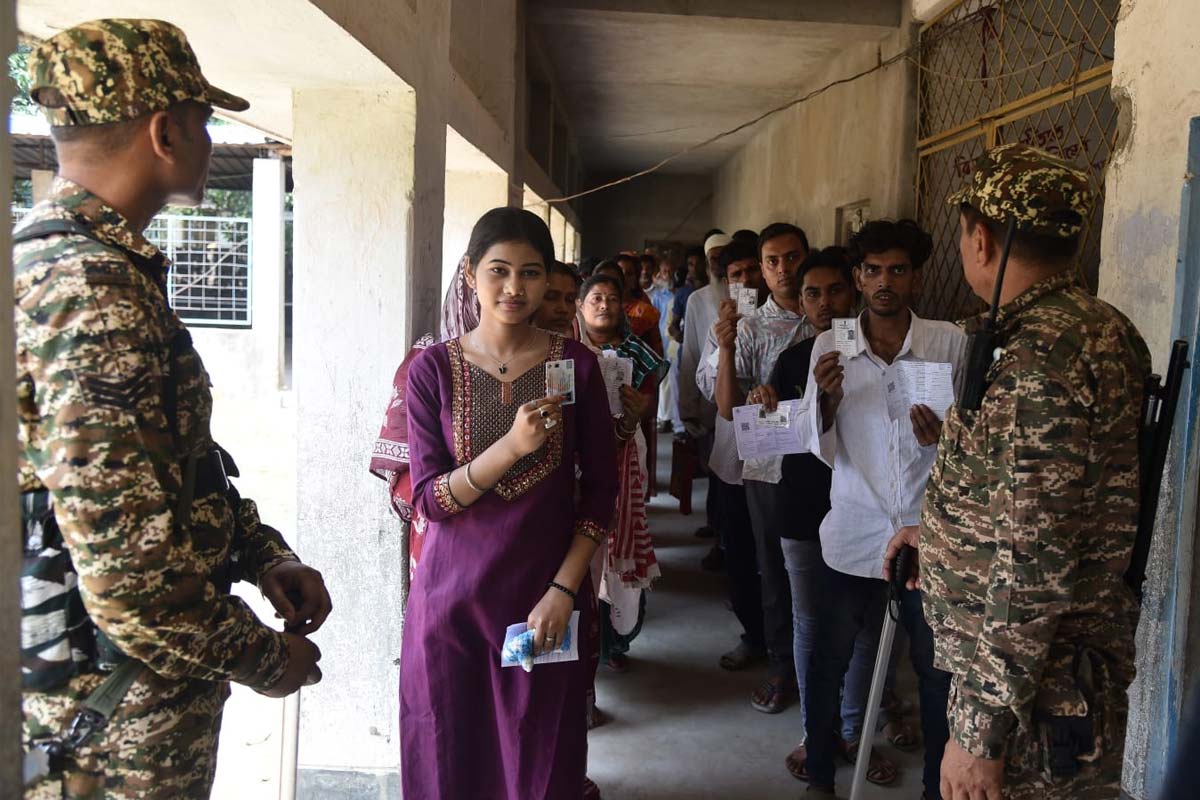
In 10 out of 152 assembly seats, voter turnout decreased in 2026 compared to 2024—what’s the reason behind this?
The voter turnout in the 2026 election is unprecedented. In the first phase, nearly 91 percent of votes were cast across 152 booths. However, when compared to the 2024 Lok Sabha elections, the data tells a different story. In 10 out of 152 assembly constituencies, voter numbers have decreased. This information has been obtained from a national media source.
More news on this topic
In North Bengal, constituencies such as Matigara-Naxalbari, Phansidewa, Siliguri, Dabgram-Phulbari, Malda’s English Bazar, Murshidabad’s Bhagwangola, Farakka, Lalgola, and Samsherganj, as well as West Midnapore’s Kharagpur Sadar, have seen voter numbers drop by over 88.7 percent. This is because these constituencies have fewer voters compared to the 2024 Lok Sabha elections. The data shows that voter numbers decreased by 18.9 percent in Samsherganj, 4.7 percent in Kharagpur, 4.6 percent in Lalgola, 4 percent in Dabgram-Phulbari, 3.1 percent in Phansidewa, 2.1 percent in Bhagwangola, 1.7 percent in Farakka, 0.9 percent in English Bazar, 0.5 percent in Siliguri, and 0.2 percent in Matigara-Naxalbari.
The most significant aspect is that among the assembly constituencies where voter numbers have decreased, Samsherganj, Lalgola, Bhagwangola, and Farakka had outgoing MLAs from 2011 to 2021, all of whom belonged to minority communities. According to the 2011 census, in five of these districts, Muslim voters constitute more than 50 percent of the total population. In the remaining districts, 12 percent of residents are Muslim. Amid the CAA (Citizenship Amendment Act) context, there have been repeated allegations that the names of people from a particular community were primarily omitted. Those allegations now seem to be confirmed. It is believed that the CAA is behind the overall increase in voter turnout in Bengal this time. The question now is, what does this huge increase in voter turnout indicate? Typically, a high voter turnout election signals a ‘wave’ or a major shift. This could be in favor of the ruling party or against it. Since the increase in voter turnout in Bengal’s current election is due to the CAA, opposition to the CAA could also impact the ballot box. If that happens, Trinamool Congress might have the last laugh.
More news on this topic
Matigara-Naxalbari
Matigara and Naxalbari are adjacent regions in the Darjeeling district of West Bengal, India, known for their agricultural landscapes and historical significance. Naxalbari gained prominence in the late 1960s as the birthplace of the Naxalite–Maoist insurgency, a radical peasant uprising led by local communist factions demanding land rights and social justice. Today, the area remains a symbol of agrarian activism and is part of the broader tea-growing and rural heartland of northern Bengal.
Phansidewa
Phansidewa is a town located in the Darjeeling district of West Bengal, India, historically part of the ancient Kamarupa kingdom and later influenced by the Koch and Mughal empires. It gained prominence during the British colonial era as a strategic railway junction on the Bengal-Darjeeling route. Today, it serves as a key commercial and cultural hub for the region’s diverse communities, including Rajbanshi and Nepali populations.
Siliguri
Siliguri is a major city in the Indian state of West Bengal, serving as a key commercial and transit hub in the northeastern region. Its strategic location at the foothills of the Himalayas made it a vital trade and military post during the British colonial era, linking India with Bhutan, Nepal, and Bangladesh. Today, it is known as the “Gateway to Northeast India” and is famous for its vibrant markets, tea gardens, and proximity to hill stations like Darjeeling.
Dabgram-Phulbari
Dabgram-Phulbari is a notable urban area in the Jalpaiguri district of West Bengal, India, known for its historical significance as a former zamindari estate. The region includes the Phulbari Rajbari, a palace built by the local royal family in the early 20th century, reflecting the area’s feudal past. Today, it serves as a rapidly developing suburban hub, blending heritage with modern urbanization.
English Bazar
English Bazar, also known as Malda, is a historic city in West Bengal, India, that served as the capital of the ancient Gour and Pandua kingdoms. It gained prominence as a major trading hub during the medieval period, particularly for silk and cotton, under the Bengal Sultanate. Today, it is known for its mango orchards and nearby archaeological ruins, including the Adina Mosque and the ancient city of Gour.
Bhagwangola
Bhagwangola, located in the Murshidabad district of West Bengal, India, is a historic river port town on the banks of the Bhagirathi River. It flourished as a major trading hub during the 18th century under the Nawabs of Bengal, serving as a key center for the export of rice, silk, and cotton. The site was also famously used by the British East India Company as a strategic military and commercial base before the decline of the Mughal-era trading networks.
Farakka
Farakka is a town in the Indian state of West Bengal, best known for the Farakka Barrage, a major dam constructed across the Ganges River. Built between 1961 and 1975, the barrage was designed to divert water to the Hooghly River, aiming to flush silt from the Kolkata port, but it has also been a source of long-standing water-sharing disputes with neighboring Bangladesh. The area is also home to the Farakka Super Thermal Power Station, one of India’s largest coal-fired power plants.
Lalgola
Lalgola is a town in the Murshidabad district of West Bengal, India, located on the banks of the Padma River near the Bangladesh border. Historically, it served as a significant river port and trading hub during the Bengal Sultanate and British colonial periods, facilitating commerce and cultural exchange. Today, it is known for the Lalgola railway station, which is a key transit point connecting the region to major Indian cities.