Bandung – The Setara Institute has just released the results of their highly anticipated annual research, the 2025 Tolerant City Index. Among the list of cities from across the archipelago, two cities from West Java, Bekasi and Sukabumi, have secured honorable positions in the top ten most tolerant cities in Indonesia.

This report is not just a set of numbers, but a portrait of the dynamics of cooperation between local governments and communities in nurturing diversity. Out of a total of 94 cities assessed, Bekasi City stands firmly in fifth place, closely followed by Sukabumi City in sixth place.

A Stage for Recognition

The launch of the 2025 Tolerant City Index served as an event to appreciate cities that consistently maintain inclusive public spaces for all religious and belief groups.

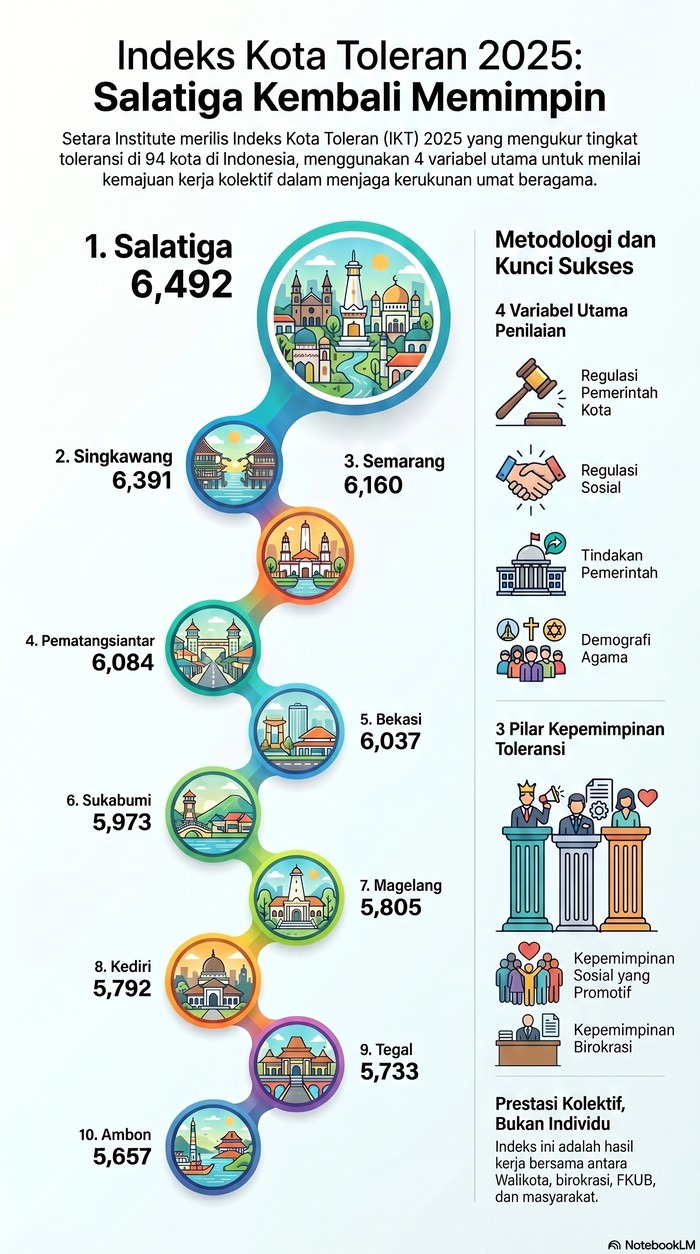
  • Top of the Ranking: Salatiga City in Central Java has again taken the top spot with a score of 6.492, followed by Singkawang City in West Kalimantan with a score of 6.391.
  • West Java’s Position: Amidst competition from cities in Central Java that dominate the list, Bekasi City (score 6.037) and Sukabumi City (score 5.973) have emerged as strong representatives from the Sundanese region, proving that tolerance can thrive in heterogeneous urban areas.

The Chairman of the Setara Institute’s Board of Directors emphasized that this achievement is a collective effort. “So, (the tolerant city index) is not solely the achievement of the Mayor, Kesbangpol, or FKUB, but it is a shared achievement,” he stated at the Mangkuluhur ARTOTEL Suites in Jakarta on Wednesday, April 22, 2026.

Benchmarks: Why Bekasi and Sukabumi Excel?

The success of Bekasi City and Sukabumi City in breaking into these elite positions did not happen by chance. The Setara Institute uses a rigorous assessment method involving four main variables and eight indicators as measurement tools.

  • Determining Variables: The scores achieved are based on variables of city government regulation, social regulation, government action, and religious demographics.
  • Concrete Actions: Bekasi City and Sukabumi City were assessed as being able to harmonize bureaucratic policies with the social needs of their communities, thereby minimizing inter-group friction through a promotive legal and social approach.

Three Formulas for Advancing Harmony

In his presentation, three main keys were outlined that form the foundation for a city to be called tolerant. These three elements appear to be interwoven in the governance of the cities in the top ten.

  1. Political Leadership: The willingness of political leaders at the city level to promote the values of tolerance in every speech and policy.
  2. Bureaucratic Leadership: A state civil apparatus that is non-discriminatory in providing public services to all citizens regardless of their belief background.
  3. Social Leadership: The active role of community figures, religious leaders, and civil organizations in constantly maintaining harmony at the grassroots level.

“First, ensuring political leadership is promotive of tolerance. Second, bureaucratic leadership. Third, social leadership,” he stated regarding this formula.

Top 10 Ranking of Tolerant Cities 2025

Based on official data from the Setara Institute, here is the complete order of the ten cities with the highest tolerance index in Indonesia:

  1. Salatiga City (score 6.492)
  2. Singkawang City (score 6.391)
  3. Semarang City (score 6.160)
  4. Pematangsiantar City (score 6.084)
  5. Bekasi City (score 6.037)
  6. Sukabumi City (score 5.973)
  7. Magelang City (score 5.805)
  8. <

    Setara Institute

    The Setara Institute is an Indonesian non-governmental organization founded in 2005, dedicated to promoting democracy, human rights, and tolerance in Indonesia. It was established by a group of activists and academics in response to rising religious intolerance and political challenges in the post-Reformasi era. The institute is best known for its annual reports on religious freedom and its advocacy for minority rights and pluralism.

    Bekasi

    Bekasi is a city in West Java, Indonesia, known for its rapid urbanization and role as a satellite city of Jakarta. Historically, it was part of the ancient Tarumanagara Kingdom, with archaeological evidence such as the Tugu Inscription dating back to the 5th century. Today, Bekasi is a major industrial and residential hub, reflecting Indonesia’s modern economic growth.

    Sukabumi

    Sukabumi is a city located in West Java, Indonesia, known for its cool climate and scenic natural surroundings, including tea plantations and waterfalls. Historically, it developed as a colonial-era retreat during Dutch rule, with the name “Sukabumi” meaning “the land that pleases” in Sundanese. Today, it remains a popular destination for both cultural heritage and outdoor recreation.

    Salatiga City

    Salatiga City, located in Central Java, Indonesia, is known for its cool climate and colonial-era architecture, reflecting its history as a Dutch colonial settlement. Established in the 18th century, it became a key administrative and trading hub, and was granted city status in 1917. Today, it is a vibrant educational and cultural center, famous for its religious diversity and annual events like the “Salatiga Festival.”

    Singkawang City

    Singkawang City, located in West Kalimantan, Indonesia, is renowned for its vibrant Chinese-Indonesian culture and is often called the “City of a Thousand Temples.” Historically, it developed as a major hub for Chinese gold miners in the 18th century, leading to a unique blend of Dayak, Malay, and Chinese traditions. Today, it is famous for its annual Cap Go Meh festival, featuring elaborate parades and cultural performances.

    Mangkuluhur ARTOTEL Suites

    Mangkuluhur ARTOTEL Suites is a modern hotel located in Jakarta, Indonesia, known for blending contemporary design with local cultural elements. The property is part of the ARTOTEL group, which emphasizes art and creativity in its hospitality concept. While the building itself is relatively new, its name references the historic Mangkuluhur Palace, a Javanese royal heritage site, connecting the hotel to Indonesia’s rich cultural and royal history.

    Jakarta

    Jakarta is the capital and largest city of Indonesia, located on the northwest coast of Java. Originally a small port town called Sunda Kelapa, it was renamed Batavia by the Dutch in the 17th century and became the center of Dutch colonial rule in the East Indies. After Indonesia’s independence, it was renamed Jakarta and has since grown into a bustling metropolis, blending modern skyscrapers with historic sites like the old town (Kota Tua).

    Semarang City

    Semarang is the capital of Central Java, Indonesia, and a major port city with a history shaped by Dutch colonial rule, Chinese migration, and Javanese culture. Its Old Town, known as Kota Lama, features well-preserved 18th-century European architecture, while landmarks like the iconic Sam Poo Kong temple reflect the city’s rich Chinese heritage. Today, Semarang blends its historical legacy with modern development as a key economic hub.