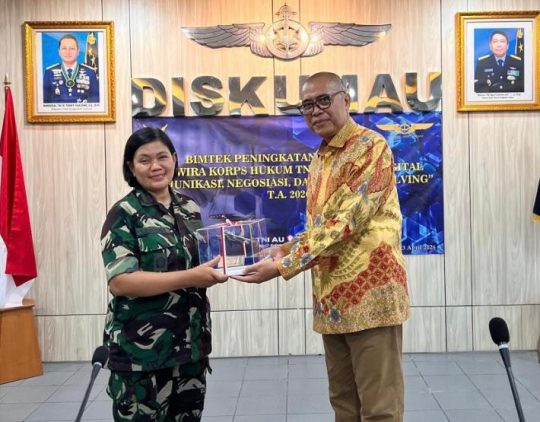
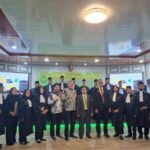
Jakarta – The General Chairman of DePA-RI (Council of the Movement of Advocates of the Republic of Indonesia), Dr. Tahir Musa Luthfi Yazid, fulfilled an invitation from the Indonesian Air Force Headquarters as a speaker to enhance the capacity of officers on Thursday, April 23, 2026.
During the event, Luthfi provided tips on negotiation, communication, and mediation techniques, which were met with enthusiasm from the officers. The activity was conducted in a hybrid format (online and offline) and was attended by hundreds of Indonesian Air Force officers from Sabang to Merauke.
Through this collaboration, Luthfi hopes that the officers can carry out their duties professionally, based on the constitutional message, and develop as individuals capable of understanding the roots of conflict, skilled in good communication, and competent in conducting effective negotiation and negotiation strategies.
He emphasized that improving communication leads to a greater opportunity to become an exemplary influencer, or “the better communication, the better your chance to influence.”
Accuracy and precision in decision-making are also fundamental, given that officers are “the man behind the gun.” Therefore, Luthfi hopes they will not only rely on military success through weaponry and technology alone but also on wisdom.
Furthermore, Luthfi stressed the importance for officers to control themselves from all forms of conflict of interest, structural conflicts, and even value conflicts, citing the writings of his friend Christopher W. Moore, from his time attending the Center for Dispute Resolution in Boulder, Colorado, USA in 1995.
“The most difficult is value conflict because it is related to beliefs, customs, ideology, or religion. Also distinguish conflicts by carefully observing and perceiving data that often arises due to information inaccuracies,” he said.
One way to achieve this, according to him, is to follow in the footsteps of idealist intellectual military figures, such as General Soedirman, General A.H. Nasution, General T.B. Simatupang, General Soemitro, General Saidiman Suryohadiprojo, and General Try Sutrisno as role models.
“Seeing the increasingly rapid disruption of law, officers must not fall behind or stagnate in the era of The Rule of Algorithm and always participate in realizing social justice,” he added.
It is known that Dr. Tahir Musa Luthfi Yazid has collaborated with Alisa J. Steren from the National Institute for Dispute Resolution (NIDR) in Washington DC, USA. Additionally, he has served as a lecturer at Gakushuin University in Tokyo for the courses Comparative Dispute Resolution and Wakai, while also being an assistant to Prof. Yoshiro Kusano, a former High Court Judge of the Hiroshima High Court.
Sabang
Sabang is a coastal city located at the northern tip of Sumatra, Indonesia, on the island of Weh. Historically, it was an important port and a hub for international trade, particularly during the Dutch colonial era when it served as a coaling station for ships. Today, Sabang is known for its beautiful beaches, coral reefs, and as a popular diving destination, as well as its designation as a duty-free zone.
Merauke
Merauke is a town in the far southeastern corner of Indonesia’s Papua region, known as the country’s easternmost city. Historically, it gained prominence in the early 20th century as a Dutch colonial administrative center and mission post, and it was a key site during the struggle for Papua’s integration into Indonesia. Today, Merauke serves as a regional hub for trade and culture, surrounded by diverse ecosystems and indigenous communities.
Boulder
Boulder, Colorado, is a vibrant city at the foothills of the Rocky Mountains, originally settled by Arapaho and Cheyenne peoples before European-American miners arrived during the 1858 Gold Rush. It is home to the University of Colorado Boulder, founded in 1876, and is renowned for its iconic Flatirons rock formations and a strong culture of outdoor recreation. The city also has a rich history as a progressive hub, with a focus on environmentalism and education.
Colorado
Colorado is a U.S. state known for its diverse landscapes, including the Rocky Mountains, high plains, and desert canyons. Its history includes Indigenous peoples like the Ancestral Puebloans, Spanish exploration, and the Pike’s Peak Gold Rush of 1858, which spurred rapid settlement and statehood in 1876. Today, Colorado is celebrated for its outdoor recreation, skiing, and cultural sites like Mesa Verde National Park.
Center for Dispute Resolution
The Center for Dispute Resolution (CDR) is an organization dedicated to promoting alternative dispute resolution methods, such as mediation and arbitration, to resolve conflicts without litigation. Founded in the late 20th century, it emerged from the growing recognition that traditional court battles are often costly, time-consuming, and adversarial. The CDR provides training, resources, and neutral facilitators to help individuals, businesses, and communities achieve more collaborative and efficient outcomes.
Washington DC
Washington, D.C., the capital of the United States, was established in 1790 through the Residence Act and designed by Pierre L’Enfant as a planned city. It serves as the seat of the federal government, housing iconic landmarks like the White House, the Capitol, and the National Mall. The city has been a central stage for American history, from the War of 1812 and the Civil War to the civil rights movement and modern political events.
Gakushuin University
Gakushuin University is a prestigious private institution in Tokyo, Japan, originally founded in 1847 as a school for the children of the imperial court and aristocracy during the Edo period. After World War II, it was reorganized as a private university and now offers a broad range of academic programs. The university is particularly known for its beautiful campus in Mejiro and its historical ties to the Japanese imperial family.
Tokyo
Tokyo is the capital and largest city of Japan, blending ultramodern skyscrapers with historic temples and shrines. Originally a small fishing village called Edo, it became the political center of Japan in 1603 under the Tokugawa shogunate and was renamed Tokyo (“Eastern Capital”) in 1868 after the Meiji Restoration. Today, it is a global hub for technology, culture, and cuisine, renowned for landmarks like the Imperial Palace, Shibuya Crossing, and the historic Asakusa district.