Student Teachers Showcase Their Skills at the HNUE 2026 Hosting Competition Finals
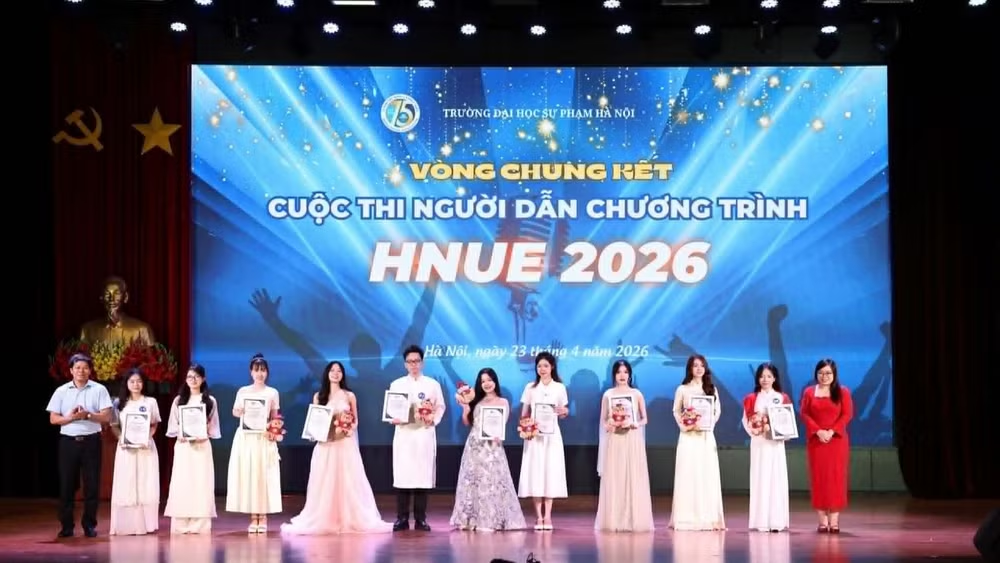
On the evening of April 23, Hanoi University of Education held the final of the HNUE 2026 Host Competition, attracting a large number of students to attend and cheer.
Speaking at the event, Associate Professor Dr. Nguyen Duc Son, Rector of Hanoi University of Education, noted that the skills required of an MC are closely related to those needed by a teacher. Because a teacher must also guide the story, from one content to another, from knowledge to knowledge, must know how to observe the classroom, how to inspire, how to make learners and students look up to them and accompany them.
The difference is that teachers have an advantage, as they face students in a familiar context where they already know each other. Meanwhile, an MC is always challenged by new contexts, faces they may have never met, and situations they could not have imagined might occur.
“Therefore, if you train the courage of an MC and perform the work of an MC well, I firmly believe that you will also succeed as a teacher,” Associate Professor Dr. Nguyen Duc Son emphasized.
After going through preliminary and qualifying rounds, 15 outstanding contestants from the faculties of Primary Education; Chemistry; History; Arts; Literature; Chinese Language and Culture; Educational Management; Educational Psychology; English; Mathematics-Informatics; Philosophy; Vietnamese Studies; and Physics participated in the final night with rounds requiring a combination of talent, knowledge, and stage presence.
In the “Shine” round, contestants showcased their personal mark through diverse performances, flexibly combining hosting with artistic elements such as singing, dancing, storytelling, and presenting. In the “Knowledge” round, contestants demonstrated their knowledge base and quick reflexes through a system of multiple-choice questions and situational scenarios, covering media knowledge, hosting skills, understanding of the school, and notable events.
The highlight of the competition night was the “MC Courage” round, where contestants had to draw random topics and deliver their hosting within a short time, while also handling situations presented by the judging panel. This round required content construction skills, coherent delivery, flexible thinking, and communication skills to handle situations confidently and persuasively, thereby helping the judging panel comprehensively assess each contestant’s abilities.
The rounds were designed around the theme of the 75th anniversary of the school’s founding, thereby evoking pride, love, and attachment among students for their alma mater, while also creating a vibrant competitive atmosphere and promoting comprehensive student development.
At the end of the competition, the organizing committee awarded prizes to recognize the efforts, talents, and impressive performances of the contestants. Specifically, the first prize went to Nguyen Luu Khanh Thao from the Faculty of Literature; the second prize was awarded to Do Huong Giang from the Faculty of Arts; the third prize included contestants Nguyen Quoc Khanh (Faculty of Chemistry), Hoang Le Ngoc Minh (Faculty of Physics), and Hoang Thi Linh (Faculty of Vietnamese Studies).
The Most Favorite MC Award went to Nguyen Luu Khanh Thao, Faculty of Literature; the Talent MC Award was given to Hoang Thi Linh, Faculty of Vietnamese Studies; the Promising MC Award went to Phung Khanh Chi, Faculty of Educational Psychology; the Elegant MC Award went to Nguyen Vu Bao Ngan, Faculty of Primary Education; the Courageous MC Award went to Nguyen Thi Thanh Nga, Faculty of Philosophy; and the Team Award for the most enthusiastic cheering squad went to the Faculty of Chemistry.
The HNUE 2026 Host Competition concluded with many highlights, continuing to affirm its role as a beneficial playground, contributing to spreading the image of dynamic, courageous, and ambitious students of Hanoi University of Education.
Some images from the competition:
Contestants in the Knowledge round – requiring solid knowledge and flexible thinking.Contestants in the Shine round.Contestants brought diverse performances, clearly showcasing their personal mark.Emotional and highly creative performances.The judging panel at the final of the HNUE 2026 Host Competition.
<
Hanoi University of Education
Hanoi University of Education, originally established in 1951 as the Hanoi University of Pedagogy, is one of Vietnam’s leading teacher training institutions. It has played a crucial role in educating generations of educators and contributing to the country’s educational development since its founding. The university is located in the Cau Giay district of Hanoi and continues to be a key center for academic research and pedagogical innovation.
Faculty of History
The Faculty of History is an academic institution dedicated to the study and teaching of historical events, cultures, and methodologies. Its origins often date back to the establishment of major universities, such as the University of Cambridge’s Faculty of History founded in the 19th century, evolving from earlier traditions of historical scholarship. Today, it serves as a hub for research and education, preserving and interpreting the past for future generations.
Faculty of Arts
The Faculty of Arts is a cornerstone of many universities, dedicated to the study of humanities, social sciences, and languages. Its roots trace back to the medieval European university system, where it served as the foundational “liberal arts” program before students specialized in law, medicine, or theology. Today, it fosters critical thinking and cultural understanding through disciplines like history, literature, and philosophy.
Faculty of Literature
The Faculty of Literature typically refers to an academic division within a university dedicated to the study of languages, literatures, and humanities. Historically, such faculties emerged in medieval European universities, evolving from the study of classical texts and rhetoric into modern departments that explore cultural criticism, creative writing, and linguistic analysis. Today, they serve as hubs for preserving and critically examining literary traditions while fostering new forms of expression.
Faculty of Chinese Language and Culture
The Faculty of Chinese Language and Culture at Guangxi University for Nationalities is a prominent academic institution dedicated to the teaching and research of Chinese linguistics and literature. Established in the mid-20th century, it has played a key role in promoting Chinese language education, particularly among ethnic minority groups in Guangxi. The faculty is known for its strong programs in classical and modern Chinese, as well as its contributions to cross-cultural exchange.
Faculty of Philosophy
The Faculty of Philosophy typically refers to an academic division within a university dedicated to the study of philosophy, logic, ethics, and related humanities. Historically, such faculties emerged from medieval European universities, where philosophy was considered a foundational discipline for higher learning. Today, these faculties often preserve traditions of critical inquiry while adapting to modern interdisciplinary studies.
Faculty of Vietnamese Studies
The Faculty of Vietnamese Studies is an academic institution dedicated to the comprehensive study of Vietnam’s language, culture, history, and society. Established to promote deeper understanding of Vietnamese heritage, it often offers programs that explore both traditional and contemporary aspects of the nation. The faculty serves as a bridge for international scholars and students, fostering cross-cultural exchange and contributing to the preservation of Vietnam’s rich cultural identity.
Faculty of Physics
The Faculty of Physics is an academic institution dedicated to the study and research of physical sciences, often housed within a larger university. Its history typically dates back to the establishment of the parent university, evolving from early departments of natural philosophy into modern centers for quantum mechanics, astrophysics, and applied physics. Many such faculties have contributed to groundbreaking discoveries, from nuclear fission to semiconductor physics, shaping both scientific progress and technological innovation.