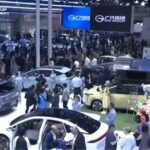
The 2026 (19th) Beijing International Automotive Exhibition will be held from April 24 to May 3 at the China International Exhibition Center (Shunyi Hall) and the Capital International Convention and Exhibition Center in Shunyi District. The total exhibition area reaches 380,000 square meters, bringing together nearly a thousand car companies from 21 countries and regions, and is expected to attract nearly one million visitors. Shunyi District aims to build a “convention-friendly city,” coordinating all regional resources to provide comprehensive service guarantees for the smooth running of the auto show, while promoting the deep integration of exhibitions, automobiles, and consumption to support high-quality regional development.
The 2026 Beijing Auto Show marks the first time the New China International Exhibition Center’s Phase I and Phase II halls are linked, setting a new historical record in scale and breaking the global auto show size record. A total of 1,451 vehicles will be on display, including 181 debut vehicles and 71 concept cars. This auto show reflects the leap in Shunyi District’s exhibition industry capabilities. The China International Exhibition Center (Shunyi Hall) and the Capital International Convention and Exhibition Center together form an exhibition complex with a building area of over 800,000 square meters. The linked halls provide an indoor exhibition area of 310,000 square meters, accounting for over 50% of the city’s total, ranking fifth nationally.
Shunyi District continues to innovate in exhibition industry systems and mechanisms. In March 2026, the Shunyi District Exhibition Bureau was officially established, becoming the only district-level exhibition promotion agency in the city. The New China International Exhibition Center’s Phase I and II have gathered four global top 100 trade fairs: the Beijing Auto Show, Machine Tool Exhibition, Construction Machinery Exhibition, and Printing Exhibition, as well as the national-level China International Supply Chain Expo. The venue’s functions are expanding from single exhibitions to a diverse ecosystem of “conferences, awards, festivals, competitions, performances, business, and tourism.” The Capital International Convention Center has been recognized as a “Global Launch Center – Launch Vitality Center,” becoming a preferred platform for brand launches and trend gatherings.
Using exhibitions as a medium, Shunyi District is transforming exhibition “traffic” into industrial “growth.” Currently, Shunyi has formed an industrial ecosystem centered on four major vehicle manufacturers, supported by seven R&D centers, and coordinated development of over 150 upstream and downstream enterprises. Li Auto, Beijing Hyundai, Mercedes-Benz New Energy, and BAIC Off-Road Vehicles are gathered in Shunyi; seven R&D centers, including BAIC Research Institute and Li Auto’s R&D headquarters, are accelerating innovation; and over a hundred parts suppliers are developing in coordination. During the “14th Five-Year Plan” period, a total of 1.8 million vehicles were produced, with an output value of 370 billion yuan, growing at an average annual rate of 8%; for every three cars produced in Beijing, one is “Made in Shunyi.”
This auto show is not only a product display platform but also a bridge for industrial connections. Hall A3 features a special exhibition area for the Beijing-Tianjin-Hebei Intelligent Connected New Energy Vehicle Technology Ecological Port. Among them, the Ecological Port (Shunyi Park) is located in Lisui Town, Shunyi District, with a planned total area of about 2,500 mu (about 166.7 hectares), focusing on three major fields: automotive electronics, automotive intelligence, and automotive quality. It is laid out with functions for R&D innovation, intelligent production, business services, and living support, building a new industrial ecosystem deeply integrating “R&D-production-testing-living.” As a core supporting facility, the national-level autonomous driving vehicle quality inspection and testing center started construction in April this year and will build a full-chain inspection and testing system. The Phase I R&D service center project of the Ecological Port has already topped out, with a total investment of about 120 million yuan, and will be put into use in June this year. After completion, the Ecological Port will form a “30-minute supporting circle” with the four major vehicle production bases in Shunyi, a “1-hour supporting circle” with other vehicle bases in Beijing, and a “2-to-3-hour supporting circle” connecting with industrial bases in Tianjin and Hebei. Core parts can be ordered, responded to instantly, and delivered on demand within the same day.
Facing the challenge of supporting a million-level visitor flow, Shunyi District has built a comprehensive, three-dimensional service guarantee system with the goals of “safety, order, convenience, and efficiency.”
Transportation support is precise and effective. A three-dimensional travel network has been built, centered on “subway as the main mode, buses as a supplement, shuttle connections, and bicycle extensions.” For rail transit,