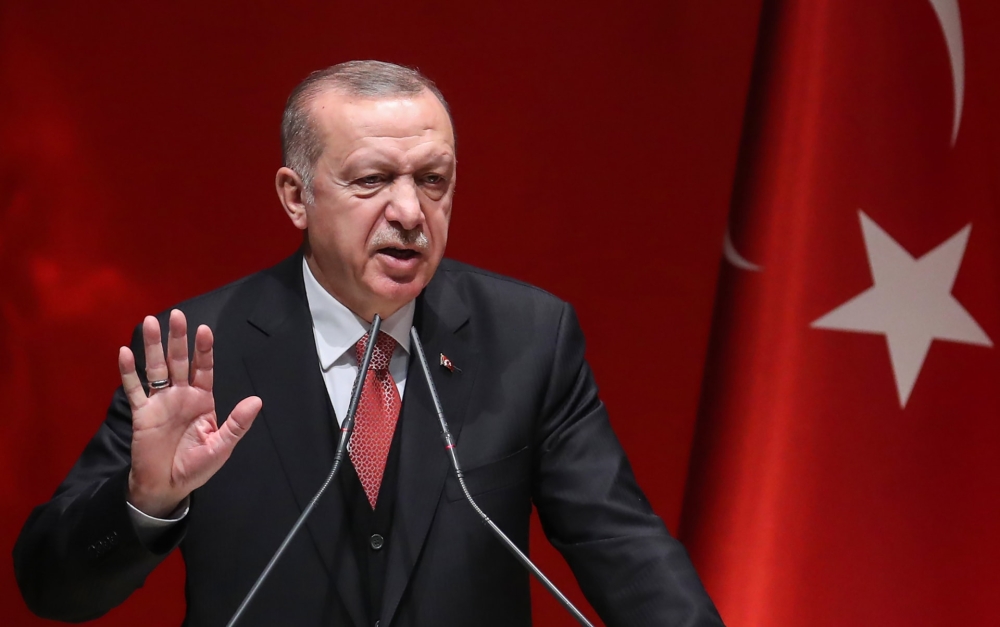
Turkish President Recep Tayyip Erdogan warned that the war in the Middle East has begun to weaken Europe, according to a statement from the Turkish presidency.
During a phone call on Wednesday with his German counterpart Frank-Walter Steinmeier, Erdogan said, “The war in our region has also begun to weaken Europe, and if we do not intervene in this situation with an approach that serves peace, the damage caused by the conflict will be much greater.”
Turkey stands on the side of peace
Earlier on Wednesday, the Turkish president indicated during a meeting with NATO Secretary General Mark Rutte, who was visiting Ankara, that his country stood on the side of peace and diplomacy within the framework of the process sparked by the attacks on Iran.
He said maintaining the transatlantic link is of utmost importance, and that Turkey expects the European component of the alliance to take on more responsibility.
He added that excluding European allies who are not members of the European Union from recent defense initiatives would be counterproductive.
Rutte affirmed that the alliance will always do what is necessary to defend Turkey, a member state that was targeted by four Iranian missiles during the past month.
Middle East
The Middle East is a historically and culturally rich region spanning Western Asia and parts of North Africa, often considered the cradle of civilization. It was home to ancient Mesopotamian empires, the birthplace of major religions like Judaism, Christianity, and Islam, and a crossroads for trade and conflict along the Silk Road. Today, the region is known for its diverse heritage, modern cities, and ongoing geopolitical significance.
Turkey
Turkey is a transcontinental country bridging Europe and Asia, renowned for its rich history as the heart of the Byzantine and Ottoman Empires. Its most famous cultural site, Hagia Sophia in Istanbul, was originally built as a Christian cathedral in 537 AD, later converted into a mosque, and now serves as a museum and mosque, symbolizing the city’s layered heritage. Turkey also boasts other iconic landmarks like the ancient city of Ephesus and the surreal landscapes of Cappadocia, reflecting millennia of civilization.
Germany
Germany is a central European country with a rich and complex history, from its origins as a collection of Germanic tribes and the Holy Roman Empire to its unification in 1871. It played a pivotal role in both World Wars and was divided into East and West during the Cold War before reunifying in 1990. Today, Germany is known for its cultural landmarks, such as the Brandenburg Gate and Neuschwanstein Castle, as well as its contributions to philosophy, music, and science.
Ankara
Ankara, the capital of Turkey, is a historic city with roots dating back to the Phrygian period, around the 8th century BCE. It was later known as Ancyra under Roman rule and became a major trading hub in the Ottoman Empire. In 1923, Mustafa Kemal Atatürk declared it the capital of the newly established Republic of Turkey, transforming it into a modern political and administrative center.
Iran
Iran, historically known as Persia, is a country in West Asia with a rich cultural heritage dating back thousands of years. It was home to ancient empires such as the Achaemenid, Parthian, and Sassanid dynasties, and later became a center of Islamic civilization after the Arab conquest in the 7th century. Today, Iran is known for its stunning architectural sites like Persepolis and Isfahan, as well as its contributions to art, literature, and science.
European Union
The European Union (EU) is a unique political and economic union of 27 European countries, established after World War II to foster peace, stability, and prosperity. Its origins trace back to the 1951 European Coal and Steel Community, evolving through the Treaties of Rome (1957) and Maastricht (1993) to create a single market, common currency (the euro), and shared institutions. Today, the EU promotes cooperation in areas like trade, law, and human rights, while facing ongoing debates about sovereignty and integration.
NATO
NATO, or the North Atlantic Treaty Organization, is a military alliance established in 1949 by 12 founding nations, including the United States, Canada, and several Western European countries, to provide collective defense against the Soviet Union during the Cold War. Its core principle, Article 5, states that an attack on one member is an attack on all, which was first invoked after the 9/11 attacks. Today, NATO has expanded to 31 member countries and continues to focus on collective security, crisis management, and cooperative security.
Europe
Europe is a continent with a rich and complex history, shaped by ancient civilizations like Greece and Rome, the Middle Ages, and the Renaissance. It has been the birthplace of major political and cultural movements, including the Enlightenment and the Industrial Revolution. Today, Europe is known for its diverse cultures, historic landmarks, and the European Union, which promotes economic and political cooperation among many of its nations.