Two “Emerald Necklaces” Adorn Springtime Beijing
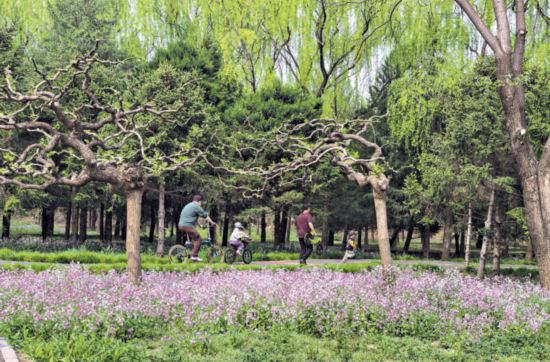
Families with children cycle and play at Dongba Park.
Yesterday marked the 57th World Earth Day. With bright spring sunshine, Beijing’s green buffer zones displayed beautiful scenery. According to relevant authorities, the urban park ring in the first green buffer zone has been completed, with 119 parks in total. The main framework of the郊野 park ring in the second green buffer zone has taken shape, with 54郊野 parks built. The vision of “building the capital into a big garden” is gradually becoming a reality.
Forests Embrace Parks: Green Buffer Zones Thrive
“We’re cycling at Dongba Park again!” Over the weekend, a family of three drove over ten kilometers from Dongcheng District to Dongba Park, located between the East Fifth Ring Road and the Airport Second Expressway. They took out their child’s bicycle from the trunk, and the parents each rented a shared bike, starting a lively family cycling trip. February orchids, crabapple blossoms, peach flowers, and pear blooms… branches that had lain dormant all winter awakened in the spring sunshine, flower buds unfolding one after another, with pink and purple hues creating a vibrant scene.
Including Dongba Park, parks in the green buffer zones have become great weekend destinations for citizens. The green buffer zones were originally planned as ecological barriers to curb urban sprawl and provide leisure spaces. The first green buffer zone covers 310 square kilometers, mainly between the Fourth and Fifth Ring Roads. The second green buffer zone spans 910 square kilometers, mainly between the Fifth and Sixth Ring Roads.
Wenyuhe Park, Olympic Forest Park, Nanyuan Forest Wetland Park, and Haidian Park are all well-known parks within the green buffer zones. “After pilot exploration and large-scale afforestation, green buffer construction has entered a new phase of quality improvement and green expansion.” During the “14th Five-Year Plan” period, significant progress was made: the urban park ring in the first green buffer zone was completed, and the main framework of the郊野 park ring in the second green buffer zone took shape.
Data from the Municipal Forestry and Parks Bureau shows that in recent years, the green buffer zones have added approximately 217 square kilometers of new afforestation. The forest coverage rate in the first green buffer zone has reached 32.58%, and in the second green buffer zone, 39.42%, both significantly higher than the plain area average. During the “15th Five-Year Plan” period, the city will add 30 new green buffer parks and 800 kilometers of urban greenways.
Harmonious Coexistence: Rare Animals Reappear
Located at the junction of Chaoyang, Shunyi, and Changping districts, Wenyuhe Park covers about 30 square kilometers and is Beijing’s largest “urban lung.” The Chaoyang demonstration area opened in 2020; Phase I of the Chaoyang section gradually opened in 2022; and in 2025, Phase II of the Chaoyang section opened areas such as Terrace Joy, Forest Stream and Flower Shadows, and Pastoral Song, offering visitors more outdoor leisure spots.
Wenyuhe Park has become a vivid example of urban ecological restoration. According to the “Beijing Wenyuhe Park Biodiversity Development White Paper (2025),” the park hosts a total of 880 species of plants and animals. National protected animals such as the Chinese merganser and Oriental white stork frequently visit, while black swans and mallards have settled here. Across the entire green buffer zone, over 2,200 species have been recorded, with many rare animals reappearing, making it a biodiversity treasure trove.
Large-scale greening supports the city’s green spatial structure, serving as an important ecological barrier for the capital’s plain areas. During the “14th Five-Year Plan” period, the green buffer zones mitigated the “heat island effect.” The average temperature in the first green buffer zone is 0.9°C lower than surrounding areas, and in the second green buffer zone, it is 1.2°C lower.
Close to Nature: A Vibrant Recreation Area for Citizens
As one of the important郊野 parks in the green buffer zones, Laoshan Park began construction as early as 2008. It has quietly transformed from a former “Olympic venue” into a “urban forest living room” for citizens to get close to nature. Entering the “Mountain Park” café, the scent of a