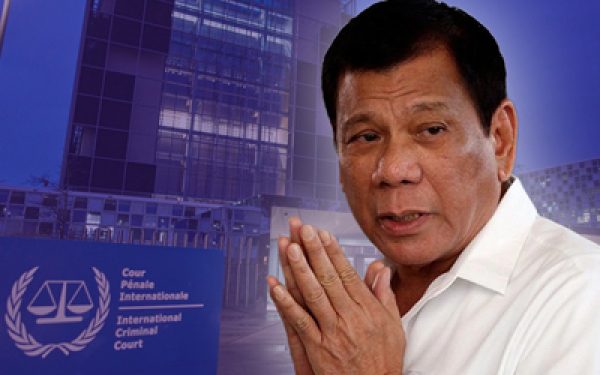
The International Criminal Court (ICC) affirmed its jurisdiction over the crimes against humanity case against former President Rodrigo “Digong” Duterte after the Appeals Chamber dismissed the petition to halt the proceedings.
Due to the decision, the petition to return Duterte to the Philippines is now moot, as he will remain in his detention facility for the possible start of his trial.
The Appeals Chamber rejected all four grounds of the petition filed by Duterte’s camp.
The Appeals Chamber explained that although the Philippines withdrew from the Rome Statute in March 2019, the preliminary examinations into the situation in the Philippines began in February 2018, or one year before the Duterte administration sent a notice to withdraw from the treaty.
The Appeals Chamber dismissed the defense’s position that the Pre-Trial Chamber erred in issuing a ruling that the ICC had jurisdiction over Duterte’s case.
The Appeals Chamber released its decision just days before the Pre-Trial Chamber I is set to announce its ruling on whether to proceed with a full trial.
Duterte was charged with three counts of crimes against humanity for the bloody war on drugs during his presidency in the Philippines.
He was arrested at Ninoy Aquino International Airport (NAIA) in March 2025 upon landing from a flight from Hong Kong. He was immediately transported to The Hague, Netherlands, where he was detained.
Duterte did not attend the confirmation of charges hearing nor the release of the Appeals Chamber decision on Wednesday.
Lawyers Joel Butuyan and Gilbert Andres had earlier stated that the Appeals Chamber would side with the position of Duterte’s victims.
International Criminal Court (ICC)
The International Criminal Court (ICC) is a permanent tribunal located in The Hague, Netherlands, established to prosecute individuals for genocide, crimes against humanity, war crimes, and the crime of aggression. It was created by the Rome Statute, which came into force on July 1, 2002, marking a significant step in international justice after the ad hoc tribunals for the former Yugoslavia and Rwanda. The ICC serves as a court of last resort, intervening only when national courts are unwilling or unable to handle such cases.
Rome Statute
The Rome Statute is the treaty that established the International Criminal Court (ICC), adopted on July 17, 1998, in Rome, Italy. It created the first permanent international court with jurisdiction to prosecute individuals for genocide, crimes against humanity, war crimes, and the crime of aggression. The statute entered into force on July 1, 2002, after being ratified by 60 countries, and now has over 120 member states.
Ninoy Aquino International Airport (NAIA)
Ninoy Aquino International Airport (NAIA) is the primary airport serving Metro Manila, Philippines. Originally opened in 1948 as Manila International Airport, it was renamed in 1987 to honor Benigno “Ninoy” Aquino Jr., a prominent opposition senator who was assassinated at the airport in 1983. Today, NAIA consists of four terminals and serves as a major hub for both domestic and international travel, though it is often noted for congestion and ongoing modernization efforts.
The Hague
The Hague, located in the Netherlands, is the country’s seat of government and home to the Dutch royal family, though Amsterdam is the official capital. Historically, it gained prominence in the 13th century as a hunting lodge for counts of Holland and later became a center for international diplomacy. Today, it is known as the “International City of Peace and Justice,” hosting institutions like the International Court of Justice and the International Criminal Court.
Netherlands
The Netherlands is a low-lying country in Western Europe known for its flat landscape, canals, tulip fields, windmills, and cycling routes. Historically, it was a major maritime power during the Dutch Golden Age in the 17th century, establishing global trade networks and influencing art and science. Today, it is a constitutional monarchy with a rich cultural heritage, famous for its liberal policies and vibrant cities like Amsterdam, Rotterdam, and The Hague.