Iran Declares It Will Not Reopen the Strait of Hormuz if the US Maintains a Blockade
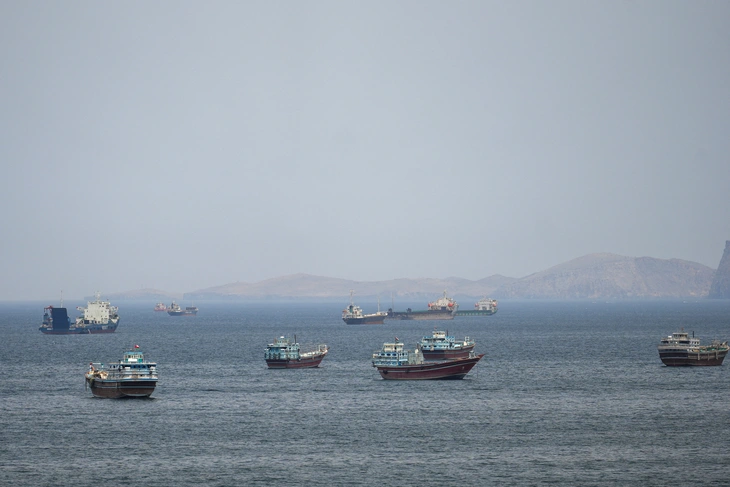
According to AFP, on April 22, Iran declared it will not reopen the Strait of Hormuz as long as the US naval blockade of Iranian ports continues, calling it a “blatant violation” of the ceasefire agreement between the two countries.
Meanwhile, Iran’s Islamic Revolutionary Guard Corps (IRGC) stated that its naval forces have seized two container ships attempting to pass through this strategic strait.
Iranian Foreign Ministry spokesman Esmaeil Baqaei said Tehran appreciates Pakistan’s efforts to end the war in the Middle East but did not comment on extending the ceasefire as announced by the US.
On April 21, US President Donald Trump said he extended the ceasefire following a request from Pakistani mediators and to allow more time for peace negotiations.
“A ceasefire is completely meaningless if it is violated through a naval blockade,” said Iranian Parliament Speaker Mohammad Bagher Ghalibaf on April 22.
He emphasized: “Reopening the Strait of Hormuz is impossible in the context of such a blatant violation of the ceasefire.”
Despite new attacks targeting shipping in the Gulf region, a second round of negotiations between the US and Iran could take place within the next three days, according to sources cited by the New York Post.
Reuters: US Blocks Iranian Oil Tankers in Asian Waters
On April 22, Reuters cited shipping and security sources revealing that US forces have intercepted at least three Iranian-flagged oil tankers in Asian waters and diverted them away from positions near India, Malaysia, and Sri Lanka.
In recent days, US forces have seized one cargo ship and one Iranian oil tanker. Meanwhile, on April 22, Iran said it had seized two container ships trying to pass through the Strait of Hormuz, after opening fire on these vessels and another one—the first seizures since the conflict began.
According to sources speaking to Reuters on April 22, the US has diverted at least three other Iranian-flagged oil tankers in recent days.
One of the targeted vessels is the Iranian-flagged supertanker Deep Sea, carrying some crude oil. According to sources and ship tracking data from MarineTraffic, this vessel was last recorded via public transponder off the coast of Malaysia a week ago.
A smaller Iranian-flagged tanker named Sevin was last
Strait of Hormuz
The Strait of Hormuz is a narrow waterway connecting the Persian Gulf to the Gulf of Oman, making it a strategically vital passage for global oil shipments. Historically, it has been a key trade route for centuries, controlled by various empires including the Portuguese, who seized the island of Hormuz in the 16th century. Today, it remains a focal point of geopolitical tension, particularly between Iran and other nations.
Iran
Iran, historically known as Persia, is a country in Western Asia with a rich cultural heritage spanning over 5,000 years. It was the center of the ancient Persian Empire, known for its monumental sites like Persepolis, and later became a major hub of Islamic civilization after the Arab conquest in the 7th century. Today, Iran is renowned for its Persian art, poetry, architecture, and traditions, including the UNESCO-listed sites of Isfahan’s Naqsh-e Jahan Square and the ruins of Persepolis.
Oman
Oman is a country on the southeastern coast of the Arabian Peninsula, known for its rich maritime history and ancient trade routes. Historically, it was a powerful seafaring nation with an empire that stretched across East Africa and the Indian Ocean, with Muscat serving as a key trading hub. Today, Oman blends its heritage of forts, souks, and traditional architecture with modern development, offering a unique cultural landscape.
Musandam
Musandam is a ruggedly beautiful peninsula in Oman, often called the “Norway of Arabia” for its dramatic fjords and mountainous coastline. Historically, it served as a vital strategic point for maritime trade and was part of the Portuguese empire before coming under Omani control in the 17th century. Today, it is renowned for its stunning dhow cruises, dolphin sightings, and the unique culture of its Shihuh people.
United States
The United States is a vast, diverse nation in North America, founded on July 4, 1776, with the Declaration of Independence from Great Britain. Its history is marked by rapid expansion westward, the Civil War over slavery, and its rise as a global superpower in the 20th century. Today, it is known for its cultural influence, economic power, and iconic landmarks like the Statue of Liberty and the Grand Canyon.
Pakistan
Pakistan is a South Asian country with a rich history that includes the ancient Indus Valley Civilization, one of the world’s earliest urban cultures. It became an independent nation in 1947 following the partition of British India, established as a homeland for Muslims in the region. The country is known for its diverse cultural heritage, including Islamic, Persian, and Central Asian influences, as well as landmarks like the Badshahi Mosque and the ancient city of Mohenjo-daro.
Middle East
The Middle East is a historically significant region that served as the cradle of civilization, with ancient Mesopotamia (modern-day Iraq) giving rise to early writing, law, and urban societies. It is the birthplace of three major religions—Judaism, Christianity, and Islam—and has been a crossroads for trade, culture, and conflict for millennia. Today, the region remains geopolitically complex, known for its rich cultural heritage, vast oil reserves, and ongoing struggles between tradition and modernity.
India
India is a vast South Asian nation known for its rich cultural heritage and ancient history, with civilizations dating back over 5,000 years to the Indus Valley. It has been home to major religions like Hinduism, Buddhism, Jainism, and Sikhism, and was shaped by various empires, including the Maurya, Gupta, and Mughal dynasties, before becoming a British colony. India gained independence in 1947 and is now the world’s most populous democracy, celebrated for its diverse languages, festivals, and landmarks like the Taj Mahal.