Robot vacuums no longer just want to clean the floors at home, but are trying to grow hands and feet.
On April 22, multiple robot vacuum companies released new products in the first quarter. Unlike before, many robot vacuums have started to feature “hands” and “feet,” including wheeled feet, bionic mechanical feet, robotic arms, grippers, and even flight modules.
According to product descriptions, the new functions range from “sweeping the floor clean” to helping users pick up socks, organize shoe cabinets, and find pets.
With iRobot falling behind, China’s “Five Tigers” of robot vacuums—Stone Technology, Ecovacs, Dreame, Xiaomi, and Narwal—have taken over the majority of the global robot vacuum market.
New business stories continue to unfold. No longer just sweeping floors means this category is trying to evolve into an all-around household butler.
But is this showing off skills or practical use? It still awaits market testing.
Collective “Spec Stacking”?
Technical parameters have always been a battleground in the consumer electronics industry.
With supply chain advantages, robot vacuums are rapidly iterating, and technical parameters are quickly “upgrading.”
For example, the suction power of robot vacuums has surged from around 2000–3000Pa in 2019 to 30,000–35,000Pa by 2026. Mopping technology has also evolved from vibrating mopping to dual-disc rotation, high-frequency vibration (over 4000 times per minute), and even 100°C boiling water immersion cleaning and steam mopping.
With the arrival of the AI era, robot vacuums have been equipped with AI recognition technology.
Robot vacuums have progressed from initial collision-based navigation and infrared recognition to today’s LiDAR and visual perception systems. To shed the label of needing human “maintenance,” various “self-cleaning technologies” have emerged: automatic dust collection, automatic drying, automatic water filling and draining, automatic water replacement, automatic cleaning solution addition, automatic sterilization… From simple charging to all-in-one base stations.
After continuously refreshing parameters and functions, robot vacuums have started to “grow limbs.”
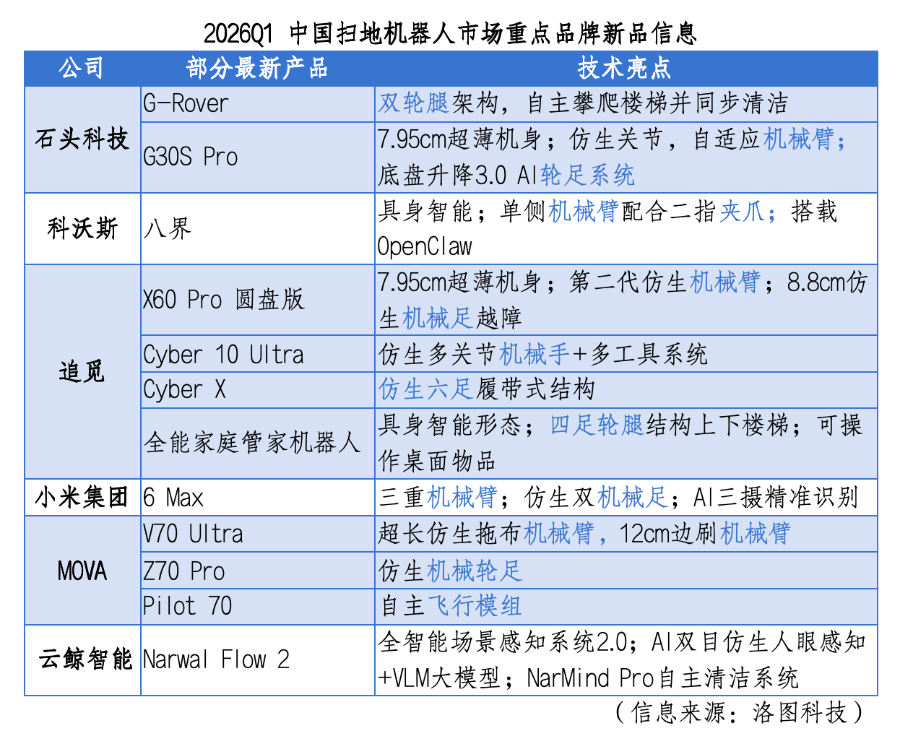
At the CES exhibition in January, Stone Technology released its first wheeled-foot robot vacuum, the G-Rover, which can autonomously climb stairs and simultaneously clean steps, expanding the product’s spatial coverage. The G30S features the first 5-axis folding bionic robotic arm, capable of grabbing socks and obstacles on the floor by itself.
Dreame launched the stair-climbing model CyberX, while also showcasing the Cyber10Ultra equipped with a robotic arm.
These are not isolated cases. Just in April, Roto Technology compiled new product information for China’s robot vacuum market in the first quarter of 2026. It is clear that China’s robot vacuum market has entered an era where robotic arms and mechanical feet have become “standard.”
Among the top five brands by market share, except for Narwal, all other brands’ new products feature robotic arm or mechanical foot structures.
The design purpose of robotic arms is to grab objects along the way and cover cleaning死角; the design purpose of wheeled feet is focused on overcoming obstacles, such as climbing stairs, to expand the cleaning range.
Even DJI, which entered the market last year, equipped its first robot vacuum, the ROMO, with a robotic arm. According to introductions, the robotic arm is usually hidden at the bottom of the body and intelligently extends based on local real-time maps and flexible fitting algorithms to clean edges of irregular furniture, table and chair legs, and under cabinets.
The most impressive is MOVA, an independent brand under Dreame—it plans to make robot vacuums “fly.”
In addition to participating in the industry’s collective evolution of robotic arms and mechanical wheeled feet, MOVA has introduced the Pilot 70, which comes with its own drone. It features a flight control system, perception system, and six-layer active protection design, and can coordinate cleaning paths and flight paths through AI. That is, when encountering extremely complex terrain, it can take off directly to achieve multi-floor three-dimensional cleaning.
Growing hands and feet easily reminds readers of the smartphone and new energy vehicle markets, which attract industry attention by stacking hardware parameters.
In the past few years