Week to celebrate Vietnam Book and Reading Culture Day 2026 opens.
On April 21, in Hanoi, the Social Sciences Publishing House and Journal, the Institute of Social Science Information, and the Youth Union of the Vietnam Academy of Social Sciences opened the Week to respond to Vietnam Book Day 2026.
Attending were members of the Party Central Committee: Pham Tat Thang, Deputy Permanent Head of the Central Propaganda and Mass Mobilization Commission; Professor, Dr. Le Van Loi, Secretary of the Party Committee, President of the Vietnam Academy of Social Sciences.
Unlike traditional exhibition activities, the 2026 Week was designed in a unified thread, creating a chain of value: “Knowledge-Information-Policy”. The core goal of the program is to gradually turn social sciences and humanities knowledge into a direct resource serving the leadership, direction, and policy formulation of the Party and State.
President of the Vietnam Academy of Social Sciences Le Van Loi delivers the opening speech.
Speaking at the opening ceremony, President of the Vietnam Academy of Social Sciences Le Van Loi emphasized that the Week to respond to Vietnam Book and Reading Culture Day 2026 is held from April 21 to 24 at the Vietnam Academy of Social Sciences, with a spirit of innovation, practicality, and close connection to the political tasks of the Academy, especially after its model transition to a unit under the Party Central Committee’s Executive Committee from April 1, 2026.
Le Van Loi stated that the opening ceremony was organized with three key contents, closely interconnected to form a unified thread from knowledge to policy and practice.
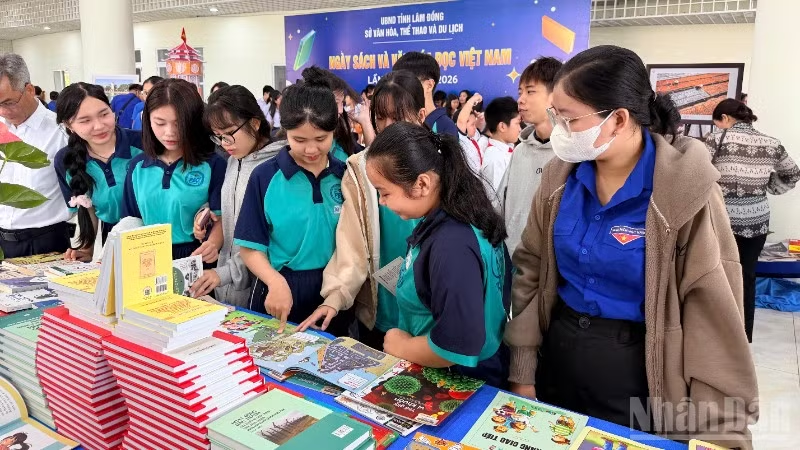
First is the exhibition space for books and materials on culture in the spirit of Resolution 80-NQ/TW. This activity aims to introduce valuable source materials, selected according to a clear orientation. This helps readers systematically access issues of Vietnamese culture, from traditional to modern. This is the initial step in the process of receiving and forming knowledge.
Delegates visit the exhibition space for books and materials on culture.
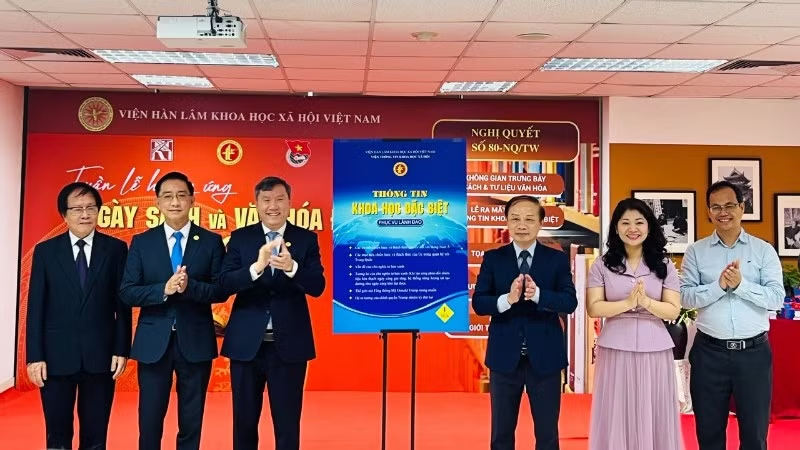
Second is the launch ceremony of the publication “Special Scientific Information for Leaders”. This is a selective information product, built on the basis of processing official social science data sources abroad. The publication aims to directly serve leadership, direction, and strategic and policy formulation. This affirms the role of the Institute of Social Science Information in providing scientific arguments for major decisions of the Party and State.
The exhibition space introduces many valuable books and materials on history, society, ethnology, literature, arts, beliefs, and religion.
Third is organizing a scientific seminar on the theme: “Opportunities and Challenges in the Process of Implementing Resolution 80-NQ/TW on Developing Vietnamese Culture to 2030, with a Vision to 2045”. This is a forum for exchange among management agencies, scientists, and businesses to clearly identify issues arising in implementation practice. From there, feasible solutions are proposed to help put the Resolution into practice.
“These three contents are linked together in a unified direction. From accessing knowledge, to processing information, and finally to policy dialogue. This is also the operational direction that the Academy’s library system should aim for in the new period,” the President of the Vietnam Academy of Social Sciences emphasized.
Introducing the publication “Special Scientific Information for Leaders”, Associate Professor, Dr. Vu Hung Cuong, Director of the Institute of Social Science Information, said that to date, the Institute has completed the first three issues from January to March 2026, each issue containing six translated articles along three thematic lines.
Director of the Institute of Social Science Information Vu Hung Cuong introduces the publication “Special Scientific Information for Leaders”.
The first thematic line is international relations: Australia’s strategy towards Southeast Asia, in relations with China; balancing US-China institutions in the Indo-Pacific region; Japan’s policy towards Taiwan; global energy supply; energy weapons.
The second thematic line concerns socio-economic issues: green capitalism; new productive forces; new growth strategy; global social capital; global populism.
The third thematic line is research on a chosen major power: the
Hanoi
Hanoi, the capital of Vietnam, is one of the oldest cities in Southeast Asia, with a history dating back over a thousand years. It served as the imperial capital of the Ly dynasty in 1010 and later became the administrative center of French Indochina, which left a lasting architectural legacy. Today, Hanoi is known for its blend of ancient temples, colonial buildings, and vibrant modern culture, including landmarks like the Hoan Kiem Lake and the Old Quarter.
Vietnam Academy of Social Sciences
The Vietnam Academy of Social Sciences (VASS) is a leading national research institution in Hanoi, established in 1953. It serves as the primary government think tank for social sciences and humanities, conducting policy-oriented research on Vietnam’s history, culture, economy, and society. Originally founded as the Vietnam Institute of Social Sciences, it has played a key role in shaping the country’s academic and policy frameworks since the mid-20th century.
Institute of Social Science Information
The Institute of Scientific Information on Social Sciences (INION) in Moscow is a major Russian research library and information center specializing in the social sciences and humanities. Founded in 1969, it was established to collect, analyze, and disseminate scholarly information, and it holds one of the largest collections of social science literature in the country, including rare books and periodicals. The institute is also known for its unique library building, but suffered a devastating fire in 2015 that damaged a significant portion of its collection.
Social Sciences Publishing House and Journal
The Social Sciences Publishing House and Journal is a key institution in Vietnam dedicated to the dissemination of academic research in the social sciences. Established under the Vietnam Academy of Social Sciences, it has a history of publishing influential scholarly works and journals that contribute to the country’s intellectual development. The institution plays a vital role in promoting social science knowledge and fostering academic discourse within Vietnam and internationally.
Vietnam Book and Reading Culture Day
Vietnam Book and Reading Culture Day is an annual event celebrated on April 21st, established in 2014 to promote reading habits and the value of books in Vietnamese society. The day honors the importance of literature and knowledge, with activities like book fairs, reading competitions, and discussions held nationwide. Its origins trace back to Vietnam’s long literary tradition and efforts to boost cultural development in the modern era.
Resolution 80-NQ/TW
Resolution 80-NQ/TW is a significant policy resolution issued by the Central Committee of the Communist Party of Vietnam, focusing on promoting the development of Vietnam’s marine economy and strengthening national defense and security in coastal and island regions. Adopted in 2012, it outlines strategies for sustainable use of marine resources, protection of maritime sovereignty, and improvement of local livelihoods. This resolution has guided Vietnam’s long-term planning for its maritime sector, emphasizing the integration of economic growth with environmental preservation and national security.
Indo-Pacific region
The Indo-Pacific region is a vast geopolitical and geographical area encompassing the Indian Ocean, the Pacific Ocean, and the coastal nations connected by these waters. Historically, it has been a crucial hub for ancient maritime trade routes, linking civilizations from East Africa and the Middle East to South Asia, Southeast Asia, and East Asia. Today, the region is recognized for its strategic importance, economic dynamism, and diverse cultural heritage, shaped by centuries of exchange and interaction.
China
China is a vast and ancient civilization with a recorded history spanning over 3,500 years, home to iconic cultural sites such as the Great Wall, the Forbidden City, and the Terracotta Army. As one of the world’s oldest continuous civilizations, it has seen the rise and fall of numerous dynasties, from the Qin to the Qing, each leaving a profound impact on its culture, philosophy, and governance. Today, China blends its rich historical heritage with rapid modernization, making it a unique and influential global power.



![[Infographic] Quy mô kỳ thi tuyển sinh vào lớp 10 năm học 2026-2027 của Hà Nội](https://asiacity.news/wp-content/uploads/2026/05/1-150x150.jpg)