Editor’s Note: The concept of political performance is a concentrated reflection of one’s worldview, outlook on life, and values in governance. As the Party launches a study and education campaign to establish and practice a correct view of political performance, CCTV.com’s “Xi’s Words of Wisdom” series presents a special report. Focusing on General Secretary Xi Jinping’s important discussions on establishing and practicing a correct view of political performance, we explore the rich connotations and practical requirements of this concept.
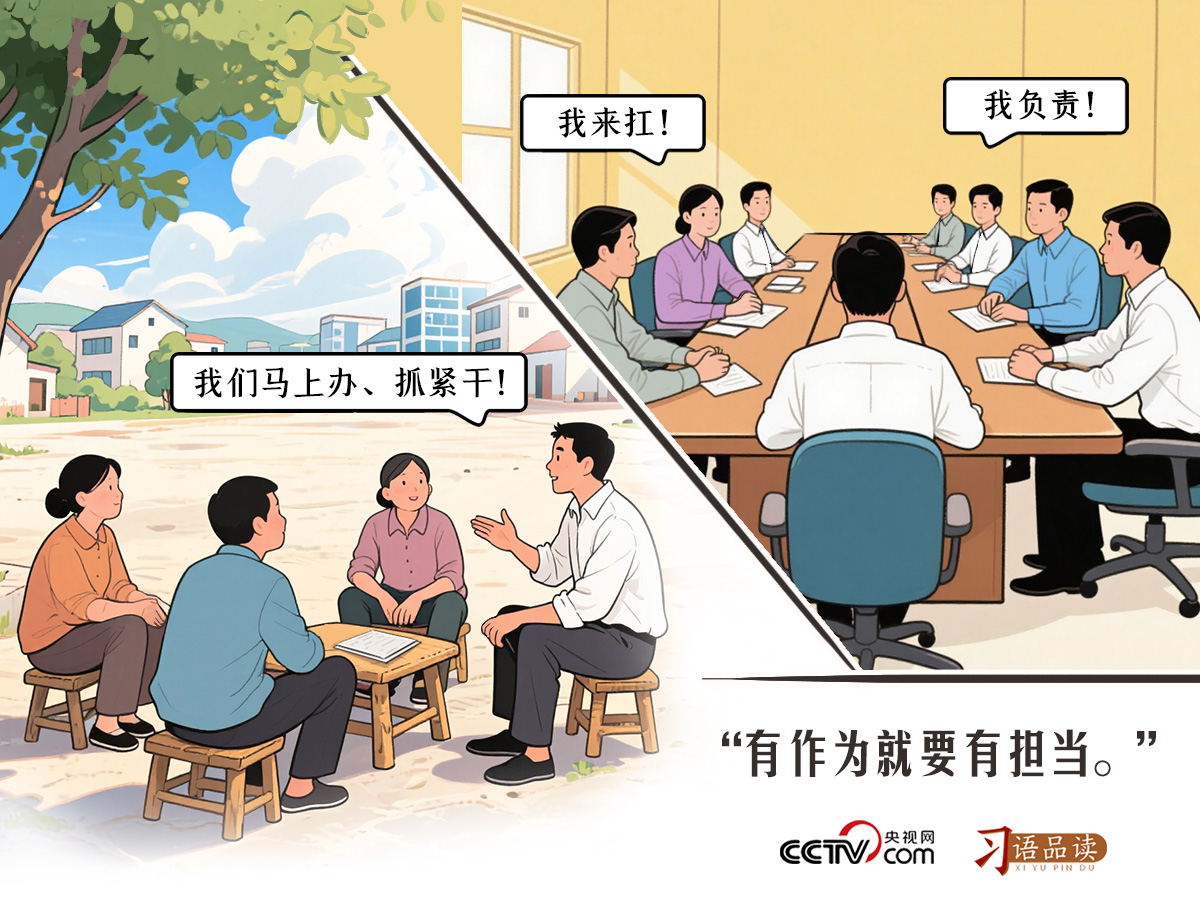
“Serve the people and take on the responsibilities that should be shouldered.”
Xi Jinping once used this sentence to summarize his governance philosophy, with the word “take on” appearing twice in just 14 characters. He not only demands this of himself but also requires Party members and officials to have a sense of responsibility, stating bluntly, “Taking on responsibilities and achieving results are one and the same. Not achieving results means not taking on responsibilities, and to achieve results, one must take on responsibilities.”
From a dialectical perspective, “taking on responsibilities” is an internalized active awareness, while “achieving results” is the externalized concrete practice. The two complement each other and are inseparable.
“To achieve results, one must take on responsibilities” not only clarifies the dialectical relationship between “taking on responsibilities” and “achieving results” but also explains the indivisible nature of a sense of responsibility and the ability to perform duties. This provides ideological guidance and a blueprint for action for Party members and officials to work hard and realize their life values.
Shirking responsibilities out of fear for one’s official position is a lifelong disgrace. The word “take on” carries great weight in Xi Jinping’s heart.
During his work in Zhengding, Hebei, Xi Jinping learned through research that due to the heavy burden of grain procurement tasks, some local farmers did not have enough food to eat and had to secretly go to other counties to exchange for dried sweet potatoes. He resisted pressure and insisted on reporting the issue to higher authorities, saying, “Better to give up the title of ‘National High-Yield County’ than to let the people live a better life.”
After several efforts, Zhengding’s grain procurement task was reduced by 28 million jin, a reduction of 36.8%. This reduction allowed local farmers to have white flour steamed buns on their tables, and the per capita annual income of farmers rose from 148 yuan to over 400 yuan.
For officials to dare to take on responsibilities and achieve results is both a political character and a fundamental duty of governance.
What does it mean to take on responsibilities and achieve results? Xi Jinping gave a clear answer: Dare to take a stand on major issues of principle, dare to face difficulties head-on in the face of contradictions, dare to step forward in times of crisis, dare to take responsibility for mistakes, and dare to resolutely fight against unhealthy tendencies and evil practices.
He believes that the greater the responsibility one takes on, the greater the career one can achieve. “Not taking on responsibilities and not achieving results not only leads to failure but is bound to ruin things and delay major matters.”
While serving as Governor of Fujian Province, Xi Jinping was the first in the country to push for the implementation of a collective forest tenure reform. This reform is also known as “another great revolution in rural China after the household contract responsibility system.”
At that time, carrying out collective forest tenure reform carried political risks. Many years later, Xi Jinping recalled during a conversation with young and middle-aged officials, “After much deliberation, I believed that the forest tenure reform concerns the vital interests of the people. If this issue is not resolved, conflicts will eventually erupt. It is better to resolve it sooner rather than later.” Huang Jianxing, then Director of the Fujian Provincial Forestry Department who participated in the reform, also said that Xi Jinping dared to take this risk “entirely out of the political mission and sentiment that ‘the people’s interests are above all else.'”
Throughout his journey, Xi Jinping has profoundly demonstrated what it means to take on responsibilities and achieve results.
Within less than 20 days of becoming General Secretary of the Communist Party of China Central Committee, he presided over the formulation of the Eight-Point Regulation to tackle deep-rooted problems in officialdom, such as公款吃喝 (public funds used for dining) and extravagance. This measure has been upheld and continuously improved, earning praise from domestic and international public opinion, with many saying “the Eight