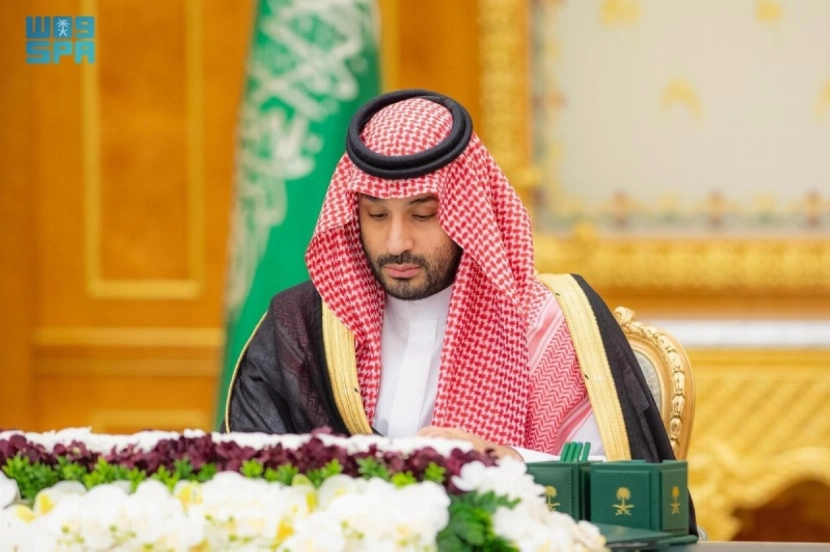
The Cabinet: The “Economic Cooperation Framework” agreement with Pakistan confirms the commitment to building a sustainable partnership.
The Cabinet, chaired by the Crown Prince and Prime Minister, approved amendments to some articles of the system governing service providers for pilgrims from abroad. The Council also expressed its gratitude to the leaders and heads of government of brotherly and friendly countries for their participation in the Future Investment Initiative conference, looking forward to its contribution in translating visions into practical strategies that propel international joint action towards all efforts serving development and prosperity worldwide.
Following that, the Cabinet reviewed the contents of talks held between the Kingdom and a number of countries worldwide; to expand frameworks for mutual bilateral cooperation in various fields in a way that achieves common interests and enhances coordination on global issues and challenges.
The Cabinet affirmed that the agreement between the Kingdom and Pakistan to launch an “Economic Cooperation Framework” extends the two countries’ pursuit of strengthening fraternal ties, confirming their shared vision towards building a sustainable partnership in various economic, commercial, and investment fields; fulfilling the aspirations of the two brotherly peoples and serving their common interests.
Condemnation of the Knesset’s Approval to Impose Sovereignty over the West Bank
Following the session, it was clarified that the Cabinet followed developments in the regional and international situation and the international efforts being made in this regard. It renewed its strongest condemnation of the Israeli Knesset’s approval of two draft laws aimed at imposing sovereignty over the West Bank and illegal colonial settlements, and affirmed support for the legitimate and historical right of the brotherly Palestinian people to establish their independent state on the 1967 borders with East Jerusalem as its capital.
The Council expressed the Kingdom of Saudi Arabia’s support for diplomatic efforts aimed at resolving conflicts through peaceful means and establishing international security and peace. In this context, it welcomed the ceasefire agreement between the Kingdoms of Thailand and Cambodia; as a prelude to a sustainable peace that fulfills the aspirations of the two countries and their peoples.
Support for International Trade and Logistic Connectivity
The Cabinet discussed developments in partnerships with international organizations, considering in this regard the Kingdom’s hosting of the UNCTAD Global Supply Chain Forum next year 2026; as confirmation of its global standing in supporting international trade, enhancing cooperation between countries, and connecting them logistically.
The Council praised the success of the Global Health Forum held in Riyadh, which witnessed the announcement of initiatives and investments amounting to approximately 124 billion riyals; which will contribute to enhancing the Kingdom’s leadership in medical and healthcare fields, localizing technologies, and supporting innovations in line with national targets.
Acknowledging the Launch of Renewable Energy Projects
On domestic affairs, the Cabinet reviewed a number of economic indicators and statistics; including the continued growth of non-oil exports as the national economy progresses in diversifying its pathways supporting various key and promising sectors and activities.
The Council acknowledged the launch of new renewable energy projects in various regions of the Kingdom with a total capacity of 4500 megawatts and investments exceeding 9 billion riyals; which will have an impact on reaching the optimal energy mix for electricity production by 2030, and enhancing global leadership in this field.
Decisions
The Cabinet reviewed the items on its agenda, including items studied jointly with the Shura Council. It also reviewed the conclusions reached by the Council of Political and Security Affairs, the Council of Economic and Development Affairs, the General Committee of the Council of Ministers, and the Experts Authority of the Council of Ministers regarding them. The Council concluded with the following:
– Authorizing the Chairman of the Board of the Nuclear and Radiological Regulatory Commission – or his delegate – to discuss with the Jordanian side regarding a draft Memorandum of Understanding between the Nuclear and Radiological Regulatory Commission in the Kingdom of Saudi Arabia and the Energy and Minerals Regulatory Commission in the Hashemite Kingdom of Jordan for cooperation in the field of nuclear safety and security and radiation protection, and to sign it.
– Approving the accession of the Kingdom of Saudi Arabia to the Donor Advisory Group of the International Federation of Red Cross and Red Crescent Societies (with full membership).
– Authorizing the Minister of Environment, Water and Agriculture – or his delegate – to discuss with the Indian side regarding a draft Memorandum of Understanding between the Ministry of Environment, Water and Agriculture in the Kingdom of Saudi Arabia and the Ministry of Agriculture and Farmers’ Welfare in the Republic of India in the field of commercial and technical exchange for the palm and dates sector, and to sign it.
<div class="my-4 p