Leaders of the Ministry of Industry and Trade, PVOIL, and Petrolimex have personally used E10 gasoline, confirming no recorded impact on engines.
On April 16, a seminar titled “Biofuel E10 – Harmonious Benefits for the People, the State, and Businesses” was held. According to the draft circular amending regulations on the nationwide roadmap for applying blending ratios, developed by the Ministry of Industry and Trade, the time for using biofuel will be adjusted to start from April 30, which is one month earlier than the old roadmap.
Implementing the roadmap from April 30?
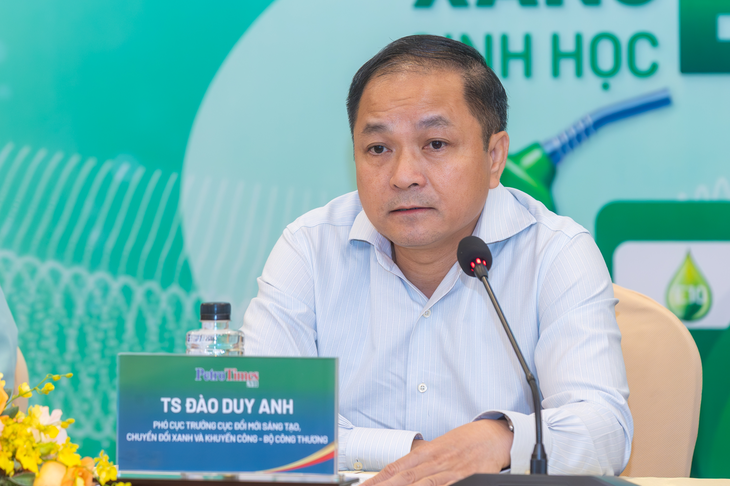
According to the Deputy Director General of the Department of Innovation, Green Transformation, and Industrial Promotion, based on the Prime Minister’s directive to accelerate the roadmap for introducing biofuels in April, the ministry has reviewed technical, economic aspects, supply conditions, blending capacity, and business readiness.
Accordingly, for the immediate future, major enterprises such as Petrolimex and PVOIL, which account for up to 75% of Vietnam’s petroleum market share, are ready to implement widespread distribution of E10 gasoline within April.
As of April 16, PVOIL announced that 418 out of 988 gas stations nationwide are distributing E10 gasoline, while Petrolimex is distributing in Ho Chi Minh City and Quang Ngai and will expand to Quang Ninh and Hai Phong.
However, to accelerate the roadmap, it is believed necessary to enhance the blending capacity of enterprises. Currently, 12 enterprises have invested in blending systems, and 3 enterprises meet the conditions to be licensed for blending. Along with that is the immediate removal of some technical regulations to allow businesses to transition immediately.
It was also stated that E10 gasoline is a starting point; the Ministry of Industry and Trade will not stop at E10 but will proceed to E15, E20, or higher.
Countries with advanced industries like the United States have been using E10 gasoline since the 1980s and are now using E85. The Philippines and Thailand are currently widely using E15, and from 2026, they will increase to E20.
Vietnam is behind these countries, but the transition needs a roadmap to create social consensus.
From practical implementation, the Deputy General Director of Vietnam Oil and Gas Group (PVOIL) said that with over 300 stores distributing biofuel, the consumption volume of E10 from early August 2025 to now has shown a clear upward trend. Especially in the context of market tensions such as in March and April, sales volume continued to improve.
Notably, throughout the implementation process from August 2025 to now, it was said that not only PVOIL but also other major distributors, including Petrolimex, have almost recorded no feedback related to the quality of using E10 gasoline. This shows that the product, when introduced to the market, has met quality requirements.
Changing consumption habits, creating social consensus
Regarding this issue, it was also stated that the negative impact of E10 gasoline on engine operation
Ministry of Industry and Trade
The Ministry of Industry and Trade is a key government body responsible for regulating and developing the industrial and commercial sectors of a nation. Its history is typically tied to a country’s modernization and economic planning, often established or significantly reformed during periods of industrialization to manage trade policies, domestic industry, and economic growth. For example, Vietnam’s current ministry was consolidated in 2007 from previous trade and industry committees, reflecting a focus on integrating into the global economy.
PVOIL
PVOIL is not a recognized historical
Ministry of Industry and Trade
The Ministry of Industry and Trade is a key government body responsible for regulating and promoting industrial and commercial activities within a nation. Its history is typically tied to a country’s modernization and economic development, often established or significantly reformed during periods of industrialization to shape national economic policy. For example, Vietnam’s current ministry was formed in 2007 from a merger, while similar entities in other countries have origins dating back to the 19th or early 20th centuries.
PVOIL
PVOIL is not a recognized historical place or cultural site, but the trading name of **PetroVietnam Oil Corporation**, a major state-owned petroleum distributor in Vietnam. It was established as a member company of the Vietnam Oil and Gas Group (PetroVietnam) and plays a significant role in the country’s energy supply chain. Therefore, it lacks a cultural history in the traditional sense but is an important part of Vietnam’s modern industrial and economic development.
Petrolimex
“Petrolimex” is not a specific cultural or historical site, but the common abbreviation for the **Vietnam National Petroleum Group**, a major state-owned oil and gas corporation in Vietnam. Founded in 1956, it has played a crucial role in the country’s energy infrastructure and economic development, managing the import, storage, and distribution of petroleum products. While it is a significant economic entity, it is not a tourist destination in the traditional sense.
United States
The United States is a federal republic founded in 1776 after declaring independence from Great Britain, with its modern government established by the Constitution in 1789. Culturally, it is a vast and diverse nation built on immigration, known for its global influence in areas like technology, entertainment, and democratic ideals. Key historical sites include landmarks like Independence Hall, the Statue of Liberty, and the National Mall, which reflect its revolutionary origins, immigrant heritage, and political evolution.
Philippines
The Philippines is an archipelagic nation in Southeast Asia with a rich cultural history shaped by centuries of indigenous traditions, Spanish colonization (1565-1898), and American influence. Its key historical sites include the Spanish-era Baroque churches, the ancient Banaue Rice Terraces, and the historic city of Intramuros in Manila, reflecting its layered heritage. Today, it is known for its vibrant festivals, diverse languages, and resilient spirit.
Thailand
Thailand, officially the Kingdom of Thailand, is a Southeast Asian nation with a rich history as the only country in the region never colonized by a European power. Its culture is deeply influenced by Theravada Buddhism, visible in its thousands of ornate temples like Bangkok’s Wat Arun and Wat Phra Kaew. The country is renowned for its vibrant festivals, distinctive cuisine, and historical sites such as the ancient capitals of Ayutthaya and Sukhothai.
Vietnam
Vietnam is a Southeast Asian nation with a rich history shaped by millennia of indigenous dynasties, Chinese imperial rule, and French colonization, culminating in its independence in the mid-20th century. Culturally, it is renowned for its diverse heritage, including UNESCO sites like the ancient town of Hội An, the complex of Huế Monuments, and the stunning natural landscapes of Hạ Long Bay. Today, it is known for its vibrant cities, distinctive cuisine, and resilient spirit.
Vietnam Oil and Gas Group
The Vietnam Oil and Gas Group (Petrovietnam) is a state-owned corporation founded in 1975, shortly after the reunification of Vietnam, to manage the country’s oil and gas resources. It played a crucial role in developing Vietnam’s first major oil fields and has grown into a key economic pillar, overseeing exploration, production, refining, and energy services. Today, it is a fully integrated energy group vital to the national economy and energy security.