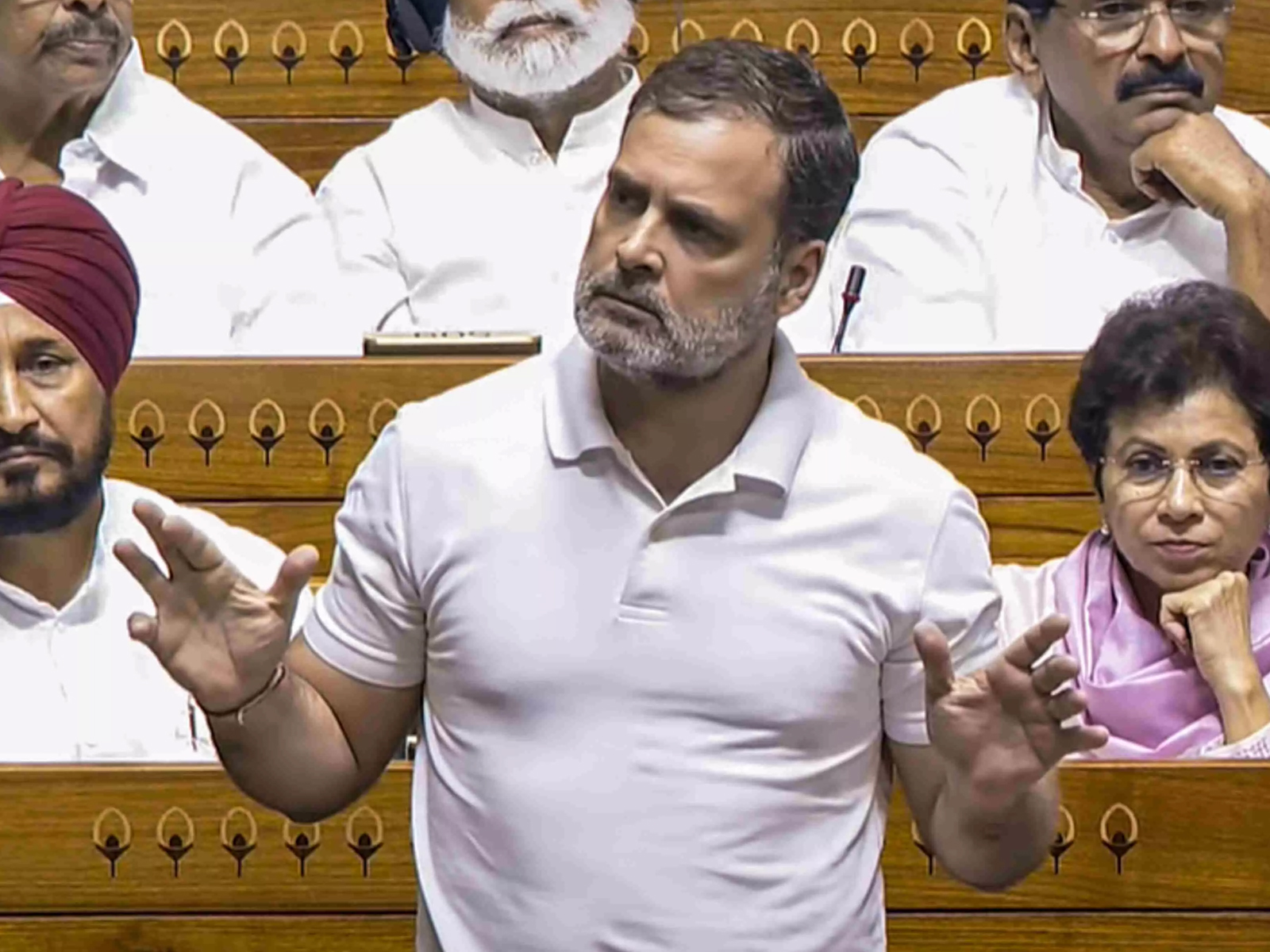
The government wants to change the map of the country’s parliamentary constituencies through three bills, not women’s empowerment. The Leader of the Opposition in the Lok Sabha spoke about the discussion on three bills, including the Women’s Reservation Bill, in the Lok Sabha.
The opposition leader said that the government side knows very well that the opposition will agree to these bills. Yet they have presented these bills. Narendra Modi has two objectives. One is to change India’s electoral map and to prove to women that he is concerned about their empowerment.
He said, we are opposing the bill that has been presented. We support the bill on women’s reservation that was passed in Parliament in September 2023.
Targeting the government, the opposition leader said, ‘By bringing this bill, the government wants to hide the caste-based census. We know the problems faced daily by women from backward sections in society. The government side wants to give legitimacy to Manuvad instead of respecting the Constitution.’
A special three-day session of Parliament began on Thursday. In this special phase of the budget session, three important bills are to be presented and discussed. These three bills are: to implement 33 percent women’s reservation from the 2029 Lok Sabha elections; the Delimitation or Seat Reallocation Bill to increase the number of Lok Sabha seats from 543 to a maximum of 850; and the Union Territory Law Amendment Bill. The Law Minister will present a proposal to suspend the provisions of Rule 66 of the Lok Sabha so that the Women’s Reservation Amendment Bill and the Delimitation Bill can be passed together. He presented the 131st Constitutional Amendment Bill for women’s reservation and the Delimitation Bill 2026. The Home Minister presented the Union Territory Law Amendment Bill 2026.
The Women’s Reservation Bill was passed in Parliament in September 2023. Although the bill was passed, speculation remained about when it would be implemented. This is because the census, which was supposed to be conducted in 2021 after 2011, did not happen.
The Women’s Reservation Act provides for 33 percent seat reservation for women in state assemblies and Parliament.
Yesterday, the Prime Minister said in the Lok Sabha, ‘One party opposed the women’s bill. The people have answered those who opposed it during the vote.’ He said, ‘The daughters will not forgive those who are opposing the Women’s Reservation Bill.’
It is noteworthy that the opposition has never opposed the Women’s Reservation Bill. Their opposition is to linking this bill with delimitation.
In 2014, Narendra Modi had promised that his first act as Prime Minister would be to arrange reservation for women. But the 2023 bill stated that first a census would be conducted, then delimitation would be done based on it, and then the reservation would be implemented.
Lok Sabha
The Lok Sabha is the lower house of India’s bicameral Parliament, located in New Delhi. Established by the Constitution of India in 1952, it is the primary legislative body where members are directly elected by the people. Its history is tied to India’s independence, succeeding the Constituent Assembly and operating from the iconic Sansad Bhavan (Parliament House), a heritage building from the British colonial era.
Women’s Reservation Bill
The Women’s Reservation Bill, officially the Constitution (108th Amendment) Bill, is a proposed legislation in India that seeks to reserve one-third of all seats in the lower house of Parliament and state legislative assemblies for women. First introduced in 1996, it faced decades of political debate and delay before finally being passed by both houses of Parliament in September 2023. Its enactment is seen as a historic step toward promoting gender equality and increasing women’s political representation in the world’s largest democracy.
Delimitation or Seat Reallocation Bill
The “Delimitation or Seat Reallocation Bill” is not a specific place or cultural site, but a type of legislative proposal. In countries like India, such bills periodically redraw electoral constituency boundaries and reallocate parliamentary seats among states based on the latest census data to ensure fair representation. Their history is often tied to constitutional mandates for adjusting political power to reflect population changes.
Union Territory Law Amendment Bill
The “Union Territory Law Amendment Bill” is not a specific place or cultural site, but a legislative proposal. It is a type of bill introduced in the Indian Parliament to amend existing laws or introduce new ones specifically for one or more of India’s Union Territories, such as Delhi, Jammu & Kashmir, or Puducherry. Its history would be tied to the particular governance needs or legal adjustments required for those territories at the time it is proposed.
131st Constitutional Amendment Bill
The 131st Constitutional Amendment Bill is not a physical place or cultural site, but a piece of Indian legislation. It was introduced in 2021 and enacted as the **Constitution (One Hundred and Fifth Amendment) Act, 2021**. Its history and purpose are to restore the power of state governments to identify and specify Socially and Educationally Backward Classes (SEBCs), thereby protecting reservation policies following a Supreme Court ruling.
Delimitation Bill 2026
The “Delimitation Bill 2026” is not a physical place or cultural site; it is a proposed piece of legislation. In political contexts, a delimitation bill typically refers to a law that redraws electoral constituency boundaries, often based on a new census, to ensure equal representation. If enacted in 2026, such a bill would aim to revise electoral maps, a process with significant political implications for future elections.
Union Territory Law Amendment Bill 2026
The “Union Territory Law Amendment Bill 2026” is not an actual place or cultural site; it is a hypothetical piece of proposed legislation. As a conceptual bill, it would be a legal document intended to amend existing laws governing a Union Territory (like Delhi, Puducherry, etc.), potentially altering its administrative or political framework. Its “history” would be a legislative process, beginning with its introduction in the Indian Parliament, followed by debate and potential enactment into law.
Women’s Reservation Act
The Women’s Reservation Act refers to the **Constitution (One Hundred and Sixth Amendment) Act, 2023**, which reserves one-third of seats for women in the Lok Sabha (India’s lower house of Parliament) and state legislative assemblies. Its history is marked by decades of advocacy and legislative attempts since the 1990s, aiming to promote gender equality in Indian political representation. The act was finally passed by Parliament in September 2023 and received presidential assent, though its implementation is contingent on a delimitation exercise.