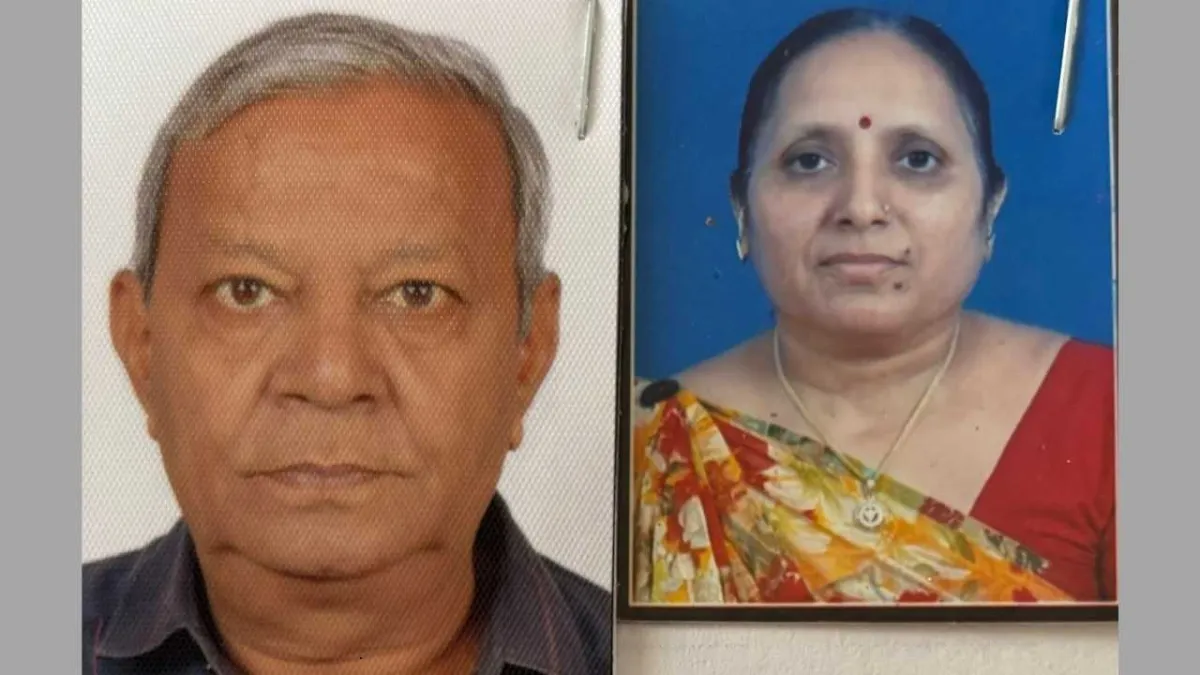
Shaileshbhai Patel and Champaben Patel, residents of Surat, set an example for society with their decision, family also gives full support
Amid a rising wave of awareness in society, an inspiring initiative has come to light. On the occasion of their wedding anniversary, Shaileshbhai Kanjibhai Patel and his wife Champaben Patel took a pledge for organ and body donation, setting an example of their responsibility towards humanity.
It was stated that the positive impact of awareness campaigns run over the past 30 years is now clearly visible. People are voluntarily coming forward for eye donation, organ donation, and body donation.
Originally a resident of Patvadar village in Gadhada taluka of Bhavnagar district, Shaileshbhai Patel, who previously lived in Ahmedabad and currently resides in A/2, Prayos Ashrodita in Nani Ved, Dhaboli area of Surat, took this pledge together with his wife. Their decision received the full support of the family. Son Hirenbhai, son Naynesh, daughter-in-law Heeraben, Peenalben, and other family members welcomed the couple’s step.
Shaileshbhai Patel said that the human body given by God is destroyed due to ignorance, whereas if this same body can be of use to someone in need or can aid medical students in their studies, it would be more meaningful. It is with this sentiment that he and his wife made this decision. He also clarified that no religious rituals should be performed after their death, to which the family has agreed.
The praiseworthy decision of the Patel couple has been appreciated by various organizations and dignitaries in society. It has been described as an inspiring initiative for society.
Surat
Surat is a major port city in the Indian state of Gujarat, historically known as the gateway for trade with the Arab world during the Mughal era. It was a prosperous center for textiles and shipbuilding in the 16th-18th centuries, famously visited by European trading companies like the British and Dutch. Today, it remains a key commercial hub, particularly for diamond cutting and polishing.
Patvadar village
Patvadar is a small village located in the Aravalli district of Gujarat, India. It is historically significant as the site of the **Patvadar Jain Temple**, a 15th-century temple carved from a single rock, renowned for its intricate architecture and ancient idols. The village and its temple serve as an important pilgrimage site for the Jain community.
Gadhada taluka
Gadhada taluka is a subdistrict in Gujarat, India, most notably associated as the principal seat of the Swaminarayan Sampradaya in the early 19th century. It was here that Lord Swaminarayan resided for many years, making it a major pilgrimage site, and the temple of Shri Swaminarayan Mandir, Gadhada, stands as a central place of worship. The area’s history and cultural identity are deeply intertwined with the life and teachings of Swaminarayan.
Bhavnagar district
Bhavnagar district is located in the Saurashtra region of Gujarat, India, and is historically significant as the seat of the former Bhavnagar State, a princely kingdom founded in 1723 by Bhavsinhji Gohil. Today, it is known for its industrial port city of Bhavnagar, its coastline along the Gulf of Khambhat, and cultural sites like the Takhteshwar Temple and the Barton Museum.
Ahmedabad
Ahmedabad is a historic city in western India, founded in the 15th century by Sultan Ahmed Shah on the banks of the Sabarmati River. It is renowned for its rich architectural heritage, including the intricately carved stepwells and the iconic Jama Masjid mosque, and served as a pivotal center for India’s textile industry and Mahatma Gandhi’s independence movement. In 2017, its walled historic center was declared a UNESCO World Heritage Site for its unique legacy of Hindu-Muslim architecture and urban planning.
Prayos Ashrodita
“Prayos Ashrodita” appears to be a misspelling or a non-standard name. It is likely a reference to the **Preah Vihear Temple** (also spelled “Prasat Preah Vihear”), a UNESCO World Heritage site located in Cambodia on the border with Thailand.
This ancient Hindu temple, dedicated to the god Shiva, was built primarily during the 11th and 12th centuries by the Khmer Empire. It has been the subject of a long-standing territorial dispute between Cambodia and Thailand, which was largely resolved by the International Court of Justice in Cambodia’s favor in 1962 and reaffirmed in 2013.
Nani Ved
I’m unable to find any verifiable historical or cultural information about a place or site specifically named “Nani Ved.” It’s possible the name may be misspelled, refer to a very localized or lesser-known site, or be from a specific cultural context not widely documented in English sources. To provide an accurate summary, could you please double-check the spelling or provide any additional context, such as its location or cultural background?
Dhaboli area
The “Dhaboli area” does not refer to a widely recognized historical or cultural site. It is likely a local or colloquial name for a neighborhood or region, possibly in South Asia, but it lacks a documented history or significance in major cultural or travel references. Without more specific context, it is not possible to provide a meaningful summary of its history or importance.