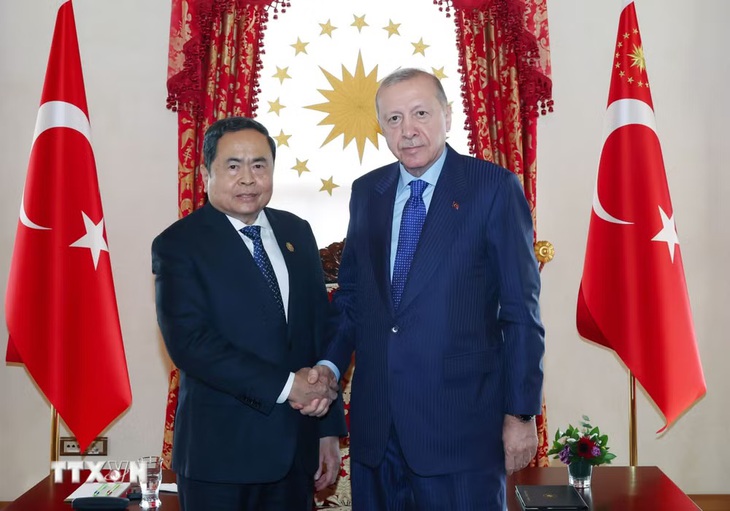
On April 16, National Assembly Chairman Tran Thanh Man held a meeting with Turkish President Recep Tayyip Erdogan.

Within the framework of his working trip to attend the 152nd Assembly of the Inter-Parliamentary Union (IPU-152) and conduct a number of bilateral activities in Turkey, on the afternoon of April 16 (local time), he met with Turkish President Recep Tayyip Erdogan.

National Assembly Chairman Tran Thanh Man thanked the host for the warm welcome and conveyed greetings to the President and senior leaders of Turkey.

He highly appreciated the role and position of Turkey on the international stage, particularly through hosting many important events in 2026.

Expressing his pleasure in welcoming National Assembly Chairman Tran Thanh Man and the high-level Vietnamese delegation, President Recep Tayyip Erdogan respectfully conveyed congratulations and greetings to General Secretary and President To Lam.

He affirmed that Turkey values its relationship with Vietnam and wishes to promote and elevate bilateral relations to new heights.

National Assembly Chairman Tran Thanh Man stated that after nearly 50 years of diplomatic relations, bilateral relations have developed to a new, more strategic level, and it is necessary to elevate the relationship to match the potential and prospects of the two countries.

The two sides agreed to continue consolidating political trust, soon organize a meeting of the Joint Committee, and take advantage of favorable conditions such as direct flights and e-visas for citizens of both countries to facilitate business connections, trade and investment cooperation, tourism, and people-to-people exchanges.

Affirming that there is still great potential for cooperation between the two countries, the two leaders emphasized making economy, trade, and investment the important pillars of cooperation, creating favorable conditions to achieve the goal of raising bilateral trade turnover to 4 billion USD, and continuing to encourage Turkish businesses to invest in Vietnam to contribute to Vietnam’s economic development.

On this occasion, National Assembly Chairman Tran Thanh Man conveyed an invitation from General Secretary and President To Lam to the Turkish President to visit Vietnam at the earliest possible time. Mr. Recep Tayyip Erdogan happily accepted the invitation.

Vietnam – Turkey to develop transport corridors and supply chain connections between the two regions
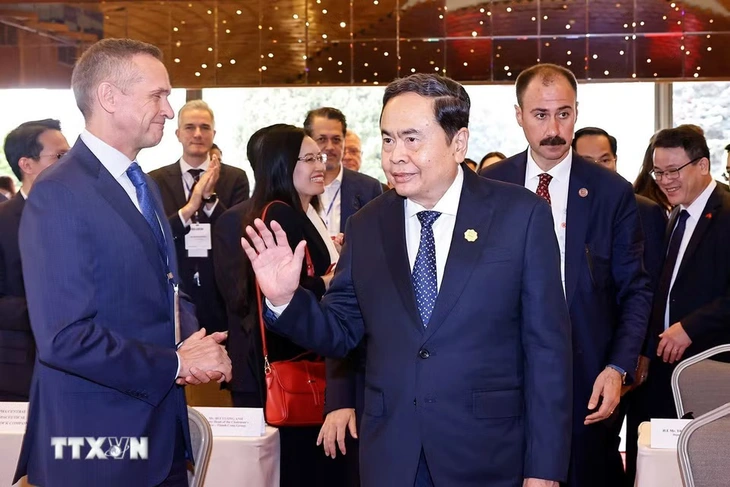
Encouraging Turkish businesses to invest in Vietnam - Image 2.

Also on April 16, National Assembly Chairman Tran Thanh Man attended a Policy Dialogue to promote Vietnam – Turkey cooperation.

According to the National Assembly Chairman, in the new development phase, Vietnam aims to become one of the region’s competitive centers for production, services, and innovation, a strategic partner, and a reliable and important link in regional and global supply chains.

Vietnam will not only participate but will proactively engage at a higher position in the value chain, not only in production but also in innovation, design, and technology mastery.

The National Assembly Chairman clarified that Turkey is one of Vietnam’s important partners in the region, playing the strategic role of a bridge between Asia and Europe.

Conversely, Vietnam is a dynamic economy and an important gateway for Turkey to access the Southeast Asian market and the Asia-Pacific region.

He proposed that the two sides consolidate political trust, vigorously promote economic, trade, investment, and tourism cooperation, strive to increase trade turnover in a balanced and sustainable direction, and create even more favorable conditions for businesses from both sides.

Expand cooperation in areas with complementary potential and strengths. In particular, attention should be paid to developing transport corridors and supply chain connections between the two regions.

The National Assembly of Vietnam commits to continue accompanying the Government in building and perfecting institutions, creating a favorable investment environment, and providing effective support for cooperation activities between Vietnam and Turkey.

The National Assembly Chairman believes that Vietnam-Turkey cooperative relations
National Assembly of Vietnam

The National Assembly of Vietnam is the country’s highest representative body and the sole organ vested with constitutional and legislative powers. Established in 1946, shortly after the Declaration of Independence, its first election was held under President Ho Chi Minh to create the government of the Democratic Republic of Vietnam. Today, it meets in the iconic Hanoi-based building completed in 2014, symbolizing modern Vietnamese governance while operating under the leadership of the Communist Party of Vietnam.

Inter-Parliamentary Union (IPU-152)

The Inter-Parliamentary Union (IPU) is a global organization of national parliaments, founded in 1889 to promote peace, democracy, and cooperation. Its 152nd Assembly was a specific session where parliamentarians from around the world convened to address urgent international issues and strengthen parliamentary diplomacy.

Turkey

Turkey, officially the Republic of Türkiye, is a transcontinental country located at the crossroads of Europe and Asia, historically known as Anatolia. It is the successor state to the vast Ottoman Empire, which lasted for over six centuries before its dissolution after World War I, leading to the establishment of the modern republic in 1923 under Mustafa Kemal Atatürk. The country is a profound cultural and historical mosaic, home to numerous UNESCO World Heritage sites like the ancient city of Ephesus, the rock formations of Cappadocia, and the historic areas of Istanbul, which served as the capital of the Byzantine and Ottoman Empires.

Vietnam

Vietnam is a Southeast Asian nation with a rich history shaped by millennia of indigenous dynasties, a millennium of Chinese influence, French colonial rule, and the 20th-century Vietnam War. Its cultural identity is reflected in diverse UNESCO sites like the ancient town of Hoi An, the imperial citadel of Hue, and the stunning karst landscapes of Ha Long Bay. Today, it is known for its vibrant cities, lush landscapes, and a resilient culture that blends tradition with rapid modern development.

Southeast Asian market

A Southeast Asian market is a vibrant, open-air hub of commerce and community life, reflecting the region’s history as a crossroads of trade routes and cultural exchange. Historically, these markets have served for centuries as central places for buying local produce, handicrafts, and street food, while also functioning as important social gathering spots. Their bustling atmosphere and diverse goods continue to showcase the rich agricultural traditions and multicultural fabric of Southeast Asian societies.

Asia-Pacific region

The Asia-Pacific region is a vast and diverse geographic area encompassing East Asia, Southeast Asia, Oceania, and the Pacific Islands, known for its immense cultural, linguistic, and ecological variety. Historically, it has been a cradle of ancient civilizations, a hub for major trade routes like the Silk Road and Spice Trade, and a focal point of colonial expansion and modern economic development. Today, it is a dynamic global center of economic growth, technological innovation, and complex geopolitical significance.

Asia

“Asia” is not a single place or cultural site but the world’s largest and most populous continent, encompassing a vast array of countries, histories, and civilizations. It is the birthplace of major world religions, ancient empires like those in Mesopotamia and China, and countless cultural traditions. Its history spans from the earliest human civilizations along the Indus and Yellow Rivers to the complex modern nations of today.

Europe

Europe is a continent with a rich and complex history, shaped by ancient civilizations like Greece and Rome, the transformative Middle Ages, the Renaissance, and periods of both empire and devastating conflict. Culturally, it is renowned for its diverse artistic, philosophical, and scientific heritage, as well as its numerous UNESCO World Heritage sites, from medieval castles to grand cathedrals. Today, it is a major political and economic union, with the European Union fostering cooperation among many of its nations.