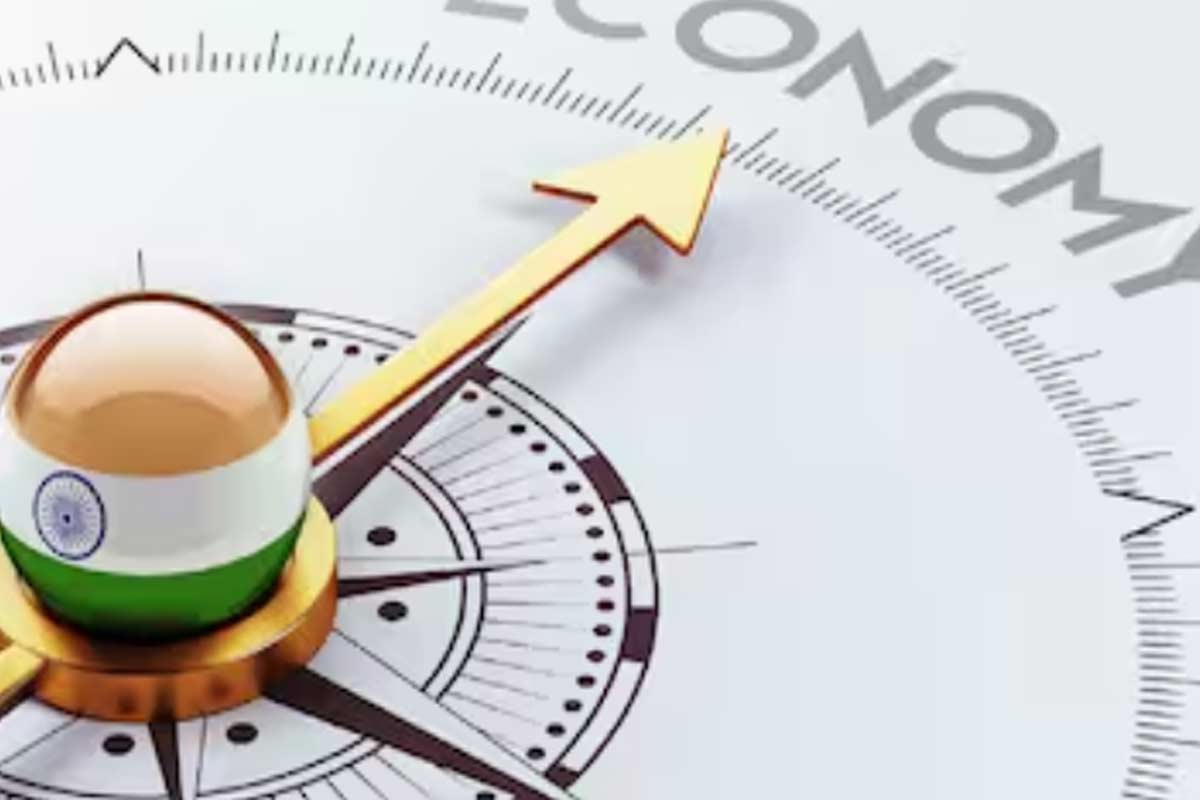
India is now the world’s sixth largest economy. Although it became the world’s fourth largest economy in 2025, it has slipped one rank in the recent report. Why this decline? This situation is believed to be due to factors such as GDP revision for the 2025-26 fiscal year and the rupee’s value against the dollar.
According to the International Monetary Fund (IMF) and recent economic data, India is positioned just behind the United States ($30.8 trillion), China ($19.6 trillion), Germany ($4.7 trillion), the United Kingdom ($4 trillion), and Japan ($4.44 trillion). India’s economy stands at $3.92 trillion.
Read More:
Incidentally, in 2024, India became the world’s fifth largest economy. The IMF report stated that India had a $3.5 trillion economy, just ahead of the United Kingdom ($3.4 trillion). Some experts had predicted that India would become the world’s third largest economy by 2027. The new report has undoubtedly dealt a blow to that possibility. Economists say India is likely to remain in sixth place in the 2026 report as well, although a ‘comeback’ could follow. It is believed that India could move to fourth place by overtaking the UK in 2027. By 2028, New Delhi could also overtake Japan. This is the claim of experts.
According to the International Monetary Fund (IMF) and recent economic data, India is positioned just behind the United States ($30.8 trillion), China ($19.6 trillion), Germany ($4.7 trillion), the United Kingdom ($4 trillion), and Japan ($4.44 trillion).
At the same time, it is known that despite the slight change in rank, India has maintained its position as the world’s fastest-growing major economy. Furthermore, India is considered one of the few countries in the world expected to sustain growth above 6 percent consistently even in the ‘mid-term’.
It was claimed some time ago that India’s economy would reach $6.17 trillion by 2030. This would significantly narrow the economic gap between India and Germany. Subsequently, India will secure its place among the world’s top three economies. However, the United States, with a $39 trillion economy, will retain the top spot, with China, with a $27.5 trillion economy, right behind it.
India
India is a vast South Asian country with one of the world’s oldest continuous civilizations, dating back over 5,000 years to the Indus Valley. Its history is marked by the rise of major religions like Hinduism and Buddhism, a succession of powerful empires, and British colonial rule before gaining independence in 1947. Today, it is a densely populated and diverse republic known for its rich cultural heritage, from classical arts and architecture to numerous UNESCO World Heritage sites.
United States
The United States is a federal republic founded in 1776 after declaring independence from Great Britain, with its modern government established by the Constitution in 1789. Culturally, it is a vast and diverse nation shaped by waves of immigration, its history of westward expansion, and significant global influence in areas like technology, entertainment, and politics. Key historical sites range from colonial landmarks like Independence Hall to monuments of its civil rights movement and expansive national parks.
China
China is one of the world’s oldest continuous civilizations, with a recorded history spanning over 4,000 years, marked by successive dynasties, profound philosophical traditions like Confucianism, and inventions such as paper and gunpowder. Today, it is a vast modern nation-state officially known as the People’s Republic of China, blending its immense historical heritage with rapid economic development and global influence. Culturally, it is renowned for landmarks like the Great Wall and the Forbidden City, which symbolize its imperial past and enduring cultural identity.
Germany
Germany is a country in Central Europe with a rich and complex history, shaped by the Holy Roman Empire, the Protestant Reformation, and its unification in 1871. Its 20th-century history was defined by two world wars, the division during the Cold War, and its peaceful reunification in 1990. Culturally, it is renowned for its contributions to philosophy, classical music, literature, and its many historic sites, including medieval castles, cathedrals, and memorials to its modern history.
United Kingdom
The United Kingdom is a sovereign nation comprising England, Scotland, Wales, and Northern Ireland, with a history shaped by Celtic, Roman, Anglo-Saxon, and Norman influences. It emerged as a major global power through the British Empire and was central to the Industrial Revolution. Today, it is known for its constitutional monarchy, parliamentary democracy, and globally influential cultural heritage in literature, music, and science.
Japan
Japan is an island nation in East Asia with a rich cultural history spanning over two millennia, from its early imperial era and feudal shogunates to its modern transformation after World War II. It is renowned for its unique blend of ancient traditions—such as Shinto shrines, Buddhist temples, and tea ceremonies—and cutting-edge technology, seen in cities like Tokyo. Key historical sites include Kyoto’s historic monuments, Hiroshima’s Peace Memorial, and the iconic Mount Fuji, reflecting both its deep heritage and resilience.
New Delhi
New Delhi is the capital city of India, officially inaugurated in 1931 as the new seat of the British Indian government, replacing Calcutta. It was designed by British architects Edwin Lutyens and Herbert Baker, featuring wide boulevards and grand colonial-era buildings like the Rashtrapati Bhavan and India Gate. Today, it serves as the political and administrative heart of the country, housing key government institutions and historical monuments from both the Mughal and British colonial periods.
International Monetary Fund
The International Monetary Fund (IMF) is a major international financial institution established in 1944 at the Bretton Woods Conference to foster global monetary cooperation and financial stability. Its primary roles are to provide policy advice, financial assistance to member countries facing balance of payments problems, and promote sustainable economic growth.