The main conspirator behind the violent wage increase protest in Noida is Aditya Anand, a former student of Jamshedpur NIT. Police have identified two other accused, Rupesh Roy and Man… read more
The main orchestrator of the violent protest in Noida demanding a wage increase is Aditya Anand, a former student of Jamshedpur NIT (National Institute of Technology). Police have identified three main accused in the violence, two of whom have been arrested while Aditya is still at large. Two X (Twitter) accounts operated from Pakistan also played a major role in inciting this riot.
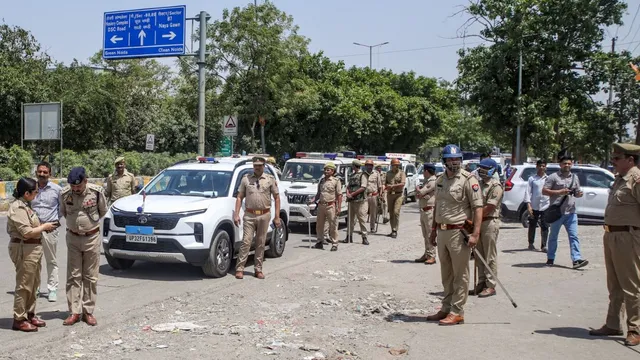
The protest by company workers in Noida’s Phase-2 (Hosiery Complex) turned violent on Monday. There was heavy stone-pelting and arson of vehicles. Police investigation has made it clear that this was not a spontaneous protest but a premeditated conspiracy. The main conspirator of this entire violence is Aditya Anand, a resident of Hazaribagh and a B.Tech graduate from Jamshedpur NIT.
Has been inciting violence across the country since 2020
Along with him, auto driver Rupesh Roy and Manisha Chauhan, both residents of Bihar, are also main accused in this case. Police arrested Rupesh and Manisha on April 11 itself, while a vigorous search is ongoing for Aditya. According to police, Aditya has been working to incite many such protests across the country since 2020.
Workers linked via QR codes
These three accused had already reached Noida on March 31 and April 1. After this, on April 9 and 10, several WhatsApp groups were created by having QR codes scanned at various places, and workers were added to them. The crowd was incited through these very groups. The presence of these accused has also been found earlier in Delhi’s CAA-NRC protests.
The Police Commissioner of Noida stated that during the violence, false information and fake news of deaths were continuously being spread from two X (Twitter) handles named Anushi Tiwari and Mir Ilyas. Cyber investigation revealed that both these accounts were being operated from Pakistan. Their main objective was to spread unrest and riots in India’s industrial areas. Currently, police are continuously conducting raids to arrest the fugitive Aditya Anand.
Noida
Noida, officially known as Noida (New Okhla Industrial Development Authority), is a planned city in the Indian state of Uttar Pradesh, established in 1976 as part of an urbanization initiative near Delhi. It was developed primarily as a residential and industrial hub to decongest the national capital, rapidly transforming from agricultural land into a major IT and commercial center. Today, it forms a key part of the National Capital Region (NCR) and is known for its modern infrastructure, high-rise buildings, and expansive green spaces.
Jamshedpur NIT
Jamshedpur does not have an institution called “NIT”; the National Institute of Technology in the city is officially named the **National Institute of Technology Jamshedpur (NIT Jamshedpur)**. It was established in 1960 as the Regional Institute of Technology and was later upgraded to an NIT, playing a key role in technical education in eastern India. The institute is known for its strong engineering programs and is situated in the industrial city founded by Jamshedji Tata.
Hazaribagh
Hazaribagh is a city and district in the eastern Indian state of Jharkhand, whose name translates to “a thousand gardens.” Historically, it was a part of the Chotanagpur plateau region and served as a notable hill station and sanatorium during the British colonial era. Today, it is known for its surrounding forests, wildlife reserves like Hazaribagh National Park, and its rich tribal cultural heritage.
Bihar
Bihar is a state in northeastern India, historically known as the cradle of ancient Indian civilization and learning. It was the center of powerful empires like the Magadha, which gave rise to Buddhism and Jainism, and hosted the renowned ancient university of Nalanda. Today, it remains a region of great historical and religious significance, featuring key pilgrimage sites such as Bodh Gaya, where the Buddha attained enlightenment.
Delhi
Delhi is India’s capital city, with a history spanning over two millennia, serving as the seat of several empires including the Delhi Sultanate and the Mughals. Today, it is a vibrant metropolis known for its striking contrast between historic landmarks like the Red Fort and Qutub Minar and modern government and commercial districts. This rich layering of ancient, medieval, and colonial history makes it a central political and cultural hub of the country.
CAA-NRC protests
The CAA-NRC protests were a nationwide movement in India (2019-2020) primarily against the Citizenship Amendment Act (CAA), which was seen as discriminatory for offering citizenship to non-Muslim immigrants from neighboring countries, and its potential link to a proposed National Register of Citizens (NRC). Sparked by concerns that this combination could marginalize Muslim citizens, the protests were historically significant for their scale, sustained peaceful sit-ins led notably by women, and their emphasis on India’s secular constitutional principles.
Pakistan
Pakistan is a modern nation-state founded in 1947 as a homeland for Muslims of British India, with a rich history rooted in the ancient Indus Valley Civilization. Its cultural landscape is a tapestry of diverse ethnic groups, languages, and traditions, shaped by influences from the Mughal Empire, British colonialism, and its Islamic heritage. Key historical sites include the archaeological ruins of Mohenjo-daro, the Mughal-era Lahore Fort, and the Islamic architecture of the Badshahi Mosque.
India
India is a vast South Asian country with one of the world’s oldest continuous civilizations, dating back over 5,000 years to the Indus Valley. Its long and complex history is marked by the rise of major religions like Hinduism and Buddhism, successive empires, Mughal rule, and British colonization before gaining independence in 1947. Today, it is a densely populated and diverse republic renowned for its rich cultural heritage, numerous languages, and historic sites like the Taj Mahal.