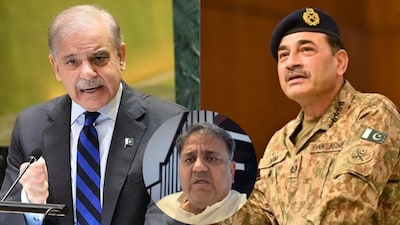
His remarks came at a time when Munir has become the main figure in Pakistan’s diplomatic efforts, especially in hosting and managing talks between the United States and Iran.
A former Pakistani Information Minister took a sharp jab at the country’s fragile leadership by putting the spotlight on Army Chief Asim Munir, whom he termed the “de facto leader” of the country.
He said that right now, the decision-making authority lies with Munir and Prime Minister Shehbaz Sharif is sidelined altogether.
“Frankly, there is no two opinions about that. Right now, Pakistan is led by General Asim Munir. He is the de facto leader of Pakistan. The decision-making right now is with the Field Marshal or CDF…” he said.
He further referred to US President Donald Trump’s remarks praising the Army Chief, saying that the former did not even bother to talk about Shehbaz Sharif.
“Even yesterday, President Trump actually named General Asim Munir as the Leader of Pakistan, and he has not even bothered to talk about Shehbaz Sharif…” he added.
His remarks came at a time when Munir has become the main figure in Pakistan’s diplomatic efforts, especially in hosting and managing important talks between the United States and Iran. From welcoming delegations himself to directly engaging with the US Vice President, he has taken a leading role in foreign policy, even overshadowing the civilian leadership.
Even Trump seemed to support that view. While suggesting that the next round of US-Iran talks might be held in Pakistan “in the next two days,” he praised Munir as a “fantastic” leader, showing confidence in him. Notably, Trump did not mention Sharif at all, adding to the impression about who really holds power.
Meanwhile, Munir arrived in Tehran to facilitate diplomatic exchanges between Iran and the United States following failed negotiations held in Islamabad over the weekend.
A top security source said that Munir is expected to hold in-depth discussions with senior Iranian officials on the recent US-Iran talks and review the positions of both negotiating sides.
Pakistan
Pakistan is a modern nation-state established in 1947 as a homeland for Muslims of British India, with a rich history rooted in the ancient Indus Valley Civilization—one of the world’s earliest urban cultures. Its territory has been a crossroads for various empires and faiths, from Buddhist Gandhara to Islamic sultanates and the Mughal Empire. Today, it is a culturally diverse country featuring significant historical sites like Mohenjo-daro, Lahore Fort, and the Badshahi Mosque.
United States
The United States is a federal republic founded in 1776 after declaring independence from Great Britain, with its modern government established by the Constitution in 1789. Culturally, it is a vast and diverse nation shaped by waves of immigration, indigenous heritage, and the blending of numerous global traditions. Key historical sites that reflect its development include Independence Hall, Civil War battlefields, and monuments like the Statue of Liberty, symbolizing freedom and opportunity.
Iran
Iran, historically known as Persia, is a country in Western Asia with one of the world’s oldest continuous civilizations, dating back to the Elamite kingdoms of the 4th millennium BCE. It is home to numerous UNESCO World Heritage Sites, including the ancient ceremonial capital of Persepolis, which was the center of the vast Achaemenid Empire founded by Cyrus the Great in the 6th century BCE. Today, Iran’s rich cultural heritage is reflected in its intricate architecture, poetry, and traditions, shaped by its pre-Islamic Zoroastrian past and its role as a center of Islamic art and scholarship following the 7th-century Arab conquest.
Islamabad
Islamabad is the purpose-built capital city of Pakistan, established in the 1960s to replace Karachi. It was meticulously planned by Greek architect Constantinos Apostolou Doxiadis and is known for its modern layout, wide boulevards, and scenic location at the foothills of the Margalla Hills. The city houses important national monuments, including the Faisal Mosque—one of the largest mosques in the world—and serves as the political and administrative heart of the country.
Tehran
Tehran is the capital and largest city of Iran, officially becoming the national capital in 1796 under the Qajar dynasty. Today, it is a major political and economic center, known for landmarks like the Golestan Palace—a UNESCO World Heritage site from the Qajar era—and modern towers such as the Milad Tower.