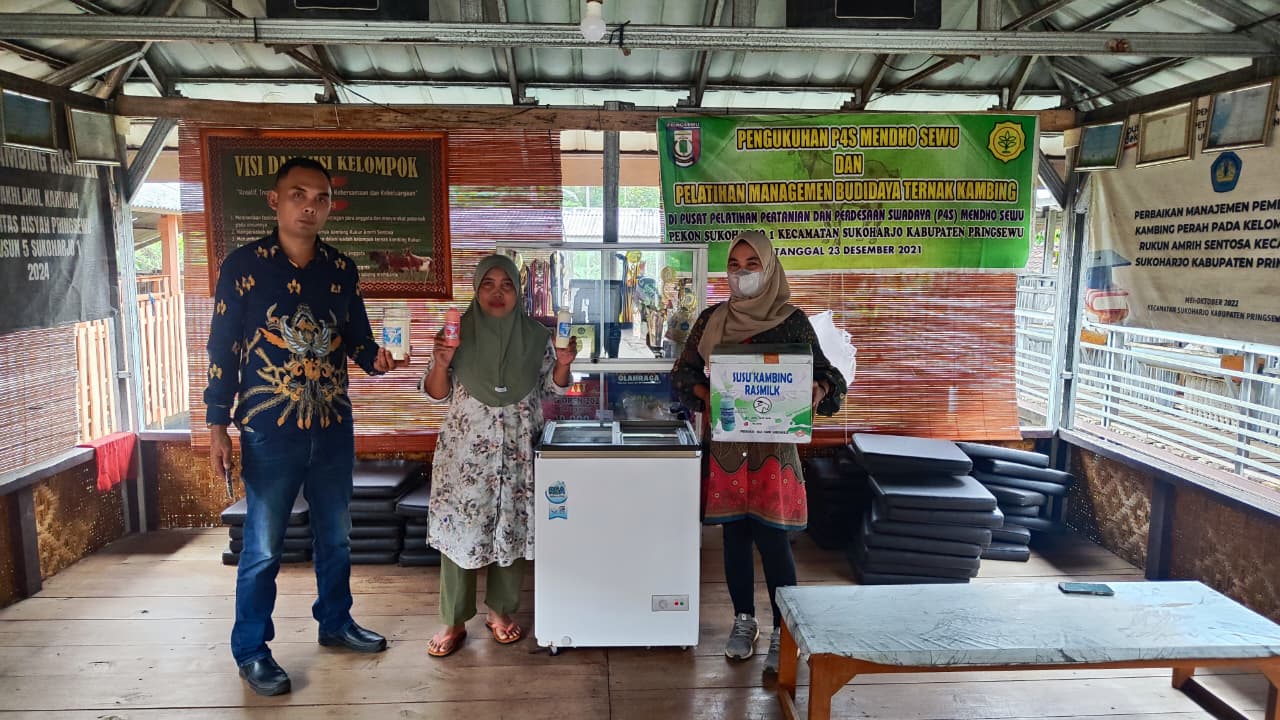
Support through the distribution of People’s Business Credit (KUR) continues to drive the development of Micro, Small, and Medium Enterprises (MSMEs) across Indonesia. One example is Ras Farm Sukoharjo I in Pringsewu, Lampung, which has successfully grown from a home-based operation into a dairy farm with hundreds of milking goats.
The business journey began from personal experience. From that experience, the utilization of goat milk started, which became the starting point for the business under the RasMilk brand.
“Initially, I milked from one goat that had just given birth, then I started milking it regularly. It turned out many people in the area were interested and started buying,” they explained.
From that activity, the potential for something bigger was seen, and the opportunity to develop the business more seriously was seized. This step was then strengthened by accessing financing through BRI’s People’s Business Credit (KUR).
With financing support, the number of dairy goats was gradually increased to boost production capacity. Starting from just 1 goat, it grew to 3, and now reaches around 100 dairy goats. “Demand keeps increasing, so we continue to add to our production capacity,” they said.
Along with the increase in business scale supported by this capital access, new challenges began to be faced, especially in marketing. The significantly increased production of fresh milk was not yet fully matched by market absorption.
Addressing this condition, the business development momentum was used to carry out product innovation. With increasingly strong capacity support, Ras Farm began processing goat milk into powdered milk products, giving it a longer shelf life while opening opportunities for broader market penetration.
This development step was then strengthened through product diversification. Ras Farm introduced various flavor variants like strawberry, melon, ginger, and mocha, tailored to modern consumer preferences, while also increasing the product’s added value in the market.
Not only focused on business growth, Ras Farm also contributes to empowering the local community. Local residents are actively involved in the production process, including receiving training in goat milking, thus opening new economic opportunities in the local environment.
In this development process, it was emphasized that financing support was a key factor. Access to affordable capital schemes allowed Ras Farm to expand the barn, increase the livestock population, and sustainably grow production capacity.
In fact, thanks to the consistency and innovation carried out, Ras Farm has also achieved recognition at the national level, further strengthening its position as a leading MSME in the livestock sector.
It was stated that the story of Ras Farm is a real reflection of how the synergy between the perseverance of business actors and financing support can encourage MSMEs to move up a class, while also creating added value for the economy and the surrounding community.
“There is a consistent role in strengthening the MSME sector through the distribution of KUR. As the largest KUR distributor in Indonesia, there is a commitment to continue supporting the government’s agenda in creating jobs and driving national economic growth.”
As information, by the end of February, KUR distribution had reached Rp31.42 trillion, equivalent to 17.46% of the total KUR allocation for the year set by the Government. This distribution has reached more than 643 thousand MSME debtors across Indonesia.