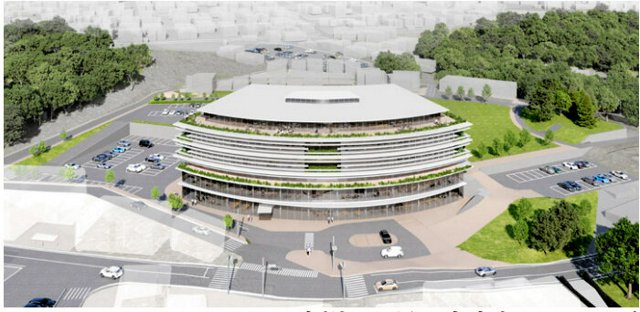
New Tama City Hall design selected for “fitting into the hillside.”
On the 16th, the city announced it selected Sato (Tokyo) as the design contractor for the replacement of its main city hall building. The goal is to create the basic design by the end of fiscal year 2026 and begin operations within fiscal year 2032.
The new city hall proposed by the company is a 5-story building with one basement floor. It was designed with the theme of “fitting into the Tama Hills and becoming a symbol of Tama City that coexists with the environment.”
Floors from the basement to the second floor will house general information and in-person service counters, while the fifth floor is planned to contain the city council chamber and a lounge usable for events. Furthermore, functionality will be enhanced by utilizing outdoor parking lots and plazas as response bases during disasters.
The city conducted an open-call review seeking proposals from multiple companies, and in February of this year, held public presentations by the companies with citizen participation. The selection was made by evaluating aspects such as the building’s form, which utilizes the site’s elevation changes.
Moving forward, based on this proposal, the basic design will be formulated over approximately one year. The total project cost is estimated at about 17.4 billion yen. “While balancing cost considerations, we aim to create a flexible and environmentally friendly city hall that can also adapt to changing work styles, such as those driven by the advancement of digital transformation,” stated the city’s head of the new city hall development division.
main city hall building
The Main City Hall building is typically the central administrative headquarters of a municipal government, often constructed in a prominent architectural style to symbolize civic pride and authority. Historically, many such buildings in Europe and North America were built during the late 19th or early 20th centuries, featuring grand designs like Beaux-Arts or Neo-Gothic to reflect the city’s growth and prosperity during industrialization. Today, it remains a key landmark for governance and public events.
Tama Hills
Tama Hills is a large recreational area in western Tokyo, Japan, originally developed as a U.S. military training facility after World War II. Today, it is managed by the U.S. Forces Japan and the Government of Japan, offering golf courses, sports fields, and outdoor spaces primarily for military personnel, their families, and authorized guests.
Tama City
Tama City is a municipality in the western part of Tokyo Metropolis, Japan, officially established in 1971 through the merger of several towns and villages. It is best known as the home of the Sanrio Puroland theme park and the Tama New Town, one of Japan’s largest planned residential developments built in the 1970s to address Tokyo’s housing shortage. The area also contains significant green spaces, including part of the Tama Hills.
city council chamber
A city council chamber is the designated meeting hall where a locally elected council convenes to debate and legislate on municipal affairs. Historically, such chambers became formalized with the rise of representative local government, often housed within a city’s main town hall as a symbol of civic authority and public access. Its design typically reflects democratic principles, with seating arranged for council members, officials, and often an area for the public and press to observe proceedings.
outdoor parking lots
Outdoor parking lots are paved or surfaced open-air areas designed for vehicle storage, typically found near commercial, residential, or public spaces. Their modern proliferation is directly tied to the rise of automobile ownership in the 20th century, transforming urban and suburban landscapes to accommodate cars. While functional, they are often cited in discussions about urban planning, land use, and environmental impact due to their large impermeable surfaces.
plazas
Plazas are open public squares found in many cities, often serving as central gathering places for social, commercial, and civic activities. Historically, they originated in ancient Roman forums and were central to Spanish colonial town planning, typically arranged around key buildings like a church or town hall. Today, they remain vital hubs for community events, markets, and public life.
new city hall
The New City Hall (Neues Rathaus) is a prominent landmark in Munich, Germany, completed in 1909 after 43 years of construction. Built in a grand Neo-Gothic style to showcase the city’s growing prosperity, it replaced the Old Town Hall as the seat of the municipal government. It is most famous for its Glockenspiel, a mechanical clock with re-enacting figurines that performs daily for visitors.
new city hall development division
The “New City Hall Development Division” is not a specific cultural site, but rather a municipal administrative department. Typically, such a division is responsible for planning, coordinating, and overseeing the construction or major renovation of a city’s main government building. Its history is tied to the specific city’s growth and the need for modernized public administration facilities.