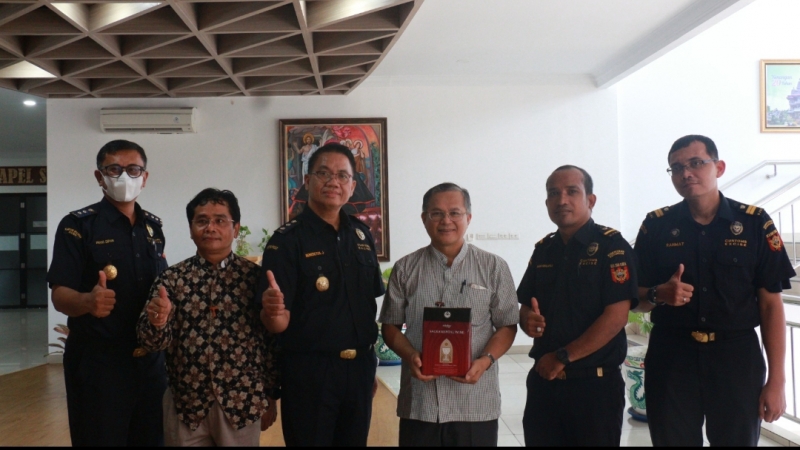
In an effort to carry out its trade facilitation function and provide a tangible contribution to the smooth running of religious activities, the Medan Customs and Excise Office implemented a Customs Visit Customers (CVC) program at the Catholic Center Christosophia in Medan.
This visit was a proactive step by Medan Customs in providing assistance related to the granting of state facilities. The presence of the Medan Customs officials was warmly welcomed, with appreciation expressed for the government’s support of the needs for Catholic worship facilities in the Archdiocese of Medan area.
This fiscal support was officially ratified through the Minister of Finance’s Decree Number KEP-78/MK/KBC.0202/2026.
This policy is a form of incentive in the form of a Duty Exemption granted specifically to support public worship needs.
The Duty Exemption facility granted consists of 3,330 liters of Sacramental Wine for the period until December 31, 2026. The sacramental wine in question is produced by a domestic producer, PT Sababay Industry, in the Province of Bali.
The Head of the Medan Customs Office emphasized that providing this facility is part of the institution’s commitment to delivering professional, accountable, and targeted service.
“The visit to the Archdiocese of Medan and the provision of this duty exemption facility is not merely an administrative task, but a tangible manifestation of the state’s presence in supporting religious harmony through the fiscal instruments we manage,” he stated.
Medan Customs and Excise Office
The Medan Customs and Excise Office is a key government institution in North Sumatra, Indonesia, responsible for regulating the flow of goods and enforcing trade laws at the Port of Belawan. Historically, its establishment and evolution are tied to the development of Medan as a major commercial hub during the Dutch colonial era and in the post-independence period, facilitating international trade in the region.
Catholic Center Christosophia
The Catholic Center Christosophia is a spiritual and cultural center in Kyiv, Ukraine, founded in the early 2000s. It serves as a hub for the local Catholic community, promoting dialogue between faiths and cultures through conferences, lectures, and charitable activities. Its establishment reflects the revival of open religious life in Ukraine following the fall of the Soviet Union.
Archdiocese of Medan
The Archdiocese of Medan is a Roman Catholic ecclesiastical jurisdiction in North Sumatra, Indonesia, established as a diocese in 1911 during the Dutch colonial period and elevated to an archdiocese in 1961. It serves as the metropolitan see for the region, overseeing a significant Catholic community that grew alongside the area’s development of plantation and trade industries. Its history reflects the growth of the Catholic faith among the diverse ethnic populations of Sumatra.
Minister of Finance’s Decree Number KEP-78/MK/KBC.0202/2026
This is not a place or cultural site, but a formal Indonesian government decree. It is a legal document issued by the Ministry of Finance, likely concerning specific fiscal regulations, tax provisions, or budgetary instructions for the year 2026. As an administrative decree, it does not have a history in the cultural or architectural sense, but is part of the ongoing legal and bureaucratic framework of the Indonesian government.
PT Sababay Industry
PT Sababay Industry is a prominent Indonesian winery located in Bali, specializing in the production of sparkling wines and grape-based beverages. Founded in 2012, it has grown by utilizing local grape varieties and modern techniques to cater to both domestic and international markets, contributing to Bali’s evolving agro-tourism and beverage industry.
Province of Bali
The Province of Bali is an Indonesian island renowned globally for its unique Hindu culture, intricate temple architecture, and vibrant arts, set against a backdrop of volcanic mountains and rice terraces. Its history is deeply shaped by the Majapahit Hindu kingdom’s influence from Java in the 14th-15th centuries, which established the island’s distinct religious and artistic traditions that persist today. Despite Dutch colonial rule in the 19th-20th centuries and modern tourism, Bali has maintained its cultural identity as a spiritual and artistic center.