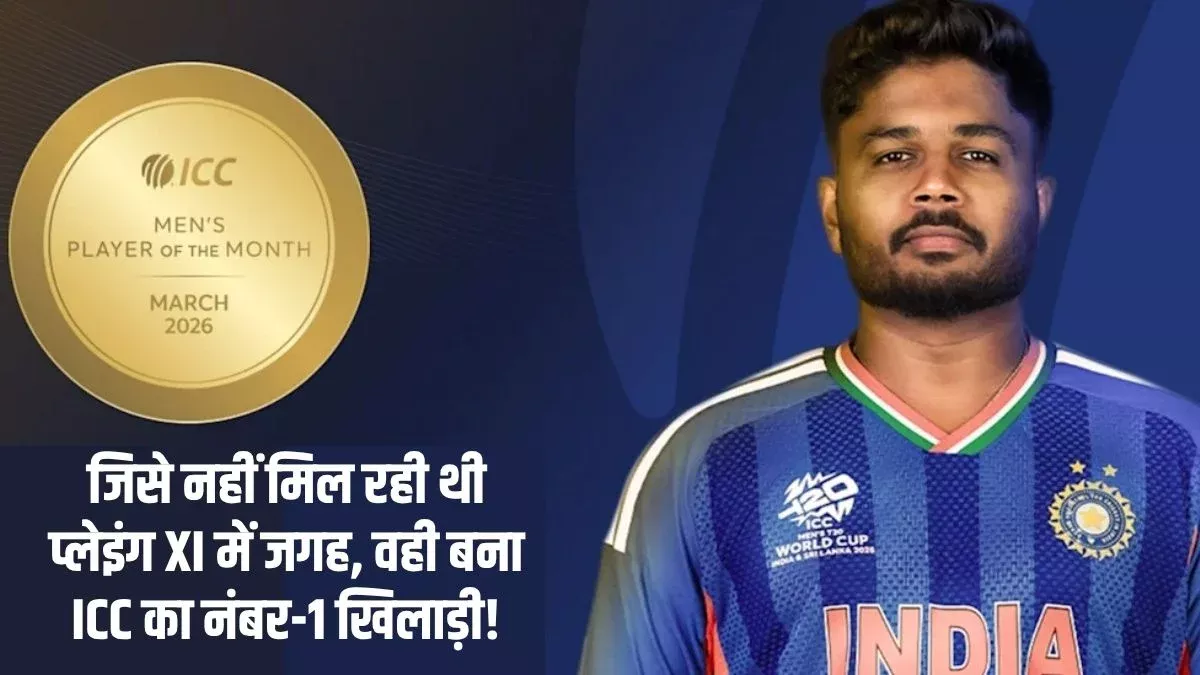
Dubai, Sanju Samson, the hero of India’s T20 World Cup victory, was named the International Cricket Council’s (ICC) Men’s Player of the Month for March on Tuesday. Samson did not get a place in the final eleven in the initial matches of the tournament, but when he was later included in the team, he delivered a brilliant performance. He scored 89 runs off 46 balls against New Zealand in the final, helping India win the T20 World Cup title for the second consecutive time earlier this year. Samson receiving this monthly honor means that over the past five months, this award has been won by a player from a different country.
Award Received During the Most Memorable Phase of My Cricket Career
The previous four players in this category include Simon Harmer (South Africa), Mitchell Starc (Australia), Daryl Mitchell (New Zealand), and Sahibzada Farhan (Pakistan). Samson described this performance as a significant phase in his career. He said that winning the ICC Player of the Month award is an incredible feeling, especially because it came during the most memorable phase of my cricket career.
Contributing to India’s victory in the Men’s T20 World Cup was truly like a dream come true, and it took me some time to fully comprehend the significance of that moment. Samson said that this is an exciting period for Indian cricket, with immense talent present in every area. I am grateful for the opportunities I have received. I am thankful to my teammates and the coaching staff for showing faith in me, which enabled me to perform at my best.
Also Read–
Dubai
Dubai is a major global city and emirate in the United Arab Emirates, historically a small fishing and pearling village. Its modern transformation began with the discovery of oil in the 1960s, but it is now best known for its ambitious diversification into tourism, finance, and trade, symbolized by iconic landmarks like the Burj Khalifa and artificial Palm Islands.
India
India is a vast South Asian country with one of the world’s oldest continuous civilizations, dating back over 5,000 years to the Indus Valley. Its long and complex history is marked by the rise of major religions like Hinduism and Buddhism, successive empires, Mughal rule, and British colonization before gaining independence in 1947. Today, it is a vibrant, diverse republic renowned for its rich cultural heritage, numerous historical monuments, and deep philosophical traditions.
T20 World Cup
The T20 World Cup is an international cricket championship for the Twenty20 format, first organized by the International Cricket Council (ICC) in 2007. It was created to capitalize on the fast-paced, popular style of T20 cricket, with the inaugural tournament won by India. Held every two years, it has become a major global sporting event, showcasing the sport’s most explosive players and attracting a massive worldwide audience.
International Cricket Council (ICC)
The International Cricket Council (ICC) is the global governing body for cricket, founded in 1909 as the Imperial Cricket Conference by representatives from England, Australia, and South Africa. It now has over 100 member nations and is responsible for the sport’s major international tournaments, including the Cricket World Cup, while overseeing the game’s laws, playing standards, and development worldwide.
New Zealand
New Zealand is an island country in the southwestern Pacific Ocean, first settled by Polynesian explorers (the Māori) between 1250 and 1300 CE. It was later colonized by the British, with the signing of the Treaty of Waitangi in 1840 forming the basis of its modern nationhood. Today, it is known for its stunning natural landscapes, unique biodiversity, and a bicultural society blending Māori and European (Pākehā) heritage.
South Africa
South Africa is a country located at the southern tip of the African continent, renowned for its diverse landscapes, wildlife, and multicultural society often described as the “Rainbow Nation.” Its modern history is profoundly shaped by colonialism and the institutionalized racial segregation of apartheid, which ended in 1994 with the country’s first democratic elections and the presidency of Nelson Mandela. Today, it is a constitutional democracy with a rich cultural heritage spanning indigenous groups, and European and Asian influences.
Australia
Australia is both a continent and a country with a rich cultural history spanning over 65,000 years of continuous Indigenous habitation. Modern Australia began with British colonization in 1788, which led to the establishment of a penal colony and later a federation of states in 1901. Today, it is known for its diverse landscapes, unique wildlife, and a multicultural society shaped by waves of immigration from around the world.
Pakistan
Pakistan is a modern nation-state established in 1947 as a homeland for Muslims of British India, with a rich history rooted in the ancient Indus Valley Civilization. Its cultural landscape is a tapestry of diverse ethnic groups, languages, and traditions, and it is home to significant historical sites like the archaeological ruins of Mohenjo-daro and Taxila.