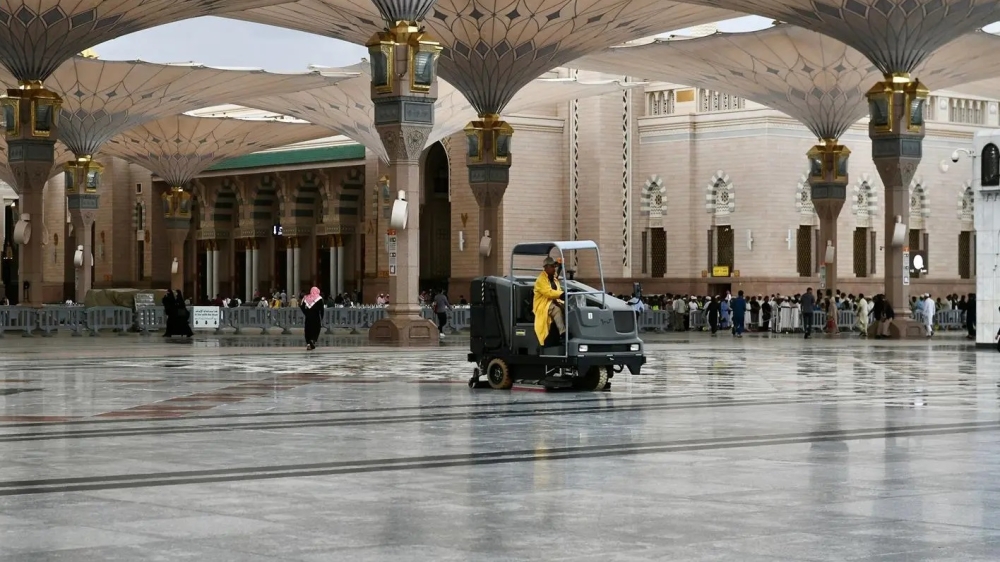
The General Authority for the Care of the Affairs of the Grand Mosque and the Prophet’s Mosque has intensified its field work in the courtyards and facilities of the Prophet’s Mosque. It has deployed its full capacity of human and mechanical resources in accordance with pre-prepared rainy weather plans, coinciding with the rainy conditions witnessed in Medina.
The authority removed carpets from exposed areas and worked on drying rainwater using machinery and manpower. It also organized pathways in the courtyards and distributed umbrellas to visitors and worshippers to ensure their safety, while providing various services to enable them to perform their worship with ease and tranquility.
Elevating the Level of Services
This comes within the framework of the authority’s commitment to caring for the Prophet’s Mosque and elevating the level of services provided to visitors and worshippers, in line with the aspirations to offer the best services to visitors of the Noble Prophet’s Mosque.
Prophet’s Mosque
The Prophet’s Mosque, located in Medina, Saudi Arabia, is the second holiest site in Islam. It was originally established and built by the Prophet Muhammad in 622 CE after his migration from Mecca. The mosque has been significantly expanded over the centuries and now serves as a vast architectural complex housing his tomb.
Grand Mosque
The Grand Mosque, often referring to the Masjid al-Haram in Mecca, is the largest mosque in the world and the holiest site in Islam. Its history dates back to the time of the Prophet Ibrahim (Abraham), with its focal point being the ancient Kaaba, a cubic structure that Muslims believe was originally built by him and his son Ismail. The mosque has been continuously expanded over centuries, most notably by various caliphs and the modern Saudi state, to accommodate the millions of pilgrims who perform the Hajj and Umrah pilgrimages annually.
Medina
The Medina refers to the historic old city center found in many North African towns, most famously in Fez, Marrakech, and Tunis. These walled districts, often dating back to the medieval period, are characterized by a dense maze of narrow streets, bustling souks (markets), mosques, and traditional houses. They were typically founded as the original urban core and remain vibrant centers of commerce and daily life, with many being designated as UNESCO World Heritage Sites for their cultural and architectural significance.
Noble Prophet’s Mosque
The Noble Prophet’s Mosque, also known as Al-Masjid an-Nabawi, is the second holiest site in Islam, located in Medina, Saudi Arabia. It was originally established and built by the Prophet Muhammad in 622 CE after his migration (Hijrah) from Mecca, and it houses his tomb. The mosque has been significantly expanded and renovated over the centuries, evolving from a simple, open-air structure into one of the world’s largest and most architecturally significant mosques.