The first comfortable tourist train from Hubei to Yunnan and Guizhou will depart this month.
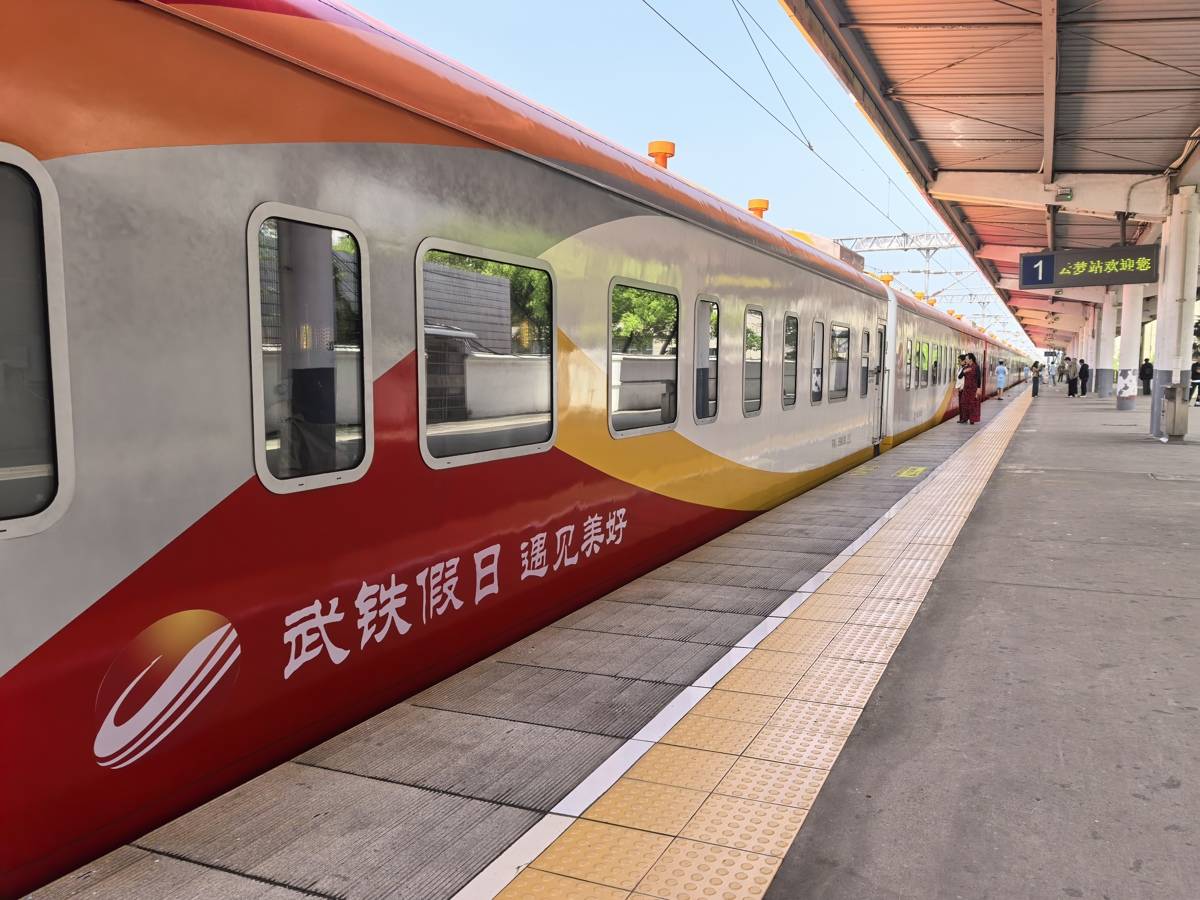
At 8:00 AM on April 10th, a train with a white body and red patterns, consisting of 18 carriages, was quietly waiting at platform 8 of Wuhan East Station. The train’s body was painted with Wuhan landmarks such as the Yellow Crane Tower and the Qingchuan Pavilion. This is the “Wutie Holiday · Encounter Beauty” comfortable tourist train, jointly launched by China Railway Wuhan Group Co., Ltd. and Encounter Beauty Cultural Tourism Technology Group, and it is also Hubei’s first comfortable tourist train.
The comfortable tourist train was upgraded and transformed from a conventional green-skinned train. Its operating speed is comparable to that of conventional passenger trains, approximately 120 kilometers per hour.
That day, the train departed from Wuhan East Station at 8:50 AM, traveled via Wuchang Station to Yunmeng Station, and returned to Wuchang Railway Station at 1:45 PM, completing its trial run. In addition to local Hubei residents, tourists from Taiwan, Hong Kong, as well as Singapore and Malaysia came specifically to experience it.
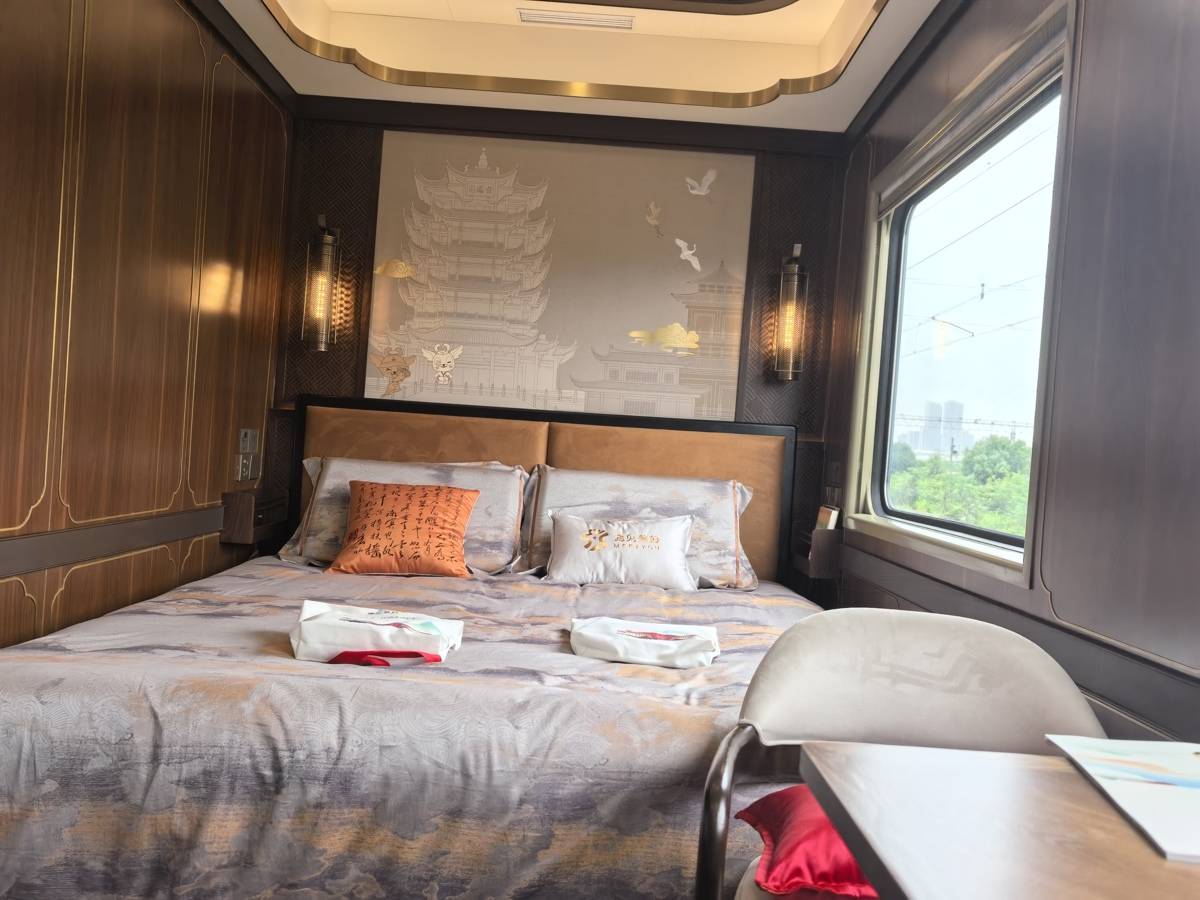
Unlike traditional trains, this train is custom-designed for tourism, focusing on comfortable, slow-paced travel. The entire train has only 231 seats, offering suites with large beds, double rooms, triple rooms, and quadruple rooms. All rooms are equipped with independent viewing windows, separate wet and dry bathrooms, safety handrails, and SOS emergency call buttons. The carriages feature a warm and tidy Chinese-style interior. Teams for dining, medical care, activities, guided tours, and concierge services accompany the journey throughout, providing customized nutritious meals, intangible cultural heritage handicraft experiences, 24-hour health support, and other special services.
A suite with a large bed.
The inaugural “12-Day Yunnan-Guizhou Tour” itinerary is scheduled to depart from Wuchang Station on April 15th. The journey connects Kunming, Dali, Lijiang, Tengchong, as well as Anshun and Bijie in Guizhou, covering attractions such as Dianchi Lake, Erhai Lake, the Jade Dragon Snow Mountain, and the Huangguoshu Waterfall. It also includes special experiences like Bai ethnic tie-dye, Tengchong hot springs, watching the “Dynamic Yunnan” song and dance performance, and tasting a flower banquet. The train primarily travels at night, with daytime scheduled for off-train sightseeing. During the 12-day trip, guests will spend some nights on the train and some in local hotels.
At the experience site, a Ms. Wang from Changsha visited with her daughter and granddaughter. She mentioned that the facilities on the train were very cozy, “like entering a home,” and the experience was excellent, so she plans to make a reservation. Her daughter, Ms. Xiao, was particularly interested in the train’s tea room.
Yellow Crane Tower
The Yellow Crane Tower is a historic landmark in Wuhan, China, originally built in 223 AD during the Three Kingdoms period as a military watchtower. It later became celebrated in Chinese poetry and folklore, most famously in a Tang dynasty poem by Cui Hao, and has been destroyed and rebuilt multiple times over the centuries. Today’s modern reconstruction serves as a symbol of the city and offers panoramic views of the Yangtze River.
Qingchuan Pavilion
Qingchuan Pavilion is a historic riverside pavilion located in Wuhan, China, overlooking the confluence of the Yangtze and Han rivers. First built during the Ming Dynasty in the 16th century, it is famously associated with the Tang Dynasty poet Cui Hao, whose poem “Yellow Crane Tower” inspired its name and cultural significance. The pavilion has been rebuilt several times and remains a noted scenic spot symbolizing classical Chinese architecture and literary heritage.
Dianchi Lake
Dianchi Lake, located near Kunming in Yunnan Province, is the largest freshwater lake on the Yunnan-Guizhou Plateau, often called the “Pearl of the Plateau.” Historically, it was a central part of the ancient Dian Kingdom’s culture over 2,000 years ago. While it has faced significant pollution challenges in recent decades, ongoing restoration efforts aim to revive its ecological health and scenic beauty.
Erhai Lake
Erhai Lake is a large freshwater lake in Yunnan Province, China, nestled at the foot of the Cangshan Mountains near the historic city of Dali. It has been a vital resource and spiritual site for the local Bai ethnic people for centuries, central to their agriculture, transportation, and folklore. The lake’s shores are dotted with ancient villages and historic sites, reflecting the region’s long history as a key hub on the ancient Southern Silk Road.
Jade Dragon Snow Mountain
Jade Dragon Snow Mountain is a sacred mountain range in Yunnan, China, revered by the local Naxi people for centuries. Its 13 peaks, with the highest reaching 5,596 meters, are perpetually snow-capped and form a dramatic backdrop to the city of Lijiang. Historically, it was a challenging site for climbing expeditions, with its main peak not summited until 1987.
Huangguoshu Waterfall
Huangguoshu Waterfall is the largest waterfall in China, located in Guizhou Province. It has been a renowned natural landmark for centuries, historically celebrated in Chinese poetry and travelogues. Today, it forms the centerpiece of a national park and is a major tourist attraction.
Bai ethnic tie-dye
Bai ethnic tie-dye is a traditional textile craft practiced by the Bai people of Yunnan, China, with a history dating back over a thousand years. Using natural plant dyes and intricate tying and stitching techniques, artisans create distinctive blue-and-white patterns often inspired by local flora, fauna, and cultural symbols. This craft, centered historically in towns like Zhoucheng, remains a vital part of Bai cultural identity and intangible heritage.
Tengchong hot springs
Tengchong hot springs are a renowned geothermal area in Yunnan Province, China, formed by volcanic activity along the Himalayan tectonic belt. Historically, they have been used for bathing and healing for centuries, with documented use dating back to the Ming Dynasty. Today, they remain a popular destination for wellness tourism and geological study.