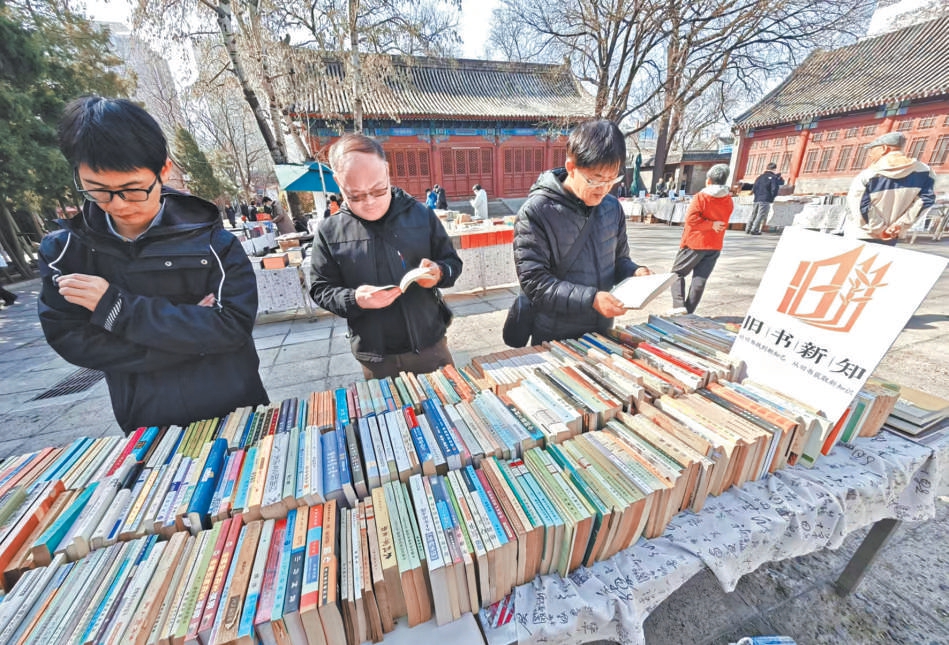
Ancient Temple Filled with the Scent of Books, Perfect Time for Spring Reading
With spring in full bloom, an ancient temple is filled with fragrance. At Baoguo Temple in Xicheng District, an elegant gathering centered on antiquarian books, aimed at nurturing the city’s cultural heritage through literature, has arrived as scheduled. The event “Reading for the Nation, Spring Reading at Gu’s Shrine” was held here, marking the opening of the 2026 Baoguo Temple Antiquarian Book Fair. It also officially launched the “Read in the Community” activity brand, serving as a concrete manifestation of advancing the implementation of the “National Reading Promotion Regulations” in Xicheng.
Exploring Stalls at the Book Fair to Discover Treasures and Experience Intangible Cultural Heritage
At 10:30 AM, a clear and melodious sound of a gong resonated from the platform in front of the third hall of Baoguo Temple, signaling the official opening of the 2026 Baoguo Temple Antiquarian Book Fair. This announced that this centuries-old temple was once again immersed in the fragrance of old books and new knowledge.
Following the ceremony, the site quickly transformed into a dialogue across time and space. Cultural figures eloquently recounted the historical and cultural legacy of Baoguo Temple. Subsequently, a poetry recital titled “Reading for the Nation, Spring Reading at Gu’s Shrine,” performed by representatives from new employment groups, elementary school students, a veterans’ choir, model civil units, united front personages, and community workers, brought the event to a climax, vividly interpreting the spiritual inheritance of “reading for the nation.”
Simultaneously, a unique “Guangnei Cultural Corridor” creative market opened, adding a rich atmosphere of daily life and interactive fun to the spring reading event. The market was orderly planned, with various characteristic stalls forming a cultural square from near to far. On one side was the “Book Fragrance Corridor” jointly presented by publishing houses, where classic texts and cutting-edge readings were readily available, allowing visitors to serendipitously discover the joy of reading. The other side gathered a dazzling array of intangible cultural heritage projects such as Beijing wax fruit, Guo’s micro-carving, Beijing court embroidery patchwork, Cao’s kites, Yu’s straw weaving, and Beijing embroidered tiger-head shoes. Artisans demonstrated their skills on-site, bringing techniques dormant in ancient texts to life at their fingertips. Additionally, local memory carriers like the former residence of Shen Jiaben and the Xuannan Museum, alongside time-honored brands and new cultural consumption brands such as Zhang Yiyuan, Guohua Mall, and Benzhen Coffee, gathered together, collectively painting a panoramic picture of community cultural life that is “readable, appreciable, enjoyable, and purchasable.”
“Four Seasons Cultural Calendar” Released
During the opening event of the Baoguo Temple Antiquarian Book Fair, Guangnei Subdistrict in Xicheng District released the “You’re ‘In'” and “Read in the Community” four-season themed activity plan, further enriching the scope of the Baoguo Temple Antiquarian Book Fair.
Rooted in the soil of “Xuannan Culture” and with the spirit of “reading for the nation” at its core, this plan outlines a vivid picture of “themes for every season, activities for every month.” Spring Harmony & Xuannan Rhyme: telling Xuannan stories together, savoring Xuannan’s past, and feeling historical changes through the scent of books. Summer Lushness & Intangible Heritage Revival: reading classic literary works together, combining historical reading with traditional craft experiences to rejuvenate ancient intangible heritage in modern life. Autumn Clarity & Cultural Legacy Transmission: sharing red stories from the “Beijing Red Map,” deepening education in original aspirations through the inheritance of red cases. Winter Warmth & Cultural Care: demonstrating reading gains through reading showcases, releasing Guangnei Subdistrict’s annual reading list, and displaying the year’s achievements in national reading.
The release of this “Four Seasons Cultural Calendar” marks the evolution of “Read in the Community” from an activity brand into a year-round, content-rich, and sustainable cultural inheritance activity, forming the “Guangnei Experience” in Xicheng’s cultural development. Relying on New Era Civilization Practice centers and volunteer teams, the activity collects public needs and builds communication bridges through a series of reading events. Using culture as a bond, it narrows the distance with the public, enhances the soft power of grassroots governance, and achieves a two-way promotion of cultural benefits for the people and governance