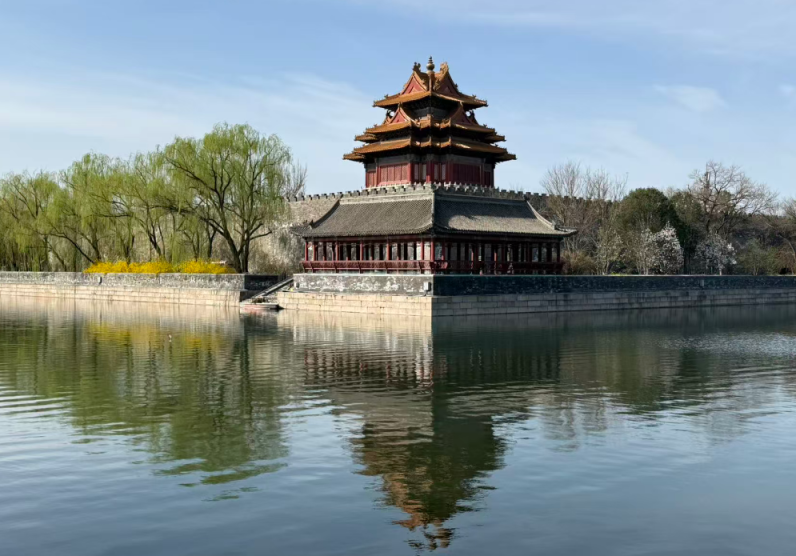
In 2026, the Beijing Meteorological Observatory’s representative station recorded the start of spring on March 22. The average start of spring for the period 1991-2020 is March 26.
According to the National Standard of the People’s Republic of China “Classification of Climatic Seasons” (GB/T 42074-2022): The start date of spring is defined as the first date with a daily average temperature greater than or equal to 10°C within a sequence of daily average temperatures (spanning 9 days). This sequence corresponds to the first instance where the 5-day moving average temperature sequence of the year registers five consecutive values greater than or equal to 10°C.
Based on preliminary observations, Beijing’s 5-day moving average temperature sequence began to reach or exceed 10°C starting March 22, 2026, and achieved five consecutive days at or above 10°C by March 26. Within the corresponding average temperature sequence, the first date with a temperature greater than or equal to 10°C was March 22 (14.6°C). Therefore, it is determined that the start of spring in Beijing for 2026 was March 22, which is 4 days earlier than the average start date.
Beijing Meteorological Observatory
The Beijing Meteorological Observatory, established in 1954, is a key institution for weather forecasting and climate research in China’s capital. It plays a vital role in monitoring atmospheric conditions, issuing public warnings, and supporting major national events, reflecting the country’s long-standing emphasis on meteorological science.
National Standard of the People’s Republic of China “Classification of Climatic Seasons” (GB/T 42074-2022)
The “National Standard of the People’s Republic of China ‘Classification of Climatic Seasons’ (GB/T 42074-2022)” is a technical standard issued in 2022 that defines and categorizes the seasons across China based on precise meteorological data. It was developed to provide a unified scientific basis for activities in agriculture, industry, public services, and daily life, reflecting China’s ongoing effort to standardize environmental and climatic information for national planning and public use.
Beijing
Beijing is the capital of China and a major historical and cultural center, with a history spanning over 3,000 years. It served as the seat of imperial power during the Ming and Qing dynasties, famously housing the Forbidden City. Today, it is a global metropolis that blends ancient landmarks like the Great Wall and Temple of Heaven with modern political and economic institutions.