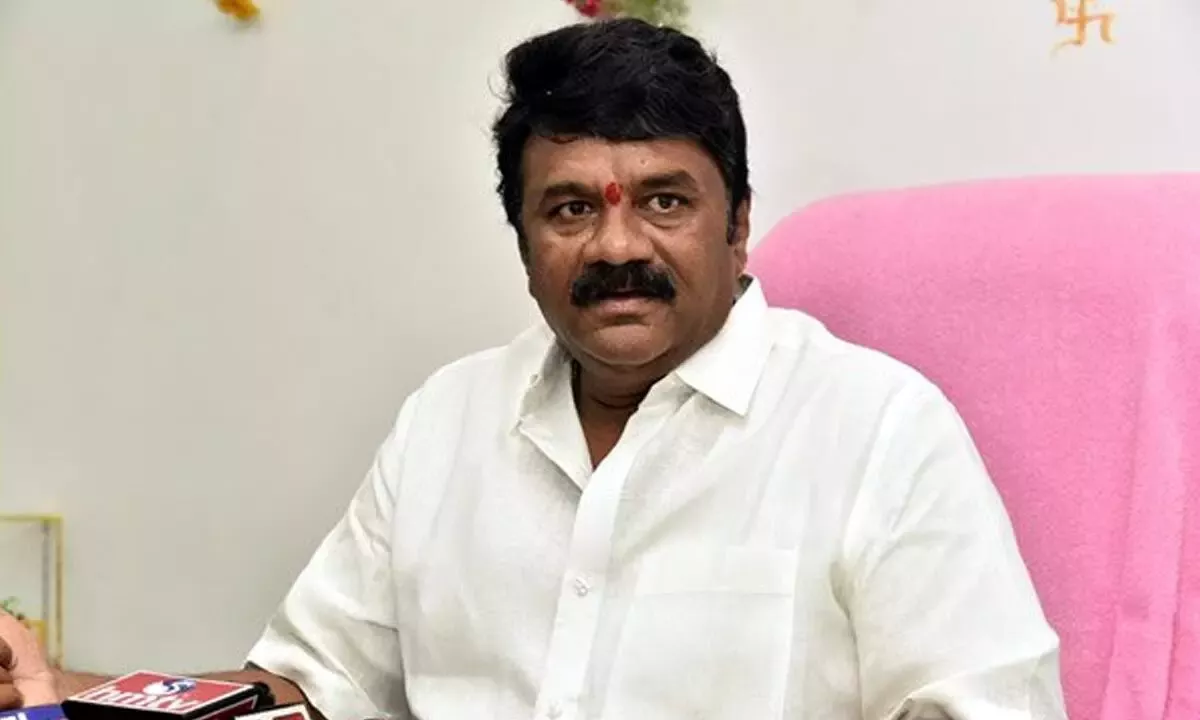
Hyderabad, In the Legislative Assembly, former minister and deputy floor leader Talasani Srinivas Yadav challenged the government on issues concerning the Backward Classes (BC) and demanded the implementation of the Kamareddy BC Declaration. He stated that before the elections, the Congress party gave false assurances to deceive the state’s public. Initiating the discussion on grant demand papers in the Assembly, Srinivas Yadav said that the BC population constitutes 56 percent of the total population in the state.
Before the elections, Congress had promised in the Kamareddy Declaration to provide 42 percent reservation for the BC class. Along with this, they assured a budgetary allocation of 20 thousand crore rupees annually for the welfare of the BC class, but Congress betrayed the BC class by not fulfilling these assurances. He said that upon coming to power, Congress did not even spend 20 percent of the budget allocated for the BC class.
BC Class Promises Unfulfilled, Questions on Budget and Reservation
During the first two years, 13,405 crore rupees were allocated, but the released budget was not spent at full capacity. Senior Congress leader Rahul Gandhi had also assured providing 42 percent reservation to the BC class. He said that according to the decisions of the Supreme Court and High Court, it is not possible to provide 42 percent reservation to the BC class in Telangana; the authority to decide on this lies with the central government.
Deciding on the BC sub-plan instead of reservation is in the hands of the state government, but it is not implementing it. He said that allocating a budget of 20 thousand crore rupees is within the state government’s power, but the government is not implementing it. He stated that the struggle to secure the rights given by Ambedkar continues and will persist.
Talasani said that the caste census in the state was also not conducted transparently. Not only that, the BC Commission’s report has not been made public yet. He said that the Congress government is committing grave injustice against the BC class, a fresh example of which is not releasing the pending fee reimbursement amount related to BC class students. In contrast, the other party has always done justice to the BC class.
BC Class Rights and Scholarship Dispute
Under the leadership of former Chief Minister K. Chandrashekar Rao, a person from the BC class was appointed as the Vice-Chancellor of Osmania University. During the other party’s tenure in power, fee reimbursement was never stopped. Not only that, two BC class leaders, Vanga Prakash and Lingam Yaddayya, were sent to the Rajya Sabha. He said that during KCR’s rule, BC class students studying abroad were provided financial assistance of 20-20 lakh rupees, but this government has not even released scholarships.
K. Chandrashekar Rao also raised questions on Congress not presenting a private bill in Parliament to provide 42 percent reservation to the BC class. Not only that, during Congress’s rule, IAS and IPS officers belonging to the BC class are being sidelined to loop lines instead of being appointed to important posts, showing discriminatory attitude.
Objecting to Srinivas Yadav’s statement, Panchayat Raj Minister Sitakka said that Rahul Gandhi had given the slogan of ‘population proportion share’. Based on this, the Congress government is striving to secure the BC class’s due share. She questioned what kind of justice the other party delivered to the BC class during its 10-year rule. Law Minister D. Sridhar Babu intervened, stating that when there are mistakes in history, it is everyone’s responsibility to correct them.
Congress Demands 20 Thousand Crore for BC Class
The Congress government is working with the aim of rectifying the injustice done to the BC class. Stating that politics should not be played over these issues, she appealed for cooperation. She said that Congress MPs have also met the President and made recommendations for BC reservation. Sports and Youth Affairs Minister Vakiti Srihari strongly objected to Talasani Srinivas Yadav’s statement, saying that he is a BC class leader.
He would have good experience of the hell one has to go through for a BC class leader to reach this level. In response, Srinivas Yadav said that he is a leader of a major brand and how he endured hardships to reach this level; he does not need anyone else’s certificate to prove himself.
<p