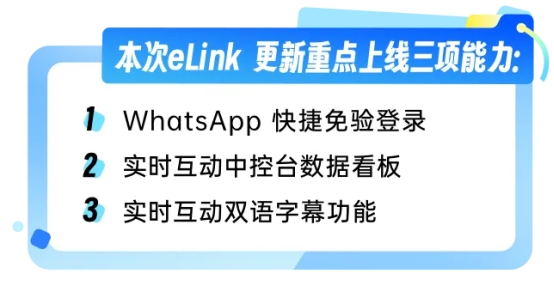
Recently, the eLink platform, independently launched by the overseas team, has completed optimization for a new version. Centered around the core needs of overseas user habits and merchant expansion operations, it has introduced functional upgrades across three key areas: login experience, real-time interactive operations, and cross-language communication. Through product capabilities designed for local adaptation, it streamlines the critical pathways for merchant expansion, helping businesses more smoothly connect with users in Southeast Asia and multiple global regions. This makes overseas online operations more aligned with local ecosystems, more efficient, and more convenient.
When conducting online operations in Southeast Asia and globally, merchants often encounter various localization challenges: some Southeast Asian users are hesitant about verification code operations, easily abandoning subsequent steps during login; it’s difficult to intuitively grasp live participation during real-time interactions, hindering timely adjustments to operational pacing; and communication barriers with multilingual user groups directly impact the user participation experience. Targeting these common pain points in expansion operations, this eLink update focuses precisely, introducing three core functional upgrades to solve these operational challenges one by one, covering the full spectrum of user login, real-time interaction, and cross-language communication.
Adapting to Local Habits: Optimizing WhatsApp Quick Login Experience
Considering the usage preferences and security concerns of users in some Southeast Asian regions, this eLink version introduces a WhatsApp Quick Login feature. This simplifies the login process in a way more aligned with local user habits, eliminating user login hesitations.
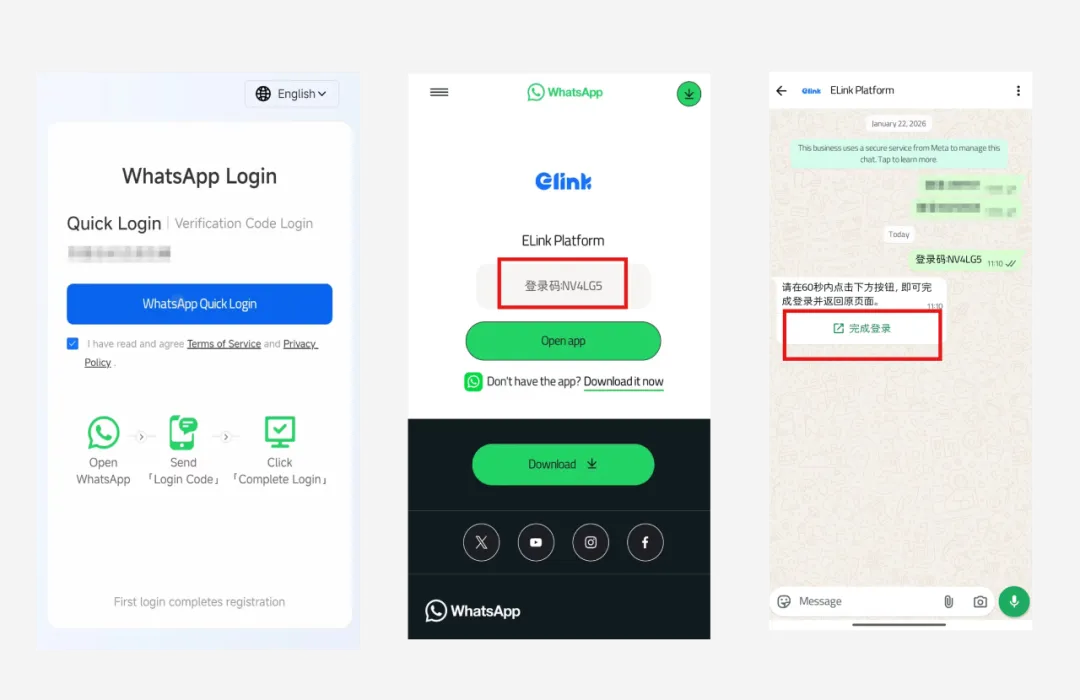
This feature delivers three core optimizations for a more convenient login operation: First, no verification code input is required; users can obtain a login link by actively sending a message, fitting the secure usage habits of Southeast Asian users. Second, the system can automatically launch the WhatsApp application and pre-fill verification information; after sending a message, users quickly receive the login link, making the process simple and smooth. Third, after login completion, users can directly return to their original access context—whether it’s a marketing interaction page, product display page, or live chat page—without repeating steps, significantly shortening the login path and enhancing the user experience.
Launching Data Dashboard to Enhance Real-Time Interactive Operation Efficiency
When conducting overseas real-time interactive operations, timely understanding of live participation is key for merchants to flexibly adjust their operational rhythm. This eLink update introduces a real-time interactive console data dashboard, providing merchants with an intuitive and convenient interface for operational data display to support refined operations.
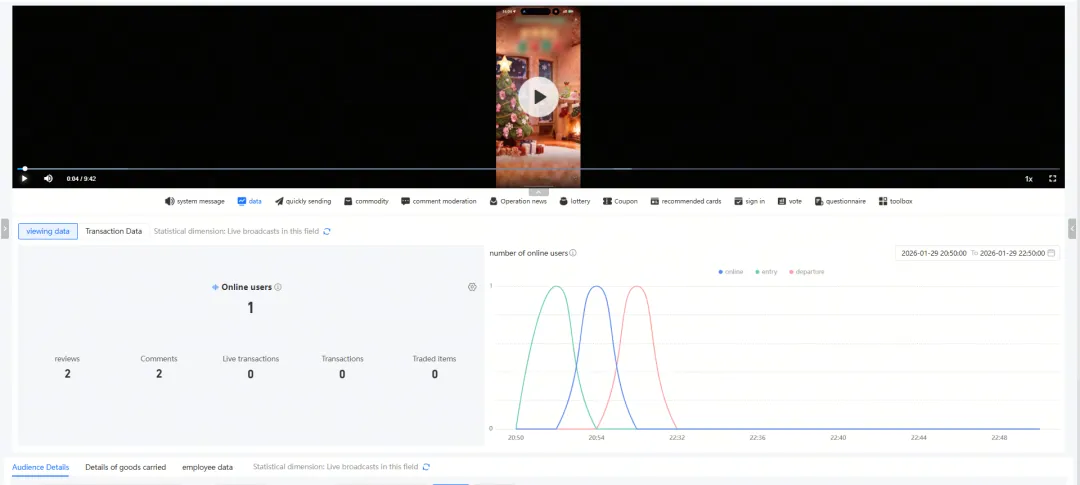
The core capabilities of the data dashboard are主要体现在 in three areas: With user authorization, it clearly displays real-time online user data and online trend curves, allowing merchants to直观 grasp the popularity changes during an interactive session. Leveraging real-time data, merchants can quickly assess the effectiveness of marketing interactions and flexibly adjust the interaction pace, product explanation methods, and conversion strategies accordingly. The dashboard features a lightweight design with no operational barriers, requiring no professional technical skills for easy adoption, comprehensively assisting merchants in managing the entire real-time interaction process. Through the dashboard’s直观 presentation, merchants can achieve timely adjustments to their operational strategies, making real-time interactive operations more targeted.
Adding Bilingual Subtitle Feature to Lower Cross-Language Communication Barriers
When operating for global multilingual user groups, language differences pose a significant communication challenge for merchants. To break down cross-language communication barriers, this eLink version officially launches a real-time interactive bilingual subtitle feature, covering multilingual translation needs to enhance the participation experience for users of different language backgrounds.
This feature supports simultaneous display of subtitles in multiple languages including Chinese, English, Japanese, Korean, Malay, Thai, and Vietnamese. During real-time interactions, users from different language backgrounds can clearly understand the content through subtitles, effectively boosting their sense of participation and experience. Simultaneously, the bilingual subtitle feature can reduce the manual workload of creating subtitles for merchants, improving the efficiency of cross-language communication. Whether in product introductions, marketing interactions, or online exchange scenarios, it helps merchants more smoothly reach users in different countries and regions, enabling efficient cross-language communication.
As more and more merchants expand into overseas markets, the localization of product capabilities has become a core key to expansion operations. This eLink functional upgrade, starting from the three critical areas of login experience, real-time interactive operations, and cross-language communication