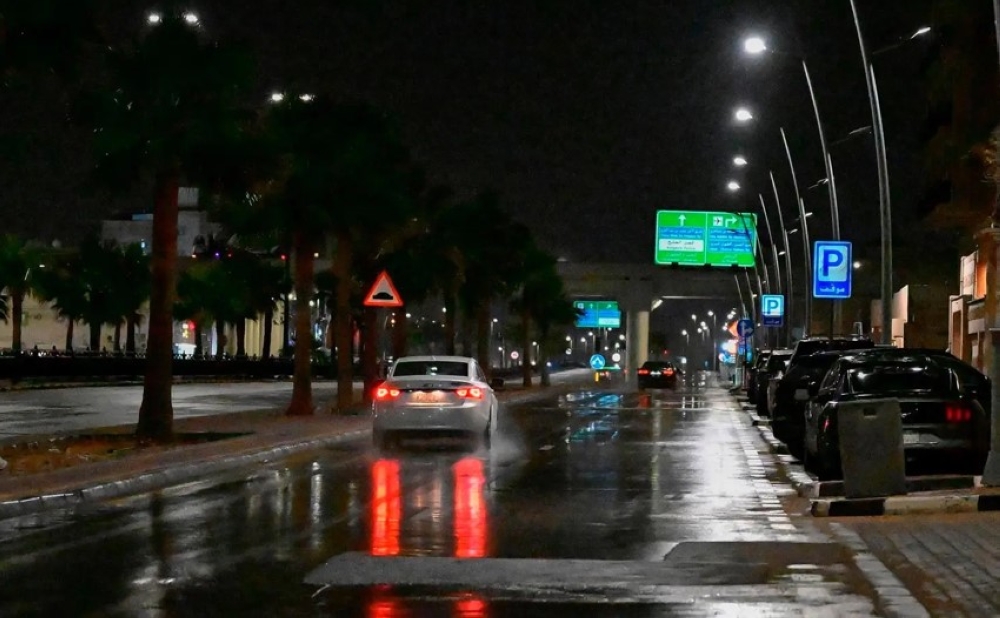
The National Center of Meteorology has warned of the possibility of thunderstorms accompanied by flash floods forming in multiple regions of the Kingdom. The forecast includes moderate to heavy rain with a chance of hail, in addition to active winds raising dust and sand and reducing visibility in parts of the Medina, Tabuk, Al-Jawf, Northern Borders, Hail, Qassim, Riyadh, and Eastern Province regions.
The Center also indicated forecasts of light to moderate rain in the Jazan, Asir, Al-Baha, and Makkah regions, with a chance of fog formation in those areas.
Regarding the Red Sea, the Center expects surface winds to be southeasterly to southerly, gradually turning to northwesterly and northerly at speeds ranging between 20 and 55 kilometers per hour, with wave heights ranging from 1.5 to 2.5 meters, and sea conditions ranging from moderate to rough.
As for the Arabian Gulf, it is expected to experience northwesterly to northerly surface winds, turning to northeasterly to easterly in the afternoon at speeds between 10 and 35 kilometers per hour, possibly reaching 50 kilometers per hour with the formation of rain-bearing thunderclouds in the northern part. Wave heights are expected to range from half a meter to one and a half meters, possibly reaching two and a half meters with rain-bearing thunderclouds in the northern part, with sea conditions ranging from light to moderate and possibly becoming rough in the northern part.
Medina
The Medina is the historic old city center found in many North African towns, most famously in Fez, Marrakech, and Tunis. These walled districts, often dating back to the medieval period, are characterized by a dense maze of narrow alleyways, bustling souks (markets), mosques, and traditional houses. They serve as a living testament to Islamic urban design and social life, having been the heart of commerce, culture, and community for centuries.
Tabuk
Tabuk is a historic city in northwestern Saudi Arabia, known today as a major urban center and gateway to the region’s developing tourism and agricultural projects. Its history is deeply rooted, as it was an important station on the ancient incense trade route and is mentioned in Islamic tradition in connection with the Expedition of Tabuk during the time of the Prophet Muhammad. The area also features archaeological sites like the ancient Tabuk Castle, which has been restored and reflects its long role as a strategic stop for pilgrims and traders.
Al-Jawf
Al-Jawf is a historical region in northwestern Saudi Arabia, known for its ancient oasis settlements and archaeological sites. It was a key part of the early trade routes, such as the Incense Road, and is home to significant ruins like the ancient city of Dumat al-Jandal, which dates back thousands of years. Today, it serves as an important agricultural area and a window into the pre-Islamic history of the Arabian Peninsula.
Northern Borders
The Northern Borders region is a vast, historically significant area in Saudi Arabia, known for its ancient trade routes and archaeological sites like the rock art at Jubbah. It served as a crucial crossroads for caravans and civilizations for millennia. Today, it is a developing frontier province that preserves this deep heritage while focusing on modern growth and tourism.
Hail
Hail is a historic city and province in northern Saudi Arabia, known as its central role in the traditional Najdi region. It was historically the seat of the powerful Al Rashid dynasty, which rivaled the Al Saud family for control of the Arabian Peninsula in the 19th and early 20th centuries. Today, it is a cultural hub famous for its preserved heritage, including the iconic Barzan Palace and its deep association with classical Arabic poetry and the legendary Hatim al-Tai.
Qassim
Qassim (also spelled Al-Qassim) is a central region of Saudi Arabia, historically significant as a major agricultural heartland and a crossroads for ancient trade and pilgrimage routes. Its capital, Buraydah, is famous for its annual date festival, reflecting the area’s deep-rooted farming heritage. Historically, the region was also a center for the spread of Islamic scholarship and witnessed pivotal events during the formation of the modern Saudi state.
Riyadh
Riyadh is the capital and largest city of Saudi Arabia, serving as the nation’s political, financial, and administrative center. Historically a walled oasis town and the historic seat of the Al Saud dynasty, its modern transformation began after it was recaptured in 1902 by King Abdulaziz Ibn Saud, who later unified the kingdoms and used it as the foundation for the modern Saudi state. Today, it is a sprawling metropolis known for its modern skyscrapers, such as the Kingdom Centre, while also preserving historic sites like the Masmak Fortress.
Eastern Province
The Eastern Province is a key region of Saudi Arabia, historically significant as the heart of the nation’s oil industry following the discovery of commercial quantities at Dammam Well No. 7 in 1938. It is also home to a rich cultural heritage, including the ancient Dilmun civilization sites and the traditional **Hofuf Oasis**, one of the world’s largest natural oases. Today, it is a major economic hub centered around cities like Dammam, Khobar, and Dhahran.