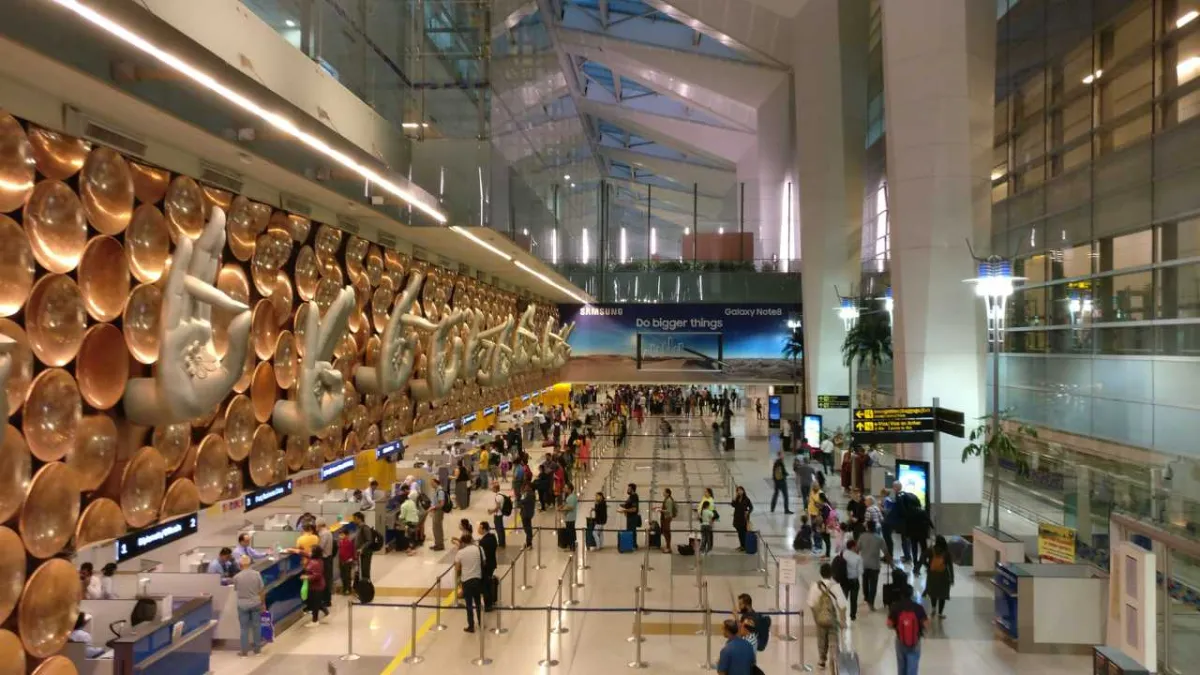
Amidst tensions rising in the Middle East, Indian citizens have returned home from Muscat, Oman. The citizens who returned to India breathed a sigh of relief upon reaching home safely on Tuesday and appreciated the authorities’ efforts in handling the tense situation in the region.
Following the death of Iran’s Supreme Leader Khamenei in an Israeli-American attack, Iran launched missile strikes on countries where the US has established its bases. In this sequence, Iran attacked several countries including Dubai, Bahrain, and Kuwait, after which the lives of ordinary citizens were thrown into turmoil.
Several passengers who arrived in Delhi from Muscat said, “Missiles were being intercepted and out of fear we decided to return. The government handled the situation very well.
Since our children were with us, we were quite worried. Seeing the current situation, we panicked. The sounds of missiles being intercepted were very loud, which was troubling the children.”
Another passenger from Muscat said, “We returned because we did not feel completely safe there. The missile defense system was working very effectively. I personally wasn’t very scared, but we had children with us, so we thought it would be better to return to India. Everything is fine now.”
Passenger Adil shared his experience, saying, “We faced a lot of uncertainty there. Due to many flight cancellations, we were worried about missing our flight. We contacted the Indian embassy for assistance.
After returning to India, I feel a great sense of relief and happiness. Initially, flights were suspended, but now services have been restored. My return journey was smooth and I did not face any major problems during the travel.”
The passengers’ return comes a few days after Iran targeted parts of the region with drones and missiles, which led to the temporary suspension of airport operations.
Thousands of Indians stranded in the United Arab Emirates (UAE) faced inconvenience due to flight cancellations and the closure of airspace in some parts of the Middle East.
The operation of several flights from Dubai and Abu Dhabi has resumed. After several days of suspension, aircraft landed in Delhi, Mumbai, and Bengaluru on Monday night.
Dubai airports have confirmed the partial resumption of operations and advised passengers not to go to the airport unless they have received confirmation of departure from their airline.
The restoration of flight services has brought significant relief to stranded passengers and their families who were awaiting their safe return.
Muscat
Muscat is the capital and largest city of Oman, a historic port city on the Arabian Sea with a history dating back over two millennia. It is known for its strategic maritime importance, traditional white-washed architecture, and landmarks like the 16th-century Portuguese forts of Al Jalali and Al Mirani. Today, it serves as Oman’s modern political and economic center while carefully preserving its cultural heritage.
Oman
Oman is a country on the southeastern coast of the Arabian Peninsula with a rich history as a major maritime trading power, dating back to ancient times when it controlled routes across the Indian Ocean. Its cultural identity is deeply tied to Ibadism, a distinct branch of Islam, and is reflected in well-preserved sites like the Bahla Fort, a UNESCO World Heritage site. Today, it is known for its dramatic desert and mountain landscapes, historic forts, and its modern transformation under the long reign of Sultan Qaboos bin Said.
Dubai
Dubai is a major global city and emirate in the United Arab Emirates, historically known as a small fishing and pearling village. Its modern transformation began with the discovery of oil in the 1960s, but it has strategically diversified its economy into tourism, finance, and trade. Today, it is renowned for its ultramodern architecture, luxury shopping, and ambitious landmarks like the Burj Khalifa, the world’s tallest building.
Abu Dhabi
Abu Dhabi is the capital and second-most populous city of the United Arab Emirates, located on an island in the Persian Gulf. Historically a small fishing and pearling village, its modern history began in the late 18th century with the settlement of the Bani Yas tribe, and it was transformed into a global metropolis following the discovery of oil in the mid-20th century. Today, it is a major political, economic, and cultural hub, known for landmarks like the Sheikh Zayed Grand Mosque and Louvre Abu Dhabi.
Delhi
Delhi is India’s capital city, with a history spanning over two millennia, serving as the seat of several empires including the Delhi Sultanate and the Mughals. It is a major cultural and political hub, home to UNESCO World Heritage Sites like the Red Fort and Qutub Minar, which reflect its layered historical legacy. Today, it is a bustling metropolis blending ancient monuments with modern urban life.
Mumbai
Mumbai, formerly known as Bombay, is a major port city on India’s west coast and the financial capital of the country. Its modern history began in the 17th century when it was transferred from Portuguese to British control, growing into a global trade hub and a center for India’s film industry, Bollywood. Today, it is a densely populated metropolis known for landmarks like the Gateway of India and its vibrant, diverse culture.
Bengaluru
Bengaluru, the capital of India’s Karnataka state, is a major tech hub known as the “Silicon Valley of India.” Historically, it was founded in the 16th century by Kempe Gowda I and later became a prominent British military station in the 19th century. Today, it blends its rich heritage, visible in sites like the Bangalore Palace and Tipu Sultan’s Summer Palace, with rapid modern urbanization.
United Arab Emirates (UAE)
The United Arab Emirates (UAE) is a federation of seven emirates on the Arabian Peninsula, formed in 1971 following the end of British protection treaties. Historically a region of pearl diving, fishing, and trade, it was transformed by the discovery of oil in the mid-20th century, leading to rapid modernization and the development of globally iconic cities like Dubai and Abu Dhabi. Today, it is known for its blend of deep-rooted Arab-Islamic heritage and ultramodern architecture, economy, and cosmopolitan society.