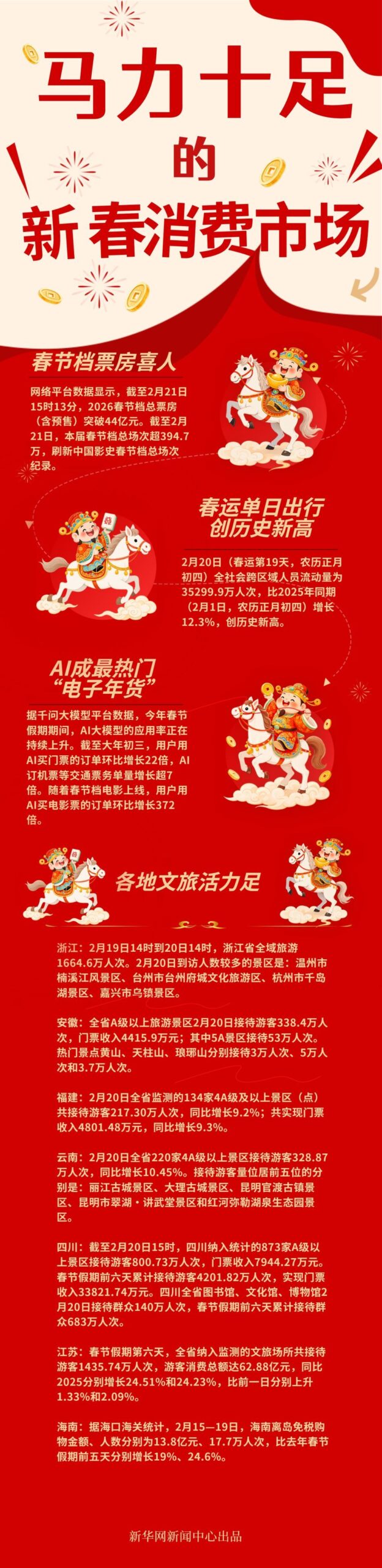
“Full Throttle” Spring Festival Consumer Market
The Spring Festival holiday has just concluded, and the consumer market across the country has demonstrated remarkable vitality, showing a “full throttle” momentum. Data indicates that during this holiday period, the total retail and catering sales nationwide exceeded 800 billion yuan, a year-on-year increase of 8.5%, setting a new historical record.
This year’s Spring Festival consumer market presents several notable characteristics. Firstly, the “home economy” continues to heat up. Sales of smart home appliances, kitchen appliances, and home fitness equipment have all seen significant growth. Secondly, experiential consumption has become a new trend. Popular activities such as temple fairs, lantern shows, ice and snow tourism, and short-distance trips around the city were well-received. Additionally, the integration of online and offline channels has become more seamless. Many physical stores leveraged live streaming and short videos to guide traffic, while e-commerce platforms offered “New Year’s goods delivered to your doorstep” services, greatly facilitating consumers.
Industry experts point out that the booming Spring Festival consumer market reflects the continuous recovery and enhancement of China’s consumption capacity, as well as the ongoing optimization and upgrading of the consumption structure. It is expected that with the further implementation of policies to expand domestic demand, the consumer market will maintain a stable and positive development trend.
In major commercial districts of various cities, there was a constant flow of people, creating a bustling atmosphere. Many shopping malls were decorated with festive red lanterns and Chinese knots, and a variety of promotional activities successfully attracted a large number of customers. A consumer, Ms. Zhang, said, “This year, I not only bought New Year’s goods but also signed up for a parent-child experience class. The whole family had a great time, and it felt very meaningful.”
It is understood that to ensure a prosperous and stable holiday market, relevant departments strengthened the monitoring of market supply and prices in advance, ensuring an ample supply of goods and maintaining stable prices.
temple fairs
Temple fairs are traditional Chinese folk gatherings that originated centuries ago as religious events held at or near temples to honor deities and ancestors during festivals. Over time, they evolved into vibrant cultural carnivals featuring performances, street food, handicrafts, and games, blending spiritual observance with community celebration. Today, they remain popular seasonal events, especially during the Lunar New Year, preserving ancient customs while serving as lively hubs of social and economic activity.
lantern shows
Lantern shows are a traditional Chinese cultural practice, often associated with festivals like the Lantern Festival on the 15th day of the Lunar New Year. Historically, they date back over 2,000 years to the Han Dynasty, originally serving as ceremonial lights to worship Buddha. Today, they feature intricate, often themed displays of illuminated silk or paper lanterns, symbolizing the wish for a bright future and family reunion.
ice and snow tourism
Ice and snow tourism centers on travel to cold-weather destinations, primarily for winter sports like skiing and snowboarding, as well as seasonal festivals and ice sculpture displays. Its modern history is largely tied to the 19th and 20th centuries, with the development of ski resorts in the Alps and the popularization of winter holidays. Today, it is a major global industry, with iconic sites ranging from the Harbin Ice Festival in China to the ski slopes of the Canadian Rockies.
short-distance trips
“Short-distance trips” is not a specific place or cultural site, but a general travel concept. Historically, such local travel became more accessible with the rise of public transit and, later, the automobile, allowing people to explore nearby towns, parks, and cultural attractions. Today, it is often associated with day trips or weekend getaways to experience local history, nature, or events without extensive travel.
shopping malls
Shopping malls are large, enclosed retail complexes that emerged in the mid-20th century, particularly in the United States, as a response to suburbanization and the rise of automobile culture. They consolidated numerous stores, services, and entertainment venues under one roof, becoming central hubs for commerce and social activity. While their popularity has faced challenges from online shopping, many have evolved into mixed-use “lifestyle centers” to remain relevant community spaces.
red lanterns
“Red lanterns” are a traditional Chinese decorative item, most famously associated with the historic **Pingyao Ancient City** in Shanxi province. Originating during the Ming and Qing dynasties, they were used to symbolize prosperity, celebration, and good fortune, and became a defining visual feature of the city’s old banking streets and courtyard homes. Today, rows of iconic red lanterns hanging throughout Pingyao’s ancient architecture have become a globally recognized symbol of traditional Chinese culture and a major tourist attraction.
Chinese knots
Chinese knots are a traditional decorative handicraft originating from ancient China, dating back to the Tang and Song dynasties, where they were used for practical fastening and later evolved into symbolic art. Each intricate design, often made from a single red cord, carries auspicious meanings—such as good luck, prosperity, or unity—reflecting cultural values and folklore. Today, they remain popular as gifts and ornaments during festivals like Chinese New Year, preserving a timeless link to China’s artistic heritage.
parent-child experience class
A parent-child experience class is a modern educational activity designed for shared participation between adults and children, typically focusing on hands-on learning in areas like arts, crafts, or science. These classes emerged from contemporary educational philosophies emphasizing bonding and interactive skill-building, rather than having a deep historical origin. They reflect a growing cultural emphasis on quality family time and experiential learning outside traditional school settings.