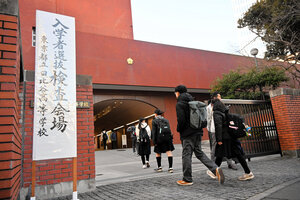
General entrance examinations for high schools were held on the 21st. According to the Metropolitan Board of Education, 35,310 applicants took the exams for 30,337 available spots across 167 full-time schools. The competition ratio was 1.16 times, 0.04 points lower than the previous year, making it the second lowest since the current exam system was introduced in 1994, following the 1.14 ratio recorded that year.
At High School, 420 applicants took the exam for 253 available spots. Examinees gathered before the gates opened at 7:45 AM. Accompanied by parents and cram school teachers who came to cheer them on, they entered the school building while receiving words of encouragement like “Do as you usually do” and “Do your best,” along with handshakes.
According to the Metropolitan Board of Education, a technical issue occurred at Setagaya Sogo High School where the volume for all five questions in the English listening section was too low to hear. All examinees (174 individuals) will be uniformly awarded 20 points for this section. The issue is believed to be caused by a malfunction in the broadcasting equipment.
The overall non-attendance rate for full-time schools increased by 0.2 percentage points from the previous year to 7.2%. The number of schools where the number of applicants fell below the recruitment capacity increased by 4 from the previous year to 66 schools.
Results will be announced on each school’s website at 8:30 AM on March 2nd. For full-time schools, the results will also be posted on school premises starting from 9:30 AM on the same day.
General entrance examinations
“General entrance examinations” refer to standardized tests used for university admissions in many countries, most famously China’s National College Entrance Examination (Gaokao). Historically, such exams have roots in ancient imperial civil service systems, like China’s keju, which aimed to select officials based on merit. Today, they are pivotal, high-stakes events that significantly shape educational and career trajectories for millions of students annually.
Metropolitan Board of Education
The Metropolitan Board of Education was the public body responsible for overseeing London’s elementary schools from 1870 to 1904. It was established by the Elementary Education Act 1870 to fill gaps in schooling and famously built a system of secular “board schools,” many in distinctive red-brick Victorian buildings. Its work was crucial in expanding basic education for London’s children before its functions were transferred to the London County Council.
High School
A high school is a secondary educational institution, typically for students aged 14-18, that prepares them for higher education or vocational paths. Its modern form evolved in the 19th and 20th centuries, expanding from classical curricula to a broader, more accessible public education system. Today, it serves as a central community institution for academic, social, and personal development.
Setagaya Sogo High School
Setagaya Sogo High School is a private high school located in Setagaya Ward, Tokyo, Japan. It was founded in 1983 as part of the Tamagawa Gakuen educational group, which has a longer history dating back to 1929, and is known for its comprehensive curriculum and emphasis on both academic and club activities.