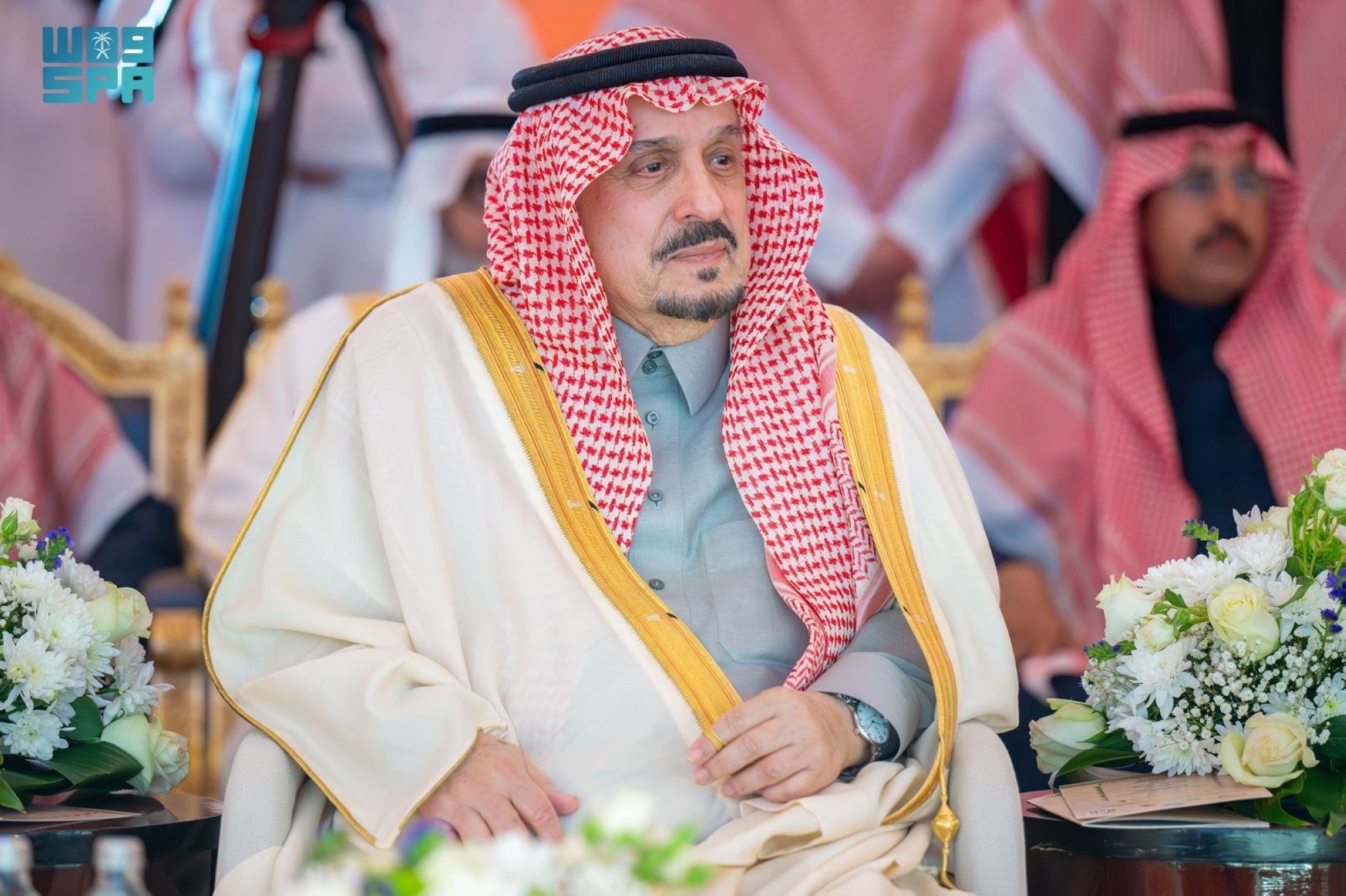
Under the patronage of the Custodian of the Two Holy Mosques, King Salman bin Abdulaziz, and on his behalf, the Amir of Riyadh, Prince Faisal bin Bandar, honored yesterday evening the winners of the local competition for the King Salman bin Abdulaziz Award for the Memorization, Recitation, and Interpretation of the Holy Quran for Boys in its 27th session. The ceremony was organized by the Ministry of Islamic Affairs, Dawah, and Guidance at the Ritz-Carlton Hotel in Riyadh.
The competition represents a well-established national project that goes beyond competition in memorization and recitation to entrenching the Quran
He was received upon his arrival by the Minister of Islamic Affairs, Dawah, and Guidance and the Minister of Education.
The Amir of Riyadh expressed his pride and honor in the award, which bears the name of the Custodian of the Two Holy Mosques and is dedicated to serving the Book of God, congratulating the winners and wishing them continued success in serving the Quran and the nation.
The ceremony began with the recitation of verses from the Holy Quran, followed by a speech by the Minister of Islamic Affairs, Dawah, and Guidance, who extended thanks to the Custodian of the Two Holy Mosques and the Crown Prince for their continuous support of the Book of God and its people, appreciating the Amir of Riyadh’s honor of attending the ceremony and his continuous support for the competition.
He affirmed that the competition represents a well-established national project that goes beyond competition in memorization and recitation to entrenching the Quran as a way of life in the hearts of the youth. He indicated that its continuity and the expansion of participation reflect the wise leadership’s care for the Holy Quran and its keenness to raise a generation proud of its religion, fortified against deviant ideas, and adhering to the values of moderation.
He explained that the current session witnessed the participation of more than 3,600 male and female contestants in the preliminary qualifiers, from whom 129 qualified for the final stage. The total prize money reached seven million riyals, awarded to the male and female winners. He called on them to continue their connection with the Quran through recitation, contemplation, and action.
The Amir of Riyadh and the attendees listened to samples of the contestants’ recitations and watched a visual presentation reviewing the award’s journey and the statistics of the current session, under the generous support and patronage it enjoys from the wise leadership.
In conclusion, Prince Faisal bin Bandar honored the members of the judging committee and the winners in the competition’s six branches. He received a commemorative gift on this occasion, and memorial photos were taken with the winners.
The ceremony was attended by a number of dignitaries, heads of Quran memorization associations, the parents of the contestants, and a gathering of those interested in Quranic affairs.
King Salman Quran Memorization Award
The King Salman Quran Memorization Award is a prestigious international Islamic prize established in 2019 by Saudi Arabia’s King Salman bin Abdulaziz. It aims to honor and motivate individuals and organizations worldwide for excellence in memorizing, reciting, and teaching the Holy Quran, thereby promoting its teachings and preserving Islamic heritage.
Two Holy Mosques
The Two Holy Mosques refer to **Al-Masjid al-Haram** in Mecca and **Al-Masjid an-Nabawi** in Medina, the two holiest sites in Islam. Al-Masjid al-Haram, which houses the Kaaba, has been a central pilgrimage site since the time of Prophet Ibrahim (Abraham), while Al-Masjid an-Nabawi was built by the Prophet Muhammad in 622 CE and marks his final resting place. Both mosques have been continuously expanded over centuries by successive Islamic rulers to accommodate the millions of pilgrims who visit annually.
Holy Quran
The Holy Quran is the central religious text of Islam, believed by Muslims to be the verbatim word of God (Allah) as revealed to the Prophet Muhammad through the angel Gabriel over approximately 23 years, beginning in 610 CE. It serves as the ultimate source of doctrine, law, and spiritual guidance for over a billion Muslims worldwide, and its compilation into a single book was completed shortly after the Prophet’s death.
Ritz-Carlton Hotel
The Ritz-Carlton Hotel is a globally renowned luxury hotel brand, originally inspired by the legendary Hôtel Ritz Paris founded by César Ritz in 1898. The modern brand began in the United States in 1983, building upon Ritz’s pioneering standards of personalized service and opulent accommodations. Today, it operates over 100 properties worldwide, synonymous with exceptional hospitality and refined elegance.
Ministry of Islamic Affairs, Dawah, and Guidance
The Ministry of Islamic Affairs, Dawah, and Guidance is a government body in Saudi Arabia responsible for overseeing religious affairs, promoting Islamic teachings (Dawah), and providing religious guidance. It was established to consolidate and manage the Kingdom’s Islamic institutions, playing a central role in regulating mosques, religious publications, and missionary activities both domestically and internationally. Its work is deeply tied to Saudi Arabia’s identity as the custodian of Islam’s two holiest sites.
Ministry of Education
The Ministry of Education is a government department responsible for national education policy, curriculum standards, and public school administration. Its specific history varies by country, but such ministries were typically established in the 19th or 20th centuries as part of modern state-building to create standardized, universal education systems. For example, France’s ministry was founded in 1828, while Japan’s modern Ministry of Education, Culture, Sports, Science and Technology (MEXT) traces its origins to 1871.
Quran memorization associations
Quran memorization associations are community-based organizations, often linked to mosques or Islamic schools, dedicated to teaching and preserving the oral recitation and memorization (hifz) of the Quran. Their history is deeply rooted in the Islamic tradition of oral transmission, dating back to the Prophet Muhammad’s time, and they have served for centuries as vital institutions for religious education and cultural continuity. Today, they operate worldwide, helping students of all ages commit the entire sacred text to memory through structured programs and communal support.
Book of God
The “Book of God” is not a specific place or cultural site, but a term often used to refer to sacred scriptures, most commonly the Quran in Islam. If referring to a physical location, it might be a colloquial name for a specific mosque, library, or shrine; without more context, a historical summary cannot be provided. For example, many Islamic libraries or manuscript museums house historic copies of the Quran and could be described poetically as a “Book of God.”