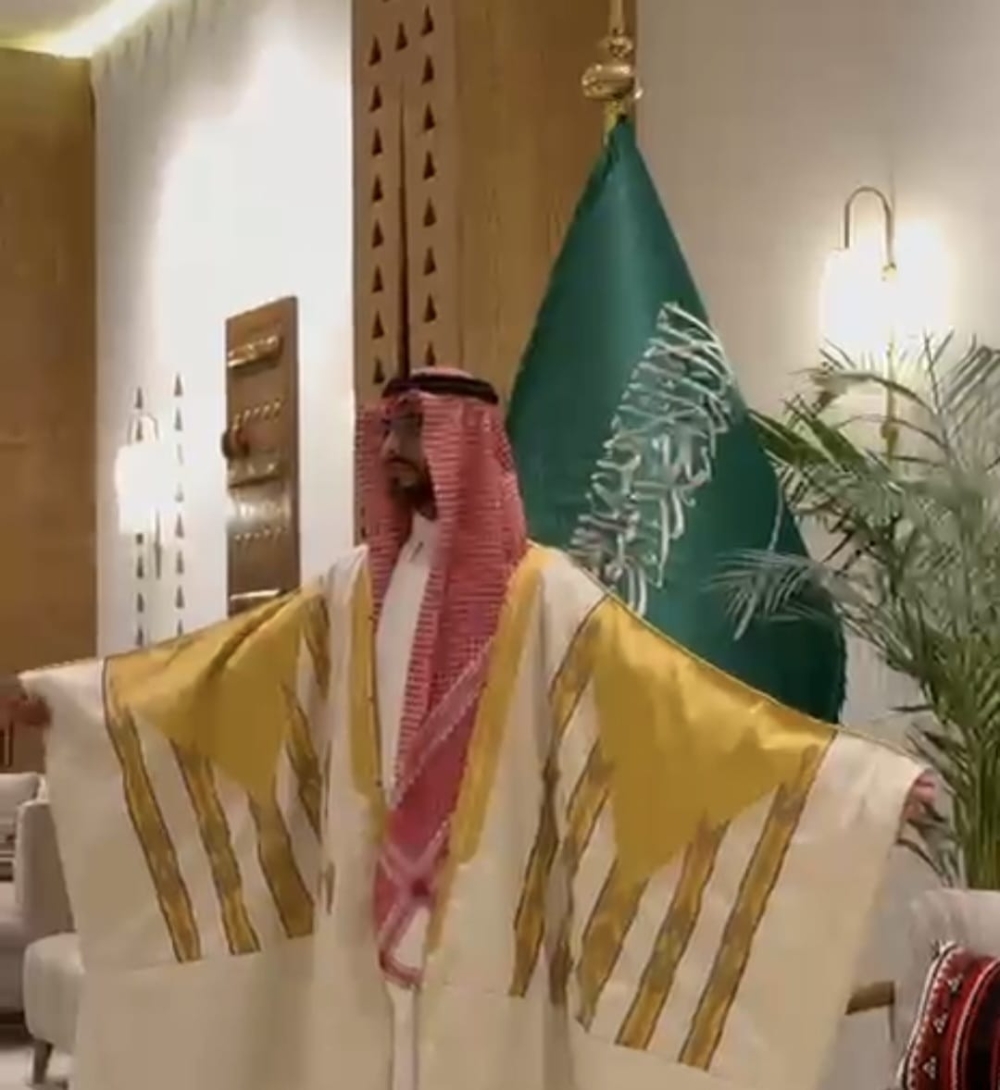
The Portuguese star Cristiano Ronaldo captivated the world yesterday evening during his celebration of Founding Day with his team Al-Nassr, by wearing a unique bisht inspired by the design of the bisht worn by King Faisal bin Abdulaziz Al Saud in his childhood. This appearance coincided with the launch of an initiative aimed at protecting this cultural heritage by including fifty schools in a specialized educational program.
The history of this exceptional bisht dates back to the Al-Ahsa craftsman who replicated a rare design commissioned by King Faisal when he was thirteen years old, and which he wore during his historic speech at the Peace Conference in London after World War I.
The bisht is entirely handmade from 100% pure camel hair, maintains the traditional “Al-Wadhha” color, and is over fifty years old. It features precise embroidery with silver threads plated in pure gold, in the complex “Al-Hayla” pattern which requires great skill and a long time to complete.
Ronaldo’s choice to wear this bisht came in response to an official invitation, where the craftsman, in cooperation with the relevant authorities and the company “Time Code”, oversaw the delivery of this artistic piece to Al-Nassr Club.
Ronaldo led his team to a resounding 4-0 victory over Al-Hazem, scoring two goals, concluding the match with a celebration that embodied the cultural connection between him and authentic Saudi heritage.
The player expressed his pride in participating in the project to develop Saudi sports, and confirmed that the Kingdom will always remain a global destination that welcomes everyone.
This event reflects the vision of the craftsman, who has previously represented the Kingdom at international forums such as the Japan Expo, in his constant endeavor to transform the Al-Ahsa bisht into a civilizational symbol connecting East and West.
As part of efforts to preserve this legacy, an unprecedented national initiative was launched to include fifty schools in Al-Ahsa Governorate in an educational program aimed at raising awareness of the importance of this art and transferring the expertise of its craft to future generations, in preservation of the Kingdom’s cultural identity.
King Faisal bin Abdulaziz Al Saud
King Faisal bin Abdulaziz Al Saud was the third King of Saudi Arabia, reigning from 1964 until his assassination in 1975. He is not a place or cultural site, but a historical figure renowned for his significant modernization reforms, his leadership during the 1973 oil embargo, and his advocacy for pan-Islamic solidarity.
Al-Ahsa
Al-Ahsa is a vast desert oasis in eastern Saudi Arabia, recognized as a UNESCO World Heritage site for its unique landscape of gardens, canals, and historic settlements. Its history dates back over 5,000 years, making it one of the oldest continuously inhabited regions on the Arabian Peninsula, and it served as a crucial hub for trade routes and the early spread of Islam. Today, it remains a major agricultural center famed for its date palm groves and rich cultural heritage.
Peace Conference in London
The “Peace Conference in London” typically refers to the London Conference of 1830, a major diplomatic meeting where Britain, France, and Russia negotiated the creation of an independent Kingdom of Greece, ending the Greek War of Independence. It was a pivotal event in 19th-century European diplomacy, establishing a sovereign Greek state under international guarantee and shaping the post-Ottoman political order in the Balkans.
World War I
World War I was a global conflict that lasted from 1914 to 1918, primarily involving the Allied Powers (including France, Britain, Russia, and later the U.S.) and the Central Powers (Germany, Austria-Hungary, and the Ottoman Empire). It was triggered by the assassination of Archduke Franz Ferdinand and is remembered for its unprecedented scale of trench warfare and immense casualties, fundamentally reshaping the political map of Europe and setting the stage for World War II.
Al-Wadhha
“Al-Wadhha” likely refers to **Al Wathba**, a significant area in the Emirate of Abu Dhabi, United Arab Emirates. It is most famous for the **Al Wathba Wetland Reserve**, a protected area of natural lakes and salt flats that was formally established as a reserve in 1998 by the late Sheikh Zayed bin Sultan Al Nahyan. Historically, the broader Al Wathba region has been known for its desert landscape and has transformed into an important site for biodiversity, particularly for migratory birds like flamingos.
Al-Hayla
Al-Hayla is a historic village located in the Hajar Mountains of northern Oman, known for its traditional mud-brick houses and ancient falaj irrigation system. It served as a seasonal settlement for centuries, with its agricultural terraces and defensive structures reflecting the region’s adaptation to a harsh, arid environment. While specific early dates are unclear, its architecture and systems are characteristic of Oman’s longstanding mountain cultures, with preservation efforts now highlighting it as a heritage site.
Japan Expo
Japan Expo is a major annual convention held in Paris, France, celebrating Japanese popular culture, including anime, manga, video games, and music. First launched in 1999, it has grown from a small fan gathering into one of the largest events of its kind in Europe, attracting hundreds of thousands of visitors. The expo serves as a cultural bridge, featuring Japanese artists, exhibitors, and traditional performances alongside modern entertainment.
Al-Ahsa Governorate
Al-Ahsa Governorate is a historic oasis region in eastern Saudi Arabia, renowned for being one of the world’s largest date palm oases with over 2.5 million trees. It has been a significant settlement for millennia due to its freshwater springs and was a major hub on ancient trade routes, later serving as a key province of the Ottoman Empire. In recognition of its unique cultural landscape and enduring human habitation, it was designated a UNESCO World Heritage Site in 2018.