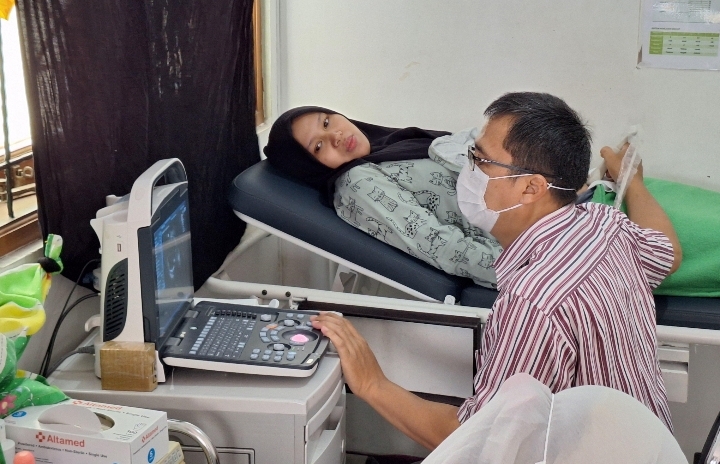
Serving public health for 21 years, efforts continue to reduce the maternal mortality rate (MMR) and infant mortality rate (IMR) through free health programs in Bandung and surrounding areas.
The Free Maternity Home (RBC) is a free maternity clinic under the auspices of a foundation for underprivileged pregnant mothers, funded by zakat, infaq, and sadaqah.
Since 2004, RBC has provided free health programs for mothers and children, with services available from pregnancy, the day of delivery, postpartum, up until the child is 2 years old.
This phase is called the first 1,000 days of life, which is considered the golden time to provide the best efforts for a child’s growth and development, including preventing stunted generations.
This is the reason why RBC’s interventions begin from the pregnancy period.
With a patient background consisting entirely of underprivileged individuals, it is not uncommon to find pregnancies in poor condition.
This ranges from fetal weight not matching gestational age to unknown fetal well-being.
Therefore, examinations conducted since pregnancy are RBC’s effort to reduce MMR and IMR.
Improving Service Quality Through Zakat
Preventing maternal and infant deaths cannot be done without professional resources and supporting equipment.
From 2004 to the present, RBC has continuously developed its services bit by bit to provide the best efforts for mothers giving birth and children born under RBC’s care.
In 2025, RBC again improved its services by introducing CTG (Cardiotocography) equipment to monitor fetal heartbeat, uterine contractions, and fetal well-being.
This CTG helps professional midwives not to be late in recognizing danger signs and making decisions.
RBC itself has handled 11 thousand free services, including pregnancy check-ups, immunizations, family planning, outpatient and inpatient care, deliveries, prenatal exercise, ultrasound examinations, and provision of pregnancy nutrition.
Approximately 435 deliveries were handled in 2025.
RBC also conducted 216 RSW (RBC Greets the Community) visits, a program of free health check-ups and education in remote villages of the Bandung region.
All these services are entirely funded by zakat, infaq, and sadaqah.
One of the goals of zakat is to bring blessings into the lives of Muslims.
Through zakat, the giver (muzakki) not only purifies their wealth but also becomes a means to alleviate the difficulties of others.
It is time for Muslims to realize that zakat has an impact and plays a role in health development.
Zakat is not only distributed as one-time aid but can also be used for long-term sectors like health.
Because, in essence, the zakat distributed is not aid, but rather giving a right to those truly entitled to receive it.
Free Maternity Home (RBC)
The Free Maternity Home (RBC) is a historic building in Kigali, Rwanda, originally constructed in the 1920s by the Belgian colonial administration to provide maternal healthcare. Today, it stands as a protected heritage site, symbolizing the early development of Rwanda’s public health system.
Bandung
Bandung is the capital of West Java, Indonesia, famously known as the “Paris of Java” for its colonial-era art deco architecture and cool highland climate. Historically, it gained prominence as a major plantation and trading hub under Dutch colonial rule and was the site of the pivotal 1955 Asia-Africa Conference, which aimed to promote economic and cultural cooperation among newly independent nations. Today, it is a vibrant center for education, creative industries, and Sundanese culture.
zakat
Zakat is not a physical place or cultural site, but one of the Five Pillars of Islam, which is a mandatory act of charity for eligible Muslims. It is a religious obligation requiring those who meet specific wealth criteria to donate a fixed portion (typically 2.5%) of their assets each year to support the poor and needy. Historically established in the 7th century CE, its practice is rooted in the Quran and the teachings of the Prophet Muhammad, aiming to purify wealth and foster social welfare within the Muslim community.
infaq
“Infaq” is not a specific place or cultural site, but an important Islamic financial and spiritual concept. It refers to the voluntary act of spending one’s wealth, beyond the obligatory alms (zakat), in the way of God for charitable purposes and community welfare. The practice is deeply rooted in the Quran and the traditions of the Prophet Muhammad, encouraging Muslims to be generous and support those in need as a core part of their faith.
sadaqah
“Sadaqah” is not a physical place or cultural site, but an important Islamic concept of voluntary charitable giving. Rooted in the teachings of the Quran and the Prophet Muhammad, it is a tradition of offering wealth, acts of kindness, or good deeds to others purely for the sake of God, without any expectation of reward. This practice has been a cornerstone of Muslim societies throughout history, promoting social welfare, compassion, and community solidarity.
maternal mortality rate (MMR)
The term “maternal mortality rate (MMR)” is not a place or cultural site, but a key public health indicator. It measures the number of maternal deaths per 100,000 live births, primarily due to complications from pregnancy or childbirth. Historically, global MMR was very high but has declined significantly over the last century due to advances in healthcare, sanitation, and access to skilled birth attendants.
infant mortality rate (IMR)
“Infant mortality rate (IMR)” is not a place or cultural site; it is a demographic and public health indicator that measures the number of deaths of infants under one year of age per 1,000 live births in a given year. Historically, tracking IMR became a key metric in the 19th and 20th centuries as nations industrialized and developed public health systems, allowing for comparisons of societal health and the effectiveness of medical care across regions and time periods.
CTG (Cardiotocography)
“CTG” refers to Cardiotocography, which is not a place or cultural site, but a medical technology. It is a continuous electronic monitoring method used during pregnancy and labor to record the fetal heart rate and the mother’s uterine contractions. Developed in the mid-20th century, it became a standard tool in obstetrics to help assess fetal well-being and detect potential distress.