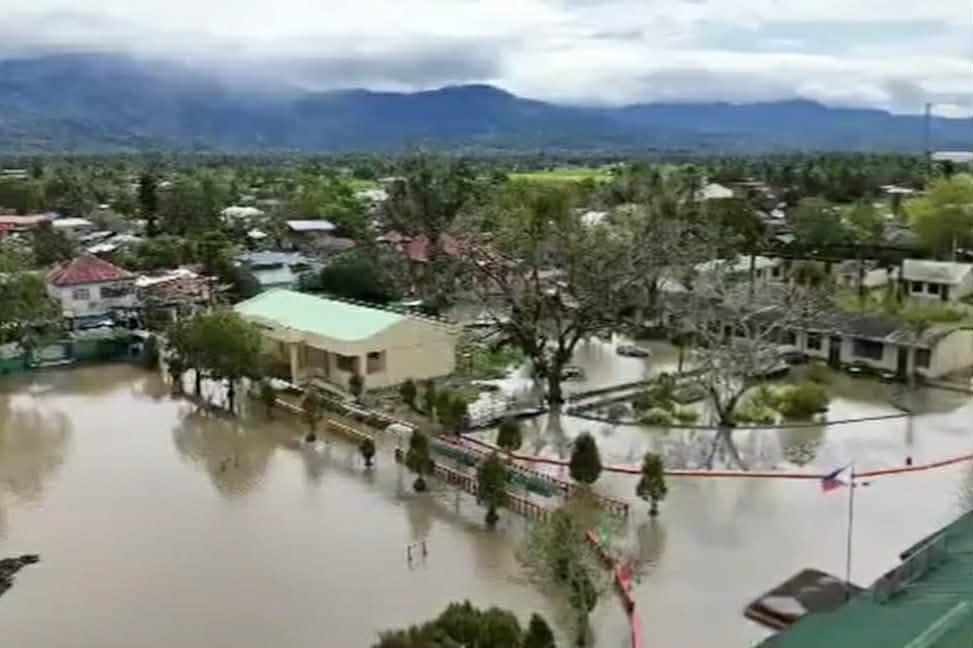
Some 467,000 individuals were affected by the impacts of tropical cyclone Basyang in Visayas and Mindanao, according to the Office of Civil Defense (OCD).
This is equivalent to 132,000 families from 850 barangays, citing the agency’s 6 a.m. data.
It has recorded 14 fatalities, all subject to validation.
Four of the fatalities died due to a landslide in Cagayan de Oro City, while the others died from drowning.
Currently, the flood has subsided, and clearing operations are being conducted.
In Iligan City, a landslide was reported.
There are 445 damaged houses, of which 38 are totally damaged, while 407 are partially damaged, the OCD said.
The OCD has yet to consolidate the cost of infrastructure and agriculture damage.
In a separate interview, the Department of Public Works and Highways (DPWH) Secretary said Basyang’s impact damaged one bridge and one unfinished flood control project.
“We mobilized operations to have steel delivered for the fixing of the bridge, which sustained minor damage,” the Secretary said.
“The flood control structure still needs to be repaired by the contractor since it is still not complete. We are continuing the repairs around the clock,” he added.
“Basyang caused heavy damage… Our first objective is to ensure that all major roads are cleared so relief goods can be delivered to those affected by Basyang,” the Secretary said.
Relief goods
The Department of Social Welfare and Development said it has sent more than 66,000 family food packs and more than 6,000 ready to eat foods to regions severely affected by Basyang.
This is in response to the augmentation requests of local government units, the DSWD said.
The relief goods were delivered to Bicol Region, Western Visayas, Negros Island Region, Central Visayas, Eastern Visayas, Zamboanga Peninsula, Northern Mindanao, and CARAGA.
More than 66,000 family food packs and more than 6,000 ready to eat foods have been delivered to the regions most affected by the recent typhoon.
Visayas
The Visayas is the central island group of the Philippines, historically significant as the first area colonized by Spain following Ferdinand Magellan’s arrival in 1521. It is renowned for its vibrant festivals like Cebu’s Sinulog, pristine beaches, and rich cultural heritage blending indigenous traditions with centuries of Spanish influence.
Mindanao
Mindanao is the second-largest island in the Philippines, known for its rich cultural diversity and significant natural resources. Historically, it has been home to various indigenous groups like the Lumad and the Muslim Moro sultanates, which resisted Spanish colonization for centuries. Today, it is a region of complex cultural heritage and ongoing efforts towards peace and development.
Cagayan de Oro City
Cagayan de Oro City, located on the northern coast of Mindanao in the Philippines, is a major urban and commercial hub known as the “City of Golden Friendship.” Historically, it was a small settlement that grew under Spanish colonial rule in the 19th century, officially becoming a city in 1950. Today, it is famous for its whitewater rafting on the Cagayan River and its role as a gateway to Northern Mindanao.
Iligan City
Iligan City is a highly industrialized urban center on the northern coast of Mindanao in the Philippines, famously known as the “City of Majestic Waterfalls” for its numerous natural cascades, including the iconic Maria Cristina Falls. Historically, its development was driven by its abundant hydroelectric power, which fueled major industries like steel and cement throughout the 20th century. The area also has pre-colonial roots, originally inhabited by the Higaonon and Maranao peoples before Spanish colonization in the 17th century.
Bicol Region
The Bicol Region is a peninsula in southeastern Luzon, Philippines, known for its iconic Mayon Volcano and rich cultural heritage. Historically, it was a significant trade hub before Spanish colonization in the 16th century, which introduced Catholicism and left landmarks like the Cagsawa Ruins. Today, the region is celebrated for its spicy cuisine, vibrant festivals like the Penafrancia, and resilient communities.
Western Visayas
Western Visayas is a region in the central Philippines, primarily comprising the islands of Panay, Guimaras, and Negros Occidental. Historically, it was a significant center of pre-colonial trade and later became a major hub under Spanish rule, with Iloilo City famously known as the “Queen City of the South” for its textile and sugar industries in the 19th century. Today, it is celebrated for its vibrant festivals like the Dinagyang of Iloilo and the MassKara of Bacolod, as well as its pristine beaches and rich culinary heritage.
Negros Island Region
The Negros Island Region is a recently re-established administrative region in the Philippines, comprising the neighboring islands of Negros and Siquijor. It was first created in 2015, dissolved in 2017, and then officially re-established by law in 2024 to streamline governance and accelerate development. The area is historically significant as a major center of the Philippine sugar industry and the site of the 1898 Negros Revolution against Spanish colonial rule.
Central Visayas
Central Visayas is an administrative region in the Philippines, anchored by the major island of Cebu. Its history is deeply tied to the arrival of Portuguese explorer Ferdinand Magellan in 1521, marking the beginning of Spanish colonization and the introduction of Christianity to the archipelago. Today, the region is a vibrant cultural and economic hub, famous for its historic landmarks like Magellan’s Cross, pristine beaches, and the lively Sinulog Festival.