-
X
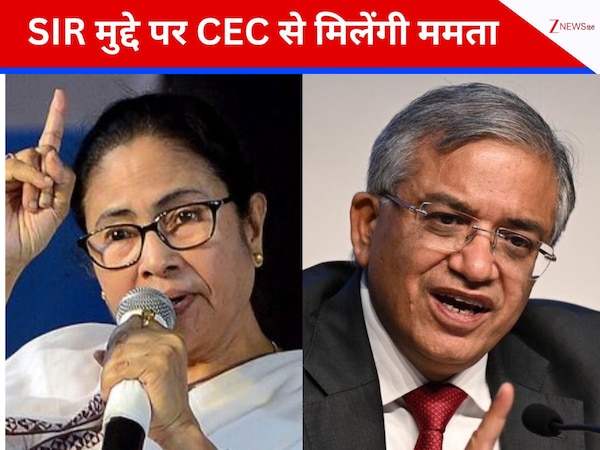
Mamata Banerjee: West Bengal Chief Minister Mamata Banerjee will meet with Chief Election Commissioner (CEC) Gyanesh Kumar at the headquarters of the Election Commission of India (ECI) in New Delhi on Monday. The main agenda of this meeting will be the ongoing Special Intensive Revision (SIR) in the state, which the Trinamool Congress and the state government have strongly objected to.
Several programs are scheduled during the Chief Minister’s visit, with discussions on the SIR issue being a primary focus. Mamata Banerjee may also meet with senior leaders of opposition parties to build a shared strategy and consensus against this revision process.
Mamata may also meet with top leaders of opposition parties
According to Trinamool Congress sources, the Chief Minister deliberately scheduled her Delhi trip during the budget session, as most top leaders of opposition parties are present in the capital during this time. However, the return date to Kolkata has not been finalized yet, but party sources say Mamata Banerjee will return before February 5th because the ‘Vote on Account’ is to be presented in the West Bengal Legislative Assembly on that same day. It is noted that the West Bengal Legislative Assembly’s budget session is also considered politically significant. The ruling Trinamool Congress is preparing to bring two important proposals in the house. The first proposal will be related to condemning the role of central investigative agencies—the CBI and the Enforcement Directorate (ED)—in the state. The second proposal will be brought in opposition to the ongoing Special Intensive Revision (SIR) process in the state and the manner of its operation.
Mamata had written a letter to the CEC
Political circles are already indicating a tough stance ahead of the talks between the Chief Minister and the Chief Election Commissioner. Recently, Mamata Banerjee wrote a strongly worded letter to the CEC in which she questioned the role and powers of Special Roll Observers (SROs) and Micro-Observers.
Also Read:
In her letter, the Chief Minister claimed that SROs and Micro-Observers have been appointed only in West Bengal to monitor the SIR and have been given powers of approval authority. CM Mamata had alleged that this has weakened the role of Electoral Registration Officers (EROs) and Assistant Electoral Registration Officers (AEROs). According to Mamata Banerjee, the additional powers given to the observers are against the spirit of democratic values, federalism, and fundamental rights enshrined in the Indian Constitution.
Election Commission of India (ECI)
The Election Commission of India (ECI) is an autonomous constitutional authority established on January 25, 1950, to administer and oversee the electoral process of the world’s largest democracy. It is responsible for conducting free and fair elections to the Parliament, State Legislatures, and the offices of the President and Vice-President, ensuring the integrity of India’s democratic framework.West Bengal Legislative Assembly
The West Bengal Legislative Assembly, located in Kolkata, is the unicameral state legislature of West Bengal. Its history dates to the British era, with the current building—known as the **West Bengal Vidhan Sabha Bhavan**—being completed in 1931 to house the Bengal Legislative Council. Following India’s independence and the state’s reorganization, it became the seat of the state’s legislative government.CBI
“CBI” is not a widely recognized acronym for a specific place or cultural site. It could refer to several things, such as the **Central Bureau of Investigation** (India’s federal investigative agency) or the **Caribbean Basin Initiative** (a U.S. trade program). Without more specific context, it is not possible to provide a meaningful historical summary of a cultural site.Enforcement Directorate (ED)
The Enforcement Directorate (ED) is a specialized financial investigation agency of the Indian government, established in 1956. Its primary mandate is to enforce economic laws and regulations, particularly concerning foreign exchange violations and money laundering. Over time, its role has expanded to include investigating major financial crimes, corruption cases, and the seizure of assets derived from illegal activities.Indian Constitution
The Indian Constitution is the supreme legal document of India, adopted on November 26, 1949, and enacted on January 26, 1950, which marks Republic Day. Drafted by the Constituent Assembly chaired by Dr. B.R. Ambedkar, it established India as a sovereign, socialist, secular, democratic republic, guaranteeing fundamental rights and outlining the framework of government. It is the world’s longest written constitution and was profoundly influenced by various global sources while being rooted in the nation’s own struggle for independence.