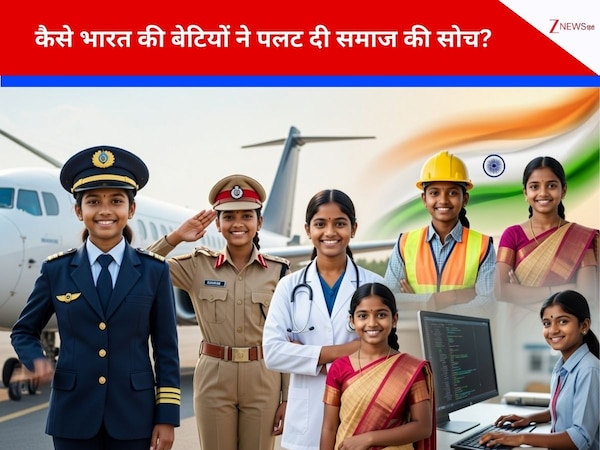
National Girl Child Day: National Girl Child Day, celebrated in India on January 24, is no longer just a day of awareness. This day tells the story of a transformation, where daughters are turning their dreams into reality. Stepping out from the thresholds of their homes, India’s daughters are now making their mark in parliament, laboratories, cockpits, and startups.
When India’s Daughter Became Prime Minister
On January 24, 1966, Indira Gandhi made history by taking the oath as Prime Minister. In memory of that historic moment, the Government of India declared this day as National Girl Child Day in 2008. The message was clear: India’s daughter can also lead.
Improvement in Sex Ratio, Change in Mindset
The sex ratio, which had once fallen to 927, has now reached 1020 according to the National Family Health Survey. This figure indicates a change in society’s mindset. However, the sex ratio at birth is still around 930, which remains a challenge.
‘Beti Bachao, Beti Padhao’ Changed the Picture
The ‘Beti Bachao, Beti Padhao’ (Save the Daughter, Educate the Daughter) campaign, launched in 2015, has now completed 11 years. In states like Haryana, where the condition of girls was once a cause for concern, the sex ratio has now crossed 923. Through the ‘Kanya Shiksha Pravesh Utsav’, over one lakh girls were reconnected with schools.
The Daughter is Now an Investment, Not a Burden
Under the Sukanya Samriddhi Yojana, more than 4.53 crore accounts have been opened. This scheme, with an 8.2% interest rate, is giving parents confidence that their daughter’s future is secure.
Soaring from Coding to the Cockpit
Today’s daughter is not confined to the kitchen. She is coding, building robots, and measuring the skies as a pilot. Schemes like ‘Udaan’ have shown rural girls the path to engineering. While participation in STEM is currently at 18%, initiatives like ‘AI for All’ are rapidly bridging this gap.
Focus on Health: The Fight Against Anemia
Nearly 59% of adolescent girls are affected by anemia. In light of this, nutrition campaigns and menstrual hygiene programs have reached village after village. Iron tablets and sanitary pads are no longer a source of shame but have become a right.
Laws Provided Strong Protective Armor
The POCSO Act and the Prohibition of Child Marriage Act have strengthened the safety of girls. The ‘Bal Vivah Mukt Bharat’ (Child Marriage Free India) campaign, launched in November 2024, aims to eradicate this malpractice by 2030. The Supreme Court has also made it clear that marriage under the age of 18 is against the dignity of a girl.
Stories of Change from Village to Village
In Uttar Pradesh, Girl Child Day is celebrated alongside UP Day, where women from self-help groups become inspirations. In Bhanhedi village of Rajasthan’s Deeg district, girls playing football are breaking traditions like child marriage. Alongside government efforts, the role of social reformers and organizations is also crucial. Social campaigns against dowry and female foeticide have deepened the change.
National Girl Child Day
National Girl Child Day is an annual observance in India, celebrated every January 24th. It was established in 2008 by the Ministry of Women and Child Development to raise awareness about the inequalities girls face and to promote their rights, education, health, and nutrition. The day aims to change societal attitudes and highlight the importance of empowering girls for the nation’s development.
Beti Bachao, Beti Padhao
“Beti Bachao, Beti Padhao” (Save the Daughter, Educate the Daughter) is a major social campaign launched by the Government of India in 2015 to address the declining child sex ratio and promote gender equality. The initiative focuses on preventing gender-biased sex selection, ensuring the survival and protection of the girl child, and guaranteeing her education and participation. While not a physical site, it represents a significant cultural movement aimed at transforming societal attitudes towards girls and women in India.
Sukanya Samriddhi Yojana
“Sukanya Samriddhi Yojana” is not a place or cultural site; it is a social welfare savings scheme launched by the Government of India in 2015. It is designed to encourage long-term savings for the future education and marriage expenses of a girl child, offering attractive interest rates and tax benefits.
POCSO Act
The Protection of Children from Sexual Offences (POCSO) Act is not a physical place or cultural site, but a landmark Indian law enacted in 2012. It was established to provide a robust legal framework specifically for protecting children from sexual assault, harassment, and pornography. The Act is historically significant as it created child-friendly procedures for reporting, recording evidence, and speedy trials, marking a major shift in India’s legal approach to such crimes.
Prohibition of Child Marriage Act
The Prohibition of Child Marriage Act (PCMA) is a key Indian law enacted in 2006 to prevent and prohibit the marriage of children, primarily girls under 18 and boys under 21. It replaced the earlier Child Marriage Restraint Act of 1929, strengthening the legal framework by making child marriages voidable and introducing provisions for punishment and support for victims. The act reflects ongoing social and legislative efforts in India to combat the deep-rooted practice of child marriage and protect children’s rights.
Bal Vivah Mukt Bharat
“Bal Vivah Mukt Bharat” (Child Marriage Free India) is not a physical place or cultural site, but a nationwide social campaign and movement in India aimed at eradicating the practice of child marriage. Its history is rooted in decades of advocacy and legal reform, most notably the Prohibition of Child Marriage Act (2006), which sets the legal age of marriage. The movement represents a collective effort by government agencies, NGOs, and communities to enforce these laws and shift social norms to protect children’s rights and futures.
Supreme Court
The Supreme Court of the United States is the highest federal court in the nation, established in 1789 under Article III of the U.S. Constitution. It holds ultimate appellate jurisdiction over all federal and state court cases involving federal law, and its landmark decisions, such as *Marbury v. Madison* (1803) which established judicial review, have profoundly shaped American law and civil rights.
Udaan
“Udaan” is not a widely recognized specific historical place or cultural site. It is most commonly known as the title of a critically acclaimed 2010 Indian coming-of-age drama film about a teenage boy’s dreams and struggles. Without a specific location reference, it cannot be summarized as a physical cultural heritage site.