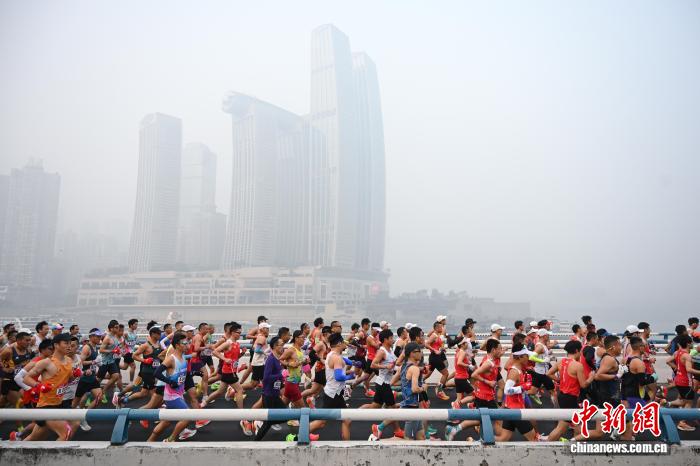
The 2026 Chongqing Marathon, also known as the 2026 Changan Automobile Chongqing Marathon, kicked off on the 18th in Nan’an District, Chongqing. It attracted 25,000 runners from 26 countries and regions to compete along the banks of the Yangtze River. Chinese “post-00s” runner Feng Peiyou finished as the men’s overall runner-up and the top Chinese male finisher with a time of 2 hours, 10 minutes, and 22 seconds, breaking the ten-year-old Chinese national record for the event.
The Chongqing Marathon, established in 2011, is a World Athletics Gold Label road race and a member of the China Marathon Grand Slam. The 2026 edition featured only the marathon distance and attracted over 260,000 applicants.
On the day, Ethiopian runner Adisu Tesfahun Tafere won the men’s championship with a time of 2:08:28. The third place went to Kenyan runner Benard Kipkorir with a time of 2:10:26. In the women’s race, Ethiopian runners took the top two spots. Chinese runner Zhu Qing, 29, finished third with a time of 2:28:53, significantly improving her personal best and becoming a top Chinese female amateur runner.
This was 24-year-old Feng Peiyou’s first time participating in the Chongqing Marathon. After the race, he said that during the latter part of the run, he felt he couldn’t go on, but the enthusiastic cheers from spectators along the route gave him immense motivation. Feng expressed hope that through his efforts, running would become more popular and encourage more people to exercise.
At the 2025 Chongqing Marathon, Zhu Qing had also set a personal best. On the 18th, history repeated itself. Zhu Qing stated, “Chongqing is my lucky place.”
Chongqing Marathon
The Chongqing International Marathon, first held in 2011, is a major annual sporting event that takes place along the scenic riverfront routes of Chongqing, a major city in southwestern China. It is renowned for its flat and fast course, attracting elite runners and amateurs alike, and has grown into a key event that promotes fitness and showcases the modern urban landscape of this mountainous municipality.
Nan’an District
Nan’an District is a central urban district of Chongqing, China, located on the southern bank of the Yangtze River. Historically, it was a vital gateway and transportation hub for ancient Chongqing, with parts of the old city wall still preserved. Today, it is a major commercial and residential area, known for landmarks like Nanshan Mountain and its lush parks.
Yangtze River
The Yangtze River is the longest river in Asia and a cradle of Chinese civilization, with a history of human settlement and agricultural development dating back millennia. It has served as a vital transportation artery and economic corridor for centuries, shaping the culture and history of central China. Today, it is also known for the monumental Three Gorges Dam, the world’s largest power station.
World Athletics Gold Label
The World Athletics Gold Label is a prestigious designation awarded by World Athletics (formerly IAAF) to top-tier international road races, such as marathons, that meet strict organizational and competitive standards. Introduced in 2008 as part of a labeling system to elevate the sport, it guarantees a high-quality event with elite athlete participation, world-class broadcasting, and rigorous anti-doping controls. Races like the Berlin Marathon and Boston Marathon hold this label, signifying their status among the world’s leading road-running events.
China Marathon Grand Slam
The China Marathon Grand Slam is not a single physical site but a prestigious annual series of four major marathons in China: Beijing, Guangzhou, Chongqing, and Wuhan. Established in 2017, it was created to elevate the standard and popularity of long-distance running in the country, mirroring the structure of international marathon majors. It represents a significant modern cultural phenomenon in Chinese sports, promoting fitness and city branding through these large-scale public events.
Chongqing
Chongqing is a major metropolis in southwestern China, historically known as a strategic port city at the confluence of the Yangtze and Jialing Rivers. It served as the provisional capital of China during the Second Sino-Japanese War (1937-1945), which spurred its industrial development. Today, it is a sprawling municipal directly under the central government, famous for its mountainous urban landscape, spicy hotpot cuisine, and role as an economic hub for inland China.