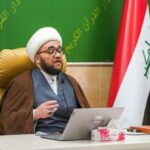
According to reports, the leader of the Ansar Allah movement confirmed that the American targeting of the Islamic Republic of Iran was intense, but it failed completely, pointing to the collapse of criminal gangs and the existence of complete control over the situation in Iran, which reflects a resounding failure for the United States in achieving its goals there.
He stressed in a speech on the anniversary of Martyr President Saleh al-Sammad the necessity of being conscious and vigilant, and not being deceived at all by the slogans raised by the Americans, no matter how much some regimes promote or applaud them, confirming that they are merely deceptive slogans that do not reflect the reality of aggressive projects. He noted that success, prosperity, and good for this nation are achieved when it moves with a free and independent will.
He explained that any activity from within the nation that moves as an extension of the American, Israeli, or British is an unjust, evil, and false activity that carries no good for the nation, but rather falls within the framework of targeting it. He affirmed that the refuge for Muslim peoples and Islamic countries in the Arab world lies in moving on the basis of authentic faith and Islamic identity, which ensures that the nation is free and not subjugated.
He called for confronting the challenges and conspiracies of enemies by seeking help from God and trusting in Him, taking the necessary means, and elevating the nation to be free and independent. He indicated that no matter the size of the challenges, difficulties, and conspiracies, trust in God, moving according to His guidance and teachings, and adhering to the faith identity are sufficient for the nation to receive God’s help and victory.
He clarified that the faith identity is based on great values and principles that make the nation a free, conscious, and insightful nation that is not deceived by its enemies nor submits to them. He concluded by emphasizing that the true hope for the entire nation is in God Almighty, and in what He has guided to, and that it should move with authenticity within this correct orientation, without placing its hopes on its enemies.
Our nation is targeted and American-Israeli control goes beyond slogans of peace and normalization
The leader of Ansar Allah confirmed that the Islamic nation is a targeted nation, explaining that even the options of liberation, independence, and dignity alone are not the basis for targeting, but rather targeting exists even with the options of domestication presented to the nation, as is the case in normalization tracks and slogans of so-called “peace.”
He pointed out that what the American and Israeli want is complete control over the region, its peoples, its wealth, its resources, and its geographical location, confirming that the American arrangements in the region are not arrangements of peace, normalization, or stable atmospheres, but rather aggressive arrangements that target the nation and aim for control, acquisition, and exploitation.
He touched on the Palestinian reality, stressing that the Israeli enemy continues its daily killing crimes in the Gaza Strip, amidst the ongoing siege, noting that all forms of persecution, injustice, and torture against the Palestinian people are still ongoing, as is happening in the West Bank, despite the Authority’s choice leaning towards “peace.”
He explained that the siege, restrictions, and all forms of suffering continue against the Palestinian people, especially in light of low-pressure weather and rain, while the enemy in the West Bank practices various forms of aggression, including killing, systematic destruction, looting, robbery, burning of crops, and others. He pointed to a full year of destruction in Jenin, followed by a new declared campaign on Hebron, within the framework of comprehensive targeting and daily torture and continuous persecution.
He referred to the continuous violation of the sanctity of Al-Aqsa Mosque through almost daily incursions, expressing regret that this issue has become almost routine for Arabs and Muslims.
In the regional context, he confirmed that in Lebanon, despite the existence of an agreement, violations of airspace, cases of killing, incursions, kidnappings, aerial bombardment, and all forms of aggression continue. As for Syria, despite the controlling groups there leaning towards the United States and their readiness for normalization, the violations are still ongoing, with great control over southern Syria, and complete violation of airspace, movements, incursions, and others.
He also confirmed that the Israeli, along with the American, do not give weight to those agreements, even those based on clear guarantees and specific terms, which reflects the nature of the ongoing aggressive project in the region.
‘Trump Council’ seeks domination, bullying, collecting money, and seizing the interests of peoples
The leader of Ansar Allah confirmed, in a speech on the anniversary of Martyr President Saleh al-Sammad, that the announcement of the